36 Yard Zero Target: Chart & 25,50,100+ Yards Data
Updated on
The 36-yard zero provides a highly effective combat trajectory that allows shooters to hit center-mass targets from 0 to 300 yards without adjusting optics. This system maximizes point-blank range for standard AR-15 rifles. Below is a complete breakdown of the 36-yard zero, ballistics charts, and comparisons.
Table of Contents
[Click to minimize]
36 Yard Zero Target
A 36-yard zero is a rifle sighting method where the bullet’s upward flight crosses the line of sight exactly at 36 yards.
This zero creates a “point and shoot” effective range from point-blank out to 300 yards without the need to calculate holdovers.
It is highly popular for standard AR-15 platforms using red dots, holographic sights, or low-power variable optics (LPVOs).
The trajectory keeps the bullet within roughly a 5-inch window above or below the point of aim across practical engagement distances.
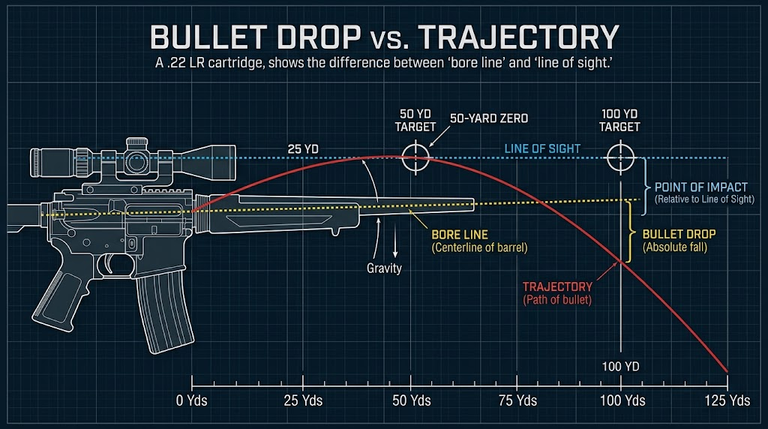
At close ranges (under 15 yards), the bullet impacts about 2 inches low due to the mechanical height of the optic over the barrel.
The projectile reaches its maximum height of roughly 4 to 5 inches above the point of aim near 150 yards.
Shooters do not need to memorize complex dope charts to achieve combat-effective center-mass hits out to 300 yards.
The following ballistics chart reflects a 36-yard zero using standard 5.56x45mm NATO ammunition.
Ammunition: 5.56x45mm 55-grain M193 FMJ
Muzzle Velocity: 3,000 fps (standard for a 16-inch barrel)
Sight Height: 2.5 inches over bore
Atmospheric Conditions: Sea level, 59°F
Wind: 10 mph crosswind (90-degree angle)
Range (Yards)
Trajectory / Drop (Inches)
Velocity (fps)
Energy (ft-lbs)
Wind Drift (Inches)
0
-2.5
3,000
1,099
0.0
25
-0.7
2,907
1,032
0.1
36
0.0
2,860
998
0.2
50
+0.8
2,816
968
0.3
100
+2.5
2,640
851
1.2
150
+2.8
2,470
745
2.8
200
+1.5
2,308
650
5.0
250
-1.5
2,152
565
8.0
300
-6.5
2,002
489
12.0
36 Yard Zero at 25 Yards
Many indoor and outdoor ranges only offer a maximum distance of 25 yards, requiring an offset zero.
You can easily establish a 36-yard zero on a 25-yard range by accounting for the bullet’s flight path.
At 25 yards, the bullet is still rising to meet the optic’s line of sight.
For a standard AR-15 with a 2.5-inch sight height, the point of impact at 25 yards should be exactly 0.7 inches below the point of aim.
Shooters can download a 36-yard zero target printable designed specifically for 25-yard ranges to remove the measurement guesswork.
Using this target, you aim at the top center bullseye and expect the bullet to strike the secondary circle located lower down.
At distances of 25 yards, sight height dictates the offset much more than bullet weight or velocity, as shown in the table below.
Always confirm the exact zero at the true 36-yard mark when you gain access to a longer outdoor range.
Target Distance: 25 Yards
Zero Distance Goal: 36 Yards
Ammunition / Load
Sight Height (Over Bore)
Muzzle Velocity (fps)
Required Point of Impact (POI) Offset at 25 Yards
5.56x45mm 55-grain M193
1.5 inches (Standard Iron Sights)
3,000
-0.4 inches (Low)
5.56x45mm 55-grain M193
2.5 inches (Standard AR-15 Optic)
3,000
-0.7 inches (Low)
5.56x45mm 55-grain M193
3.5 inches (Tall / NVG Mount)
3,000
-1.0 inches (Low)
5.56x45mm 77-grain OTM
2.5 inches (Standard AR-15 Optic)
2,750
-0.7 inches (Low)
.300 Blackout 110-grain V-Max
2.5 inches (Standard AR-15 Optic)
2,350
-0.7 inches (Low)
36 Yard Zero vs 50 Yard Zero
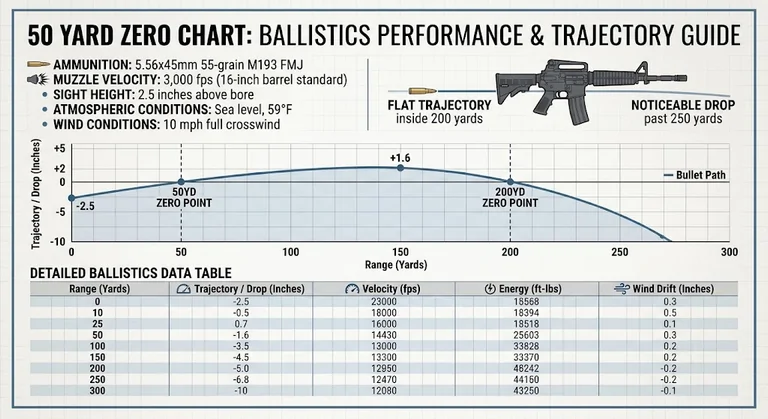
The 50-yard zero is the primary alternative to the 36-yard zero for modern sporting rifles.
A 50-yard zero crosses the line of sight at 50 yards and crosses back down near 200 yards (often called the 50/200 zero).
The 36-yard zero crosses at 36 yards and crosses back down near 300 yards (acting as a 36/300 zero).
A 50-yard zero offers a tighter, flatter trajectory out to 200 yards but drops aggressively past 250 yards.
A 36-yard zero creates a slightly higher mid-range arc but stretches the usable “point and shoot” range out to 300 yards.
Ammunition for Comparison: 5.56x45mm NATO 55-grain M193 FMJ, 3,000 fps, 2.5-inch sight height.
Range (Yards)
36 Yard Zero Trajectory (Inches)
50 Yard Zero Trajectory (Inches)
Difference (Inches)
25
-0.7
-1.2
0.5
50
+0.8
0.0
0.8
100
+2.5
+1.4
1.1
150
+2.8
+1.6
1.2
200
+1.5
0.0
1.5
250
-1.5
-3.5
2.0
300
-6.5
-9.0
2.5
The 50-yard zero requires a specific holdover for 300-yard targets because the bullet drops roughly 9 inches.
The 36-yard zero requires aiming just slightly high at 300 yards because the drop is limited to about 6.5 inches.
Defensive shooters often prefer the 50-yard zero for its minimal deviation inside 100 yards, which is ideal for close-quarters engagements.
Tactical shooters often prefer the 36-yard zero for maximum flexibility across unknown distances in open environments.
Frequently Asked Questions
1. What is a 36-yard zero?
It is a rifle sighting method where the bullet crosses the shooter’s line of sight exactly at 36 yards, allowing center-mass hits out to 300 yards without adjusting aim.
2. Can I zero for 36 yards at a 25-yard range?
Yes, by aiming at a designated point and adjusting your optic so the bullet impacts approximately 0.7 inches below the point of aim (for a standard 2.5-inch optic height).
3. Why do Marines use the 36-yard zero?
The USMC popularized the 36-yard zero (often shot in meters) because it keeps the 5.56mm bullet trajectory within the dimensions of a human-sized target from point-blank out to 300 yards.
4. Does barrel length affect my 36-yard zero?
Yes, shorter barrels produce lower muzzle velocities, which causes the bullet to drop faster at extended ranges, though the differences remain minimal inside 200 yards.
5. How much drop does a 36-yard zero have at 300 yards?
Firing a standard 5.56x45mm 55-grain bullet from a 16-inch barrel, the drop at 300 yards is approximately 6.5 inches below the point of aim.
6. Is a 36-yard zero good for home defense?
Yes, but remember that at typical room distances (under 10 yards), your bullet will impact roughly 2 to 2.5 inches below where your red dot is aiming due to height over bore.
7. Does sight height change how I zero at 25 yards?
Absolutely; iron sights (1.5 inches high) require a 0.4-inch low offset at 25 yards, while tall optic mounts (3.5 inches high) require a 1.0-inch low offset.
8. Which zero is flatter: 36-yard or 50-yard?
The 50-yard zero provides a flatter trajectory inside 200 yards (never rising more than about 1.6 inches), while the 36-yard zero arches up to nearly 3 inches high at 150 yards.
9. Do I need a special target for a 36-yard zero?
While not strictly necessary, using a printable 36-yard offset target specifically designed for 25-yard ranges takes the guesswork out of measuring the required point of impact.
10. Does a 36-yard zero work for .300 Blackout?
Yes, but due to the heavier, slower bullet, the maximum point-blank range will be shorter than a 5.56mm, and the bullet will experience significantly more drop at 300 yards.