25 Yard Zero Target: Chart & 25,50,100+ Yards Data
Updated on
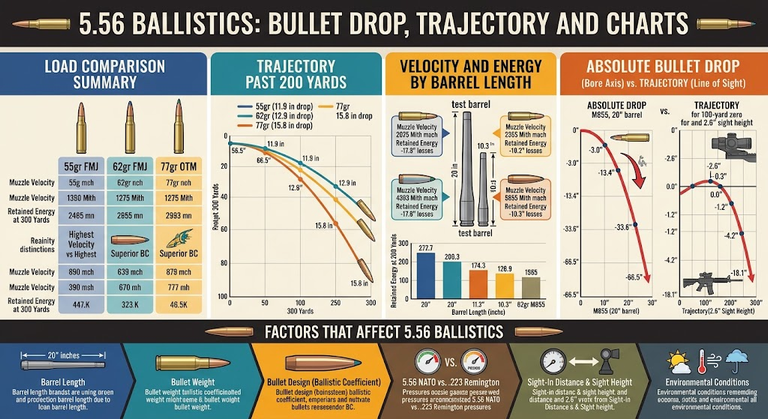
The 25-yard zero is a widely utilized zeroing method for standard rifles that is designed to replicate a point of impact out to 300 yards. While it offers an extended maximum point-blank range, its aggressive mid-range trajectory requires a clear understanding of your rifle’s ballistics. Below is a complete guide to the 25-yard zero, required holdovers, and trajectory charts.
Table of Contents
[Click to minimize]
25 Yard Zero Target
A 25-yard zero target is designed so that the bullet’s upward flight path intersects the shooter’s line of sight exactly 25 yards from the muzzle.
When aiming at the center bullseye of a target placed at 25 yards, the point of impact and the point of aim will be exactly the same.
This zero forces a steep upward trajectory because the barrel must be angled significantly upward to meet the optic’s line of sight over such a short distance.
It has traditionally been favored by the military as a standard zero for AR-pattern rifles to achieve a 300-meter effective combat range.
Shooters must be aware that the bullet will strike significantly higher than the point of aim at medium distances due to this steep upward arc.
At extreme close-quarters distances (inside 10 yards), the bullet will still strike roughly 1 to 2 inches low due to the mechanical height of the optic over the bore.
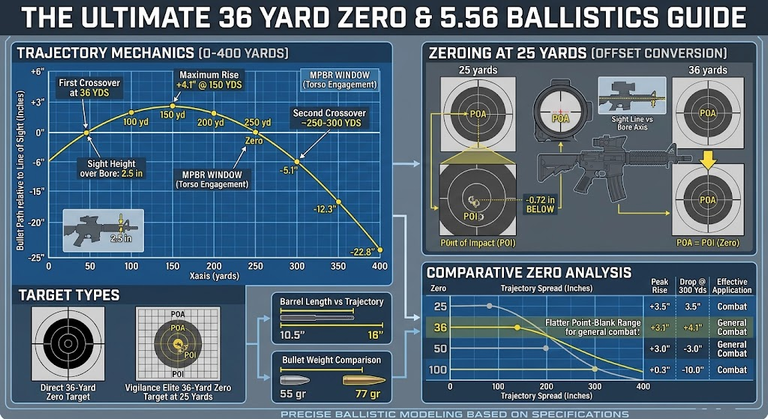
Shooters who prefer a flat 100-yard zero but only have access to a 25-yard indoor or outdoor range can use a calculated offset target.
To successfully achieve a 100-yard zero at a 25-yard range, the bullet must strike slightly below the point of aim.
At 25 yards, a bullet that is zeroed for 100 yards is still rising to meet the optic’s crosshairs and has not yet crossed the line of sight.
For a standard AR-15 equipped with a 2.5-inch optic height, the required point of impact is roughly 1.4 inches low at 25 yards.
Using an offset zero at 25 yards for 100 allows for a perfectly flat point-of-aim at 100 yards, which is heavily preferred for precision target shooting.
Optic mount height drastically changes this offset distance, as shown in the specific data table below.
Target Distance: 25 Yards
Desired Zero Distance: 100 Yards
Ammunition / Load
Sight Height (Over Bore)
Muzzle Velocity (fps)
Required Point of Impact (POI) Offset at 25 Yards
5.56x45mm 55-grain M193
1.5 inches (Standard Iron Sights)
3,000
-0.7 inches (Low)
5.56x45mm 55-grain M193
2.5 inches (Standard AR-15 Optic)
3,000
-1.4 inches (Low)
5.56x45mm 55-grain M193
3.5 inches (Tall / NVG Mount)
3,000
-2.2 inches (Low)
25 Yard Zero Chart
The ballistics table below illustrates the complete flight path, velocity, and energy retention of a standard 25-yard zero.
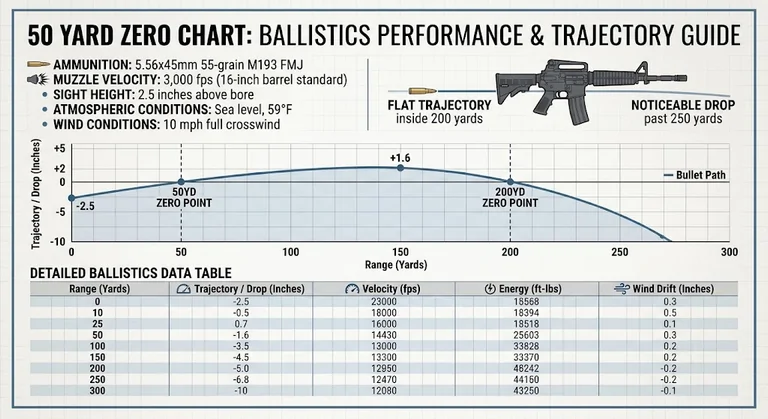
Ammunition: 5.56x45mm 55-grain M193 FMJ
Muzzle Velocity: 3,000 fps (standard for a 16-inch barrel)
Sight Height: 2.5 inches over bore
Atmospheric Conditions: Sea level, 59°F
Wind: 10 mph full crosswind (90-degree angle)
Range (Yards)
Trajectory / Drop (Inches)
Velocity (fps)
Energy (ft-lbs)
Wind Drift (Inches)
0
-2.5
3,000
1,099
0.0
25
0.0
2,907
1,032
0.1
50
+1.6
2,816
968
0.3
100
+4.2
2,640
851
1.2
150
+5.5
2,470
745
2.8
200
+5.3
2,308
650
5.0
250
+3.2
2,152
565
8.0
300
-1.0
2,002
489
12.0
25 Yard Zero vs 50 Yard Zero
The 25-yard zero and the 50-yard zero produce drastically different mid-range trajectories for modern sporting rifles.
A 25-yard zero forces the bullet into a high arc, crossing the line of sight at 25 yards and dropping back through it near 300 yards.
A 50-yard zero provides a much flatter arc, crossing the line of sight at 50 yards and dropping back through it near 200 yards.
With a 25-yard zero, shooters must aim up to 5.5 inches low for targets between 150 and 200 yards to avoid shooting completely over them.
With a 50-yard zero, the bullet never rises more than 1.6 inches above the line of sight, requiring minimal mid-range holdovers.
Ammunition for Comparison: 5.56x45mm NATO 55-grain M193 FMJ, 3,000 fps, 2.5-inch sight height.
Range (Yards)
25 Yard Zero Trajectory (Inches)
50 Yard Zero Trajectory (Inches)
Difference (Inches)
25
0.0
-1.2
1.2
50
+1.6
0.0
1.6
100
+4.2
+1.4
2.8
150
+5.5
+1.6
3.9
200
+5.3
0.0
5.3
250
+3.2
-3.5
6.7
300
-1.0
-9.0
8.0
The 50-yard zero is widely preferred for civilian, law enforcement, and defensive use because it keeps the bullet tighter to the point of aim across standard engagement distances.
The 25-yard zero remains highly effective for open-field tactical applications where hitting a human-sized silhouette at 300 yards is prioritized over precision grouping at 150 yards.
Frequently Asked Questions
1. What is a 25-yard zero?
It is a sighting method where your optic is adjusted so that the bullet impacts exactly where you are aiming at a distance of 25 yards.
2. Is a 25-yard zero the same as a 300-yard zero?
For a standard 5.56mm AR-15, yes. The bullet arcs upward through the line of sight at 25 yards and falls back down through it near the 300-yard mark.
3. Why does my 25-yard zero shoot so high at 100 yards?
Because zeroing at such a close distance requires a steep upward barrel angle, the bullet reaches its maximum height of roughly 5.5 inches above your aiming point between 150 and 200 yards.
4. How do I get a 100-yard zero at a 25-yard range?
Place your target at 25 yards, aim dead center, and adjust your optic so the rounds impact roughly 1.4 inches below the bullseye (assuming a standard 2.5-inch optic height).
5. Which is better, a 25-yard or a 50-yard zero?
The 50-yard zero is generally better for civilian defense and target shooting because it offers a much flatter mid-range trajectory. The 25-yard zero is better suited for open-field military engagements out to 300 yards.
6. Do I need a special target for a 25-yard zero?
No, to achieve a true 25-yard zero, you can use any target and simply adjust your optic until your point of impact perfectly matches your point of aim at 25 yards.
7. Does optic height affect my 25-yard zero trajectory?
Yes. Taller optics require an even steeper upward barrel angle to cross the line of sight at 25 yards, which will cause the bullet to arc even higher at distances like 100 and 200 yards.
8. Can I use a 25-yard zero for a 9mm pistol caliber carbine (PCC)?
Yes, but pistol calibers travel much slower and drop much faster than rifle rounds, meaning your secondary zero intersection will happen much closer than 300 yards.