50 Yard Zero Target: Chart & 10,25,100+ Yards Data
Updated on
The 50-yard zero remains a top choice for AR-15 owners seeking a highly predictable and flat trajectory. By establishing this zero, shooters can reliably strike center-mass targets from point-blank distances out to 200 yards without adjusting their sights. This complete guide explores 50-yard targets, ballistic charts, close-range offset methods, and MRAD calibration.
Table of Contents
[Click to minimize]
50 Yard Zero Target
Utilizing a 50-yard zero target guarantees the projectile meets your optic’s crosshairs at exactly 50 yards.
It is frequently called the 50/200 zero, as the bullet arcs downward to cross the line of sight again near the 200-yard mark.
This specific calibration keeps the bullet’s flight path within roughly two inches of your aiming point for the first 200 yards.
Shooters do not need to memorize complicated holdovers or adjust turrets for most standard engagement scenarios.
A proper zeroing target for this distance will typically feature a high-contrast bullseye for easy visibility at 50 yards without magnification.
50 Yard Zero Chart
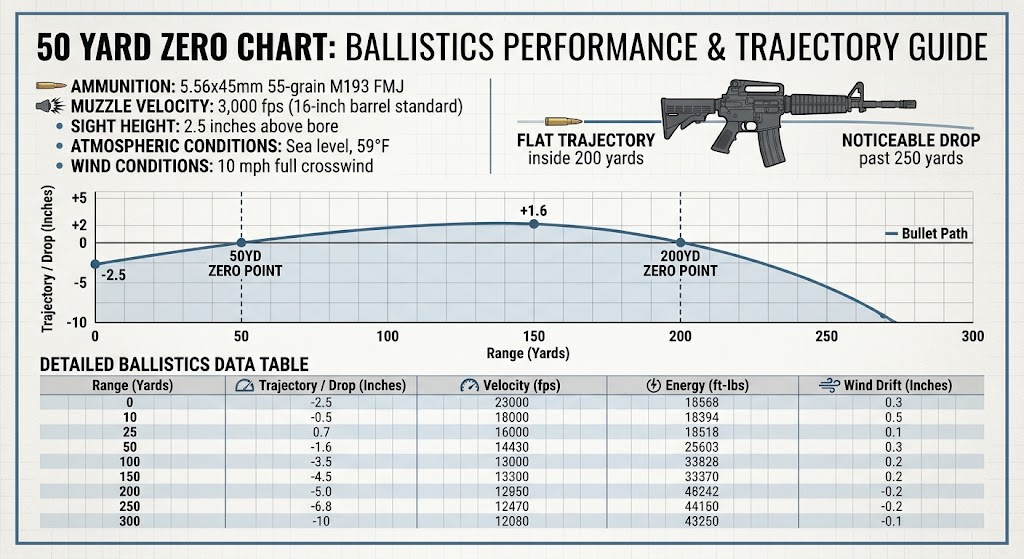
The ballistics chart below maps the exact flight path of a standard 5.56mm NATO round when zeroed at 50 yards.
It highlights the extreme flatness of this trajectory, showing how the bullet rarely deviates from the point of aim inside 200 yards.
The round will experience noticeable drop past 250 yards, requiring deliberate elevation adjustments as shown in the table.
When restricted to a 25-yard range facility, you must use a calculated hold-under to mimic a 50-yard flight path.
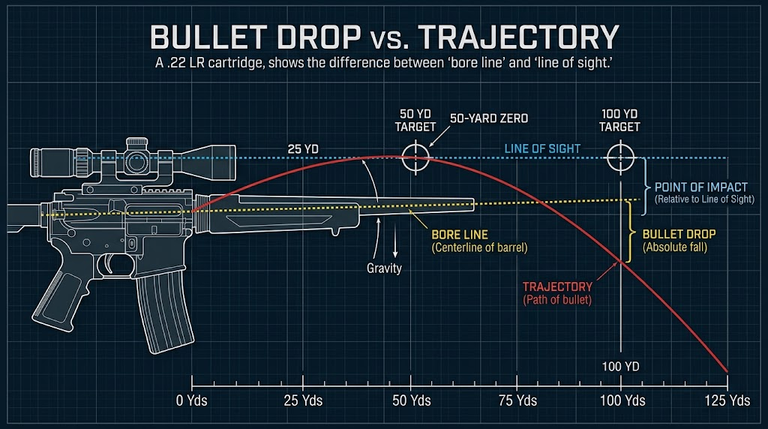
At the 25-yard mark, the projectile is still climbing toward the center axis of your optic glass.
To successfully lock in a 50-yard trajectory at 25 yards, your group needs to land exactly 1.2 inches below the bullseye.
A specialized 25-yard offset target removes the guesswork by providing a dedicated lower impact zone for your crosshairs.
Your chosen optic mount height is the primary variable that dictates this required offset distance.
Target Distance: 25 Yards
Zero Distance Goal: 50 Yards
Ammunition / Load
Sight Height (Over Bore)
Muzzle Velocity (fps)
Required Point of Impact (POI) Offset at 25 Yards
5.56x45mm 55-grain M193
1.5 inches (Standard Iron Sights)
3,000
-0.7 inches (Low)
5.56x45mm 55-grain M193
2.5 inches (Standard AR-15 Optic)
3,000
-1.2 inches (Low)
5.56x45mm 55-grain M193
3.5 inches (Tall / NVG Mount)
3,000
-1.7 inches (Low)
5.56x45mm 77-grain OTM
2.5 inches (Standard AR-15 Optic)
2,750
-1.2 inches (Low)
50 Yard Zero at 10 Yards
Zeroing a rifle at just 10 yards requires a severe offset because the bullet has barely exited the muzzle.
At this extreme close range, the round is still traveling several inches below the optic’s line of sight.
A standard AR-15 setup demands a full 2.0-inch low point of impact when shooting a target placed at 10 yards.
Setting your zero at 10 yards amplifies small shooter errors, making it strictly a preliminary method to “get on paper.”
You must verify the true trajectory at longer 50-yard or 100-yard distances to guarantee accurate alignment.
Target Distance: 10 Yards
Zero Distance Goal: 50 Yards
Ammunition / Load
Sight Height (Over Bore)
Muzzle Velocity (fps)
Required Point of Impact (POI) Offset at 10 Yards
5.56x45mm 55-grain M193
1.5 inches (Standard Iron Sights)
3,000
-1.2 inches (Low)
5.56x45mm 55-grain M193
2.5 inches (Standard AR-15 Optic)
3,000
-2.0 inches (Low)
5.56x45mm 55-grain M193
3.5 inches (Tall / NVG Mount)
3,000
-2.8 inches (Low)
MRAD 100 Yard Zero Target
Precision shooters often bypass 50-yard zeros in favor of a 100-yard zero using MRAD (Milliradian) targets.
A 100-yard zero ensures the bullet only drops at extended ranges, never forcing the shooter to aim under the target.
An MRAD 100-yard zero target utilizes a grid scaled exactly to 0.1 MRAD increments instead of traditional inches.
This grid aligns perfectly with tactical optic turrets, meaning one grid square equals one physical click on the scope.
If a shot lands two squares low on an MRAD target, the shooter simply dials up 0.2 MRAD without calculating MOA conversions.
Ammunition: .308 Winchester 175-grain Sierra MatchKing
Muzzle Velocity: 2,600 fps
Sight Height: 2.0 inches over bore
Atmospheric Conditions: Sea level, 59°F
Range (Yards)
Trajectory (Inches)
Elevation Hold / Dial (MRAD)
Velocity (fps)
Energy (ft-lbs)
100
0.0
0.0
2,427
2,289
200
-4.5
+0.6
2,261
1,987
300
-15.5
+1.4
2,101
1,716
400
-34.0
+2.4
1,948
1,475
500
-61.5
+3.4
1,803
1,263
Frequently Asked Questions
1. What exactly is a 50-yard zero?
It is an optic calibration that aligns your crosshairs with the bullet’s flight path precisely at a 50-yard distance, giving you a flat mid-range trajectory.
2. Why do experts recommend the 50/200 yard zero?
It provides exceptional consistency for 5.56mm rifles, ensuring your shots will impact no more than two inches above or below your target out to 200 yards.
3. How do I achieve a 50-yard zero on a 25-yard range?
You can replicate this zero at 25 yards by intentionally adjusting your optic so your bullets hit 1.2 inches below the center of your bullseye.
4. Is zeroing at 10 yards a good idea?
It is only recommended for initially sighting in a brand-new optic to ensure you hit the paper, but it is not accurate enough to serve as a final zero.
5. Why do I need to aim low when zeroing at close distances?
Because your scope sits physically higher than your rifle barrel, the bullet starts below your line of sight and needs distance to travel upward and meet the crosshairs.
6. What makes an MRAD target different from a standard target?
MRAD targets feature grids based on milliradians rather than inches, allowing shooters to match their impacts directly to the 0.1 MRAD clicks on modern precision scopes.
7. Should I choose a 50-yard or 100-yard zero?
The 50-yard zero is best for general-purpose and defensive rifles for fast hits, while the 100-yard zero is the standard for precision, long-range shooting where drop is dialed manually.
8. Will a 50-yard zero work for long-range shots at 300 yards?
You can hit targets at 300 yards, but you will need to aim roughly 9 inches above your intended point of impact to compensate for bullet drop.
9. Can I use a 50-yard zero for pistol caliber carbines (PCCs)?
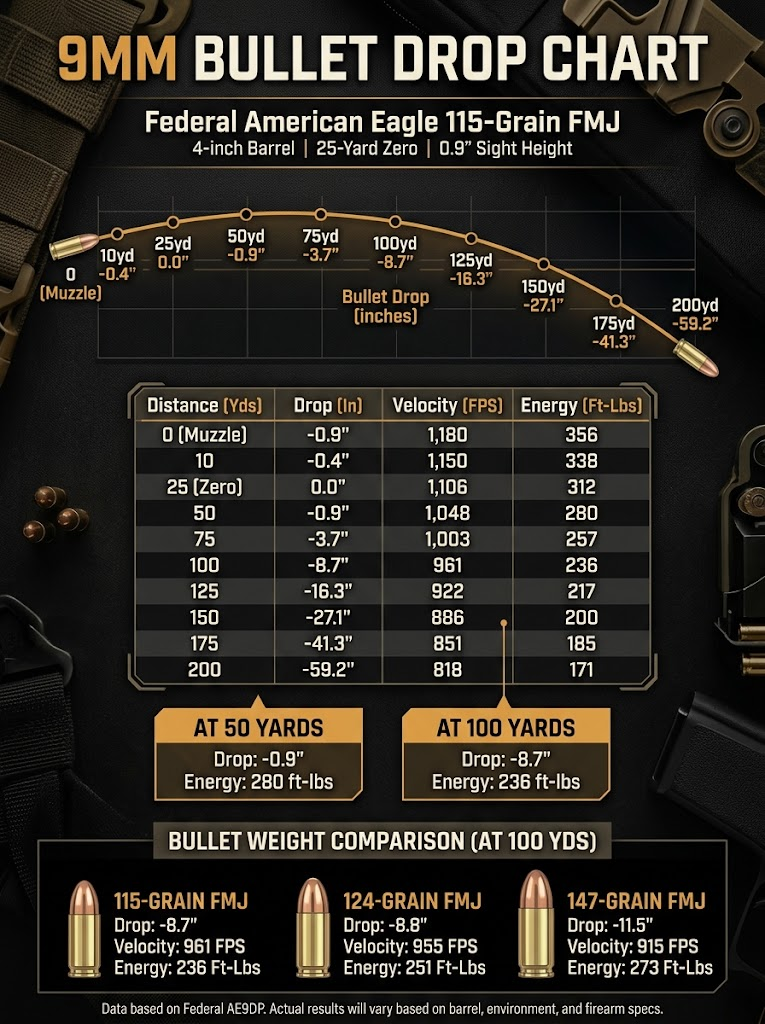
A 50-yard zero works well for 9mm carbines, but the bullet will drop severely after 75 yards, entirely changing the trajectory compared to a 5.56mm rifle.
10. Does changing ammunition ruin my 50-yard zero?
Yes, changing bullet weights (such as moving from 55-grain to 77-grain) or brands will slightly alter your velocity and point of impact, requiring you to re-confirm your zero.