5.56 Ballistics: Bullet Drop And Trajectory Chart
Analyzing 5.56 ballistics involves tracking projectile performance from the muzzle to the target. Variations in bullet weight, barrel length, and sight-in distance significantly alter energy retention and the overall 5.56 bullet trajectory.
Table of Contents [Click to minimize]
5.56 Ballistics Chart
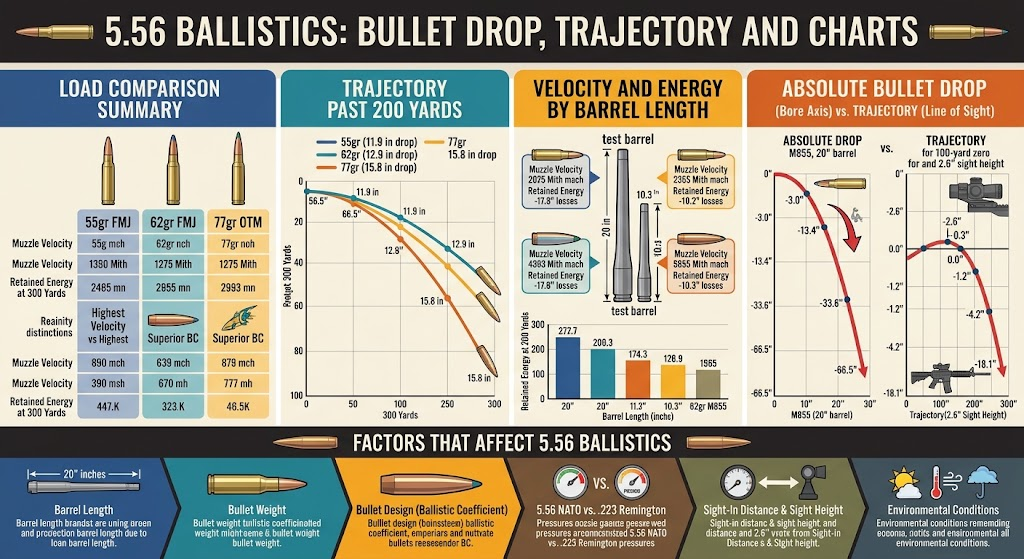
| Bullet Weight | Bullet Type | Manufacturer and Load | Barrel Length | Muzzle Velocity | Velocity at 100 Yards | Velocity at 300 Yards | Muzzle Energy | Energy at 300 Yards | Trajectory at 200 Yards | Ballistic Coefficient |
| 55 Grain | FMJBT | Federal XM193 | 20 in | 3165 fps | 2840 fps | 2252 fps | 1223 ft-lbs | 619 ft-lbs | -2.8 in | 0.243 (G1) |
| 62 Grain | FMJBT | Winchester M855 | 20 in | 3020 fps | 2736 fps | 2217 fps | 1255 ft-lbs | 676 ft-lbs | -3.1 in | 0.304 (G1) |
| 77 Grain | OTM | Black Hills Mk 262 | 18 in | 2750 fps | 2530 fps | 2120 fps | 1293 ft-lbs | 768 ft-lbs | -4.2 in | 0.373 (G1) |
5.56 NATO Performance Overview
- Muzzle velocities range from 2750 fps for heavy 77-grain loads to 3165 fps for lighter 55-grain loads.
- The 55-grain XM193 loses 913 fps by 300 yards.
- Heavier 77-grain bullets retain 768 ft-lbs of energy at 300 yards, compared to 619 ft-lbs for 55-grain bullets.
- Trajectory drops range from 2.8 inches to 4.2 inches at 200 yards with a 100-yard zero.
5.56 Ballistics by Barrel Length
| Barrel Length | Bullet Weight | Ammunition Load | Muzzle Velocity | Velocity at 100 Yards | Velocity at 300 Yards | Muzzle Energy | Energy at 200 Yards |
| 10.3 in | 62 Grain | Winchester M855 (Est.) | 2550 fps | 2280 fps | 1792 fps | 895 ft-lbs | 566 ft-lbs |
| 14.5 in | 62 Grain | Winchester M855 (Est.) | 2850 fps | 2565 fps | 2040 fps | 1118 ft-lbs | 725 ft-lbs |
| 16.0 in | 62 Grain | Winchester M855 (Est.) | 2920 fps | 2631 fps | 2100 fps | 1173 ft-lbs | 765 ft-lbs |
| 20.0 in | 62 Grain | Winchester M855 (Test) | 3020 fps | 2736 fps | 2217 fps | 1255 ft-lbs | 839 ft-lbs |
Velocity and Barrel Length Effects
- Shorter barrels reduce powder burn time, lowering muzzle velocities.
- A 10.3-inch barrel loses roughly 470 fps compared to a standard 20-inch barrel using 62-grain ammunition.
- Muzzle energy drops significantly from 1255 ft-lbs in a 20-inch barrel to 895 ft-lbs in a 10.3-inch barrel.
5.56 62 Grain Ballistics Chart
| Manufacturer and Load | Bullet Weight | Muzzle Velocity | Velocity at 200 Yards | Velocity at 400 Yards | Muzzle Energy | Energy at 200 Yds | Trajectory at 200 Yds | Ballistic Coefficient |
| Winchester M855 FMJ | 62 Grain | 3020 fps | 2469 fps | 1980 fps | 1255 ft-lbs | 839 ft-lbs | -3.1 in | 0.304 (G1) |
| Federal Fusion MSR | 62 Grain | 2750 fps | 2226 fps | 1768 fps | 1041 ft-lbs | 682 ft-lbs | -4.3 in | 0.310 (G1) |
62-Grain Performance Data
- Muzzle velocities for 62-grain loads span from 2750 fps to 3020 fps based on the manufacturer.
- The Winchester M855 retains 839 ft-lbs at 200 yards, outperforming slower hunting loads.
- At 200 yards, these projectiles drop between 3.1 and 4.3 inches when zeroed at 100 yards.
5.56 77gr Ballistics Chart
| Manufacturer and Load | Test Barrel | Muzzle Velocity | Velocity at 200 Yds | Velocity at 400 Yds | Muzzle Energy | Energy at 300 Yds | Trajectory at 200 Yds | Ballistic Coefficient |
| Black Hills Mk 262 | 18 in | 2750 fps | 2320 fps | 1930 fps | 1293 ft-lbs | 768 ft-lbs | -4.2 in | 0.373 (G1) |
| Federal Gold Medal | 20 in | 2720 fps | 2299 fps | 1915 fps | 1265 ft-lbs | 755 ft-lbs | -4.4 in | 0.372 (G1) |
77-Grain vs 62-Grain Comparison
- 77-grain loads launch roughly 250 fps slower than standard 62-grain military rounds.
- High ballistic coefficients (0.372) allow 77-grain bullets to retain energy better, yielding over 750 ft-lbs at 300 yards.
- The 5.56 trajectory requires slightly more elevation at 200 yards, dropping 4.2 to 4.4 inches.
5.56 Ammo Ballistics Chart
| Manufacturer and Load | Bullet Weight | Bullet Type | Muzzle Velocity | Velocity at 300 Yds | Muzzle Energy | Energy at 300 Yds | Ballistic Coefficient |
| Federal XM193 | 55 Grain | FMJBT | 3165 fps | 2252 fps | 1223 ft-lbs | 619 ft-lbs | 0.243 |
| Winchester M855 | 62 Grain | FMJBT | 3020 fps | 2217 fps | 1255 ft-lbs | 676 ft-lbs | 0.304 |
| Black Hills Mk 262 | 77 Grain | OTM | 2750 fps | 2120 fps | 1293 ft-lbs | 768 ft-lbs | 0.373 |
Key Ammunition Differences
- The 55-grain XM193 is the fastest but has the lowest retained energy at 300 yards.
- Match-grade 77-grain OTM bullets provide the highest energy downrange.
- Ballistic coefficients vary widely from 0.243 for basic FMJ to 0.373 for heavy match projectiles.
5.56 Bullet Drop Chart
| Distance | Bullet Drop (Absolute) | Remaining Velocity | Remaining Energy | Notes |
| Muzzle | 0.0 in | 3020 fps | 1255 ft-lbs | Line of departure |
| 100 Yards | -3.0 in | 2736 fps | 1030 ft-lbs | Drop from bore axis |
| 200 Yards | -13.4 in | 2469 fps | 839 ft-lbs | Drop from bore axis |
| 300 Yards | -33.6 in | 2217 fps | 676 ft-lbs | Drop from bore axis |
| 400 Yards | -66.5 in | 1980 fps | 540 ft-lbs | Drop from bore axis |
Gravity Drop Analysis
- Values represent Winchester M855 (62-grain) fired from a 20-inch barrel, measuring absolute gravity drop without a sight offset.
- At 200 yards, the bullet falls 13.4 inches from the bore axis.
- By 400 yards, the absolute drop extends to 66.5 inches.
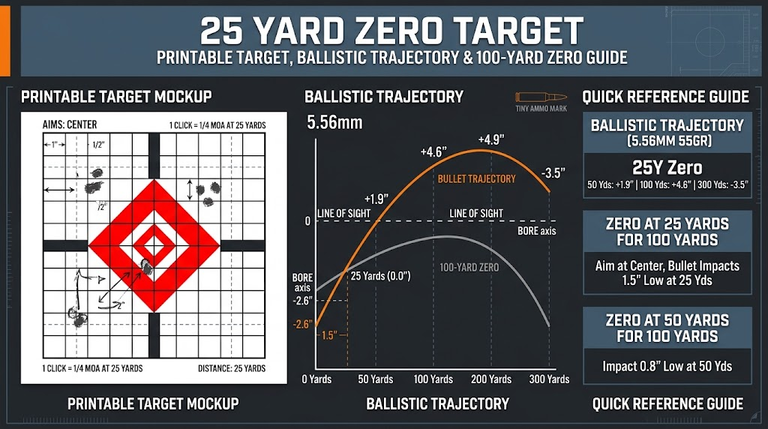
5.56 Ballistics Chart 100 Yard Zero
| Distance | Trajectory (Line of Sight) | Velocity | Energy |
| Muzzle | -2.6 in | 3020 fps | 1255 ft-lbs |
| 100 Yards | 0.0 in | 2736 fps | 1030 ft-lbs |
| 200 Yards | -4.2 in | 2469 fps | 839 ft-lbs |
| 300 Yards | -18.1 in | 2217 fps | 676 ft-lbs |
100-Yard Zero Trajectory
- Based on 62-grain M855 from a 20-inch barrel using a 2.6-inch optic height.
- The trajectory begins 2.6 inches low at the muzzle and intersects the crosshairs at 100 yards.
- At 300 yards, the shooter must hold over by 18.1 inches.
5.56 Trajectory Chart
| Distance | Trajectory (1.5″ Height) | Trajectory (2.6″ Height) | Velocity |
| Muzzle | -1.5 in | -2.6 in | 3165 fps |
| 100 Yards | 0.0 in | 0.0 in | 2840 fps |
| 200 Yards | -3.2 in | -2.8 in | 2536 fps |
| 300 Yards | -12.1 in | -11.4 in | 2252 fps |
Trajectory and Sight Height
- Comparing Federal XM193 (55-grain) with iron sights (1.5 inches) versus a taller optic mount (2.6 inches) with a 100-yard zero.
- At 200 yards, the taller mount yields a slightly flatter holdover of 2.8 inches compared to 3.2 inches.
Factors That Affect 5.56 Ballistics
Shorter barrels reduce the powder burn time, causing lower muzzle velocities and reducing effective range.
Bullet weight impacts speed and drag. Light 55-grain bullets are fast but lose energy quickly, while heavy 77-grain bullets resist wind and retain downrange energy.
A higher ballistic coefficient means the bullet cuts through the air more efficiently, resulting in a flatter 5.56 trajectory.
While 5.56 NATO and .223 Remington share dimensions, 5.56 NATO is loaded to higher pressures and requires a specific chamber specification.
Optic height and sight-in distance dictate the bullet’s arc relative to your crosshairs.
Environmental conditions like wind push the bullet laterally, while high temperatures and altitude reduce air density, resulting in less drag.
Frequently Asked Questions
1. What is the effective ballistic range of 5.56 NATO?
Standard military ammunition is effective up to 300 yards from a 20-inch barrel, while heavy match loads can reach 600 yards.
2. How far does a 5.56 bullet drop at 100 yards?
A 62-grain bullet drops roughly 3 inches from the bore axis due to gravity, but strikes exactly on target if zeroed at 100 yards.
3. How much does a 5.56 bullet drop at 200 yards?
With a 100-yard zero and modern optic height, a 62-grain bullet drops about 4.2 inches at 200 yards.
4. What is the trajectory of a 5.56 round with a 100-yard zero?
It starts 2.6 inches low at the muzzle, hits precisely at 100 yards, drops about 4 inches at 200 yards, and drops roughly 18 inches at 300 yards.
5. How does barrel length affect 5.56 ballistics?
A 10.3-inch barrel can lose nearly 500 fps compared to a 20-inch barrel, reducing energy and increasing drop at distance.
6. What is the difference between 62-grain and 77-grain 5.56 ammunition?
62-grain rounds are lighter and faster, while 77-grain rounds are heavier, slower at the muzzle, but retain more energy downrange.
7. What is the muzzle velocity of 5.56 NATO?
A 55-grain bullet reaches over 3160 fps from a 20-inch barrel, while a 77-grain bullet typically launches around 2750 fps.
8. How much energy does a 5.56 bullet retain at 300 yards?
A 55-grain load retains about 619 ft-lbs, whereas a 77-grain match load retains around 768 ft-lbs.
9. Is 5.56 NATO the same as .223 Remington?
No, 5.56 NATO is loaded to higher pressures and features a different chamber throat design than .223 Remington.
10. Which factors have the greatest effect on 5.56 bullet drop?
Muzzle velocity, distance, and ballistic coefficient have the largest impact on how quickly the projectile falls.