Handgun Caliber Ballistics Chart: Bullet Size and Comparison
Selecting the right ammunition requires a clear understanding of velocity, kinetic energy, and physical dimensions. The comprehensive handgun caliber ballistics chart and physical handgun caliber size chart below detail the performance of the most popular defensive and hunting rounds. Whether you are comparing the everyday carry 9mm to the heavy-hitting .45 ACP, this handgun bullet caliber chart provides the essential data needed to understand stopping power and cartridge specifications.
Table of Contents [Click to minimize]
Handgun Caliber Ballistics Chart
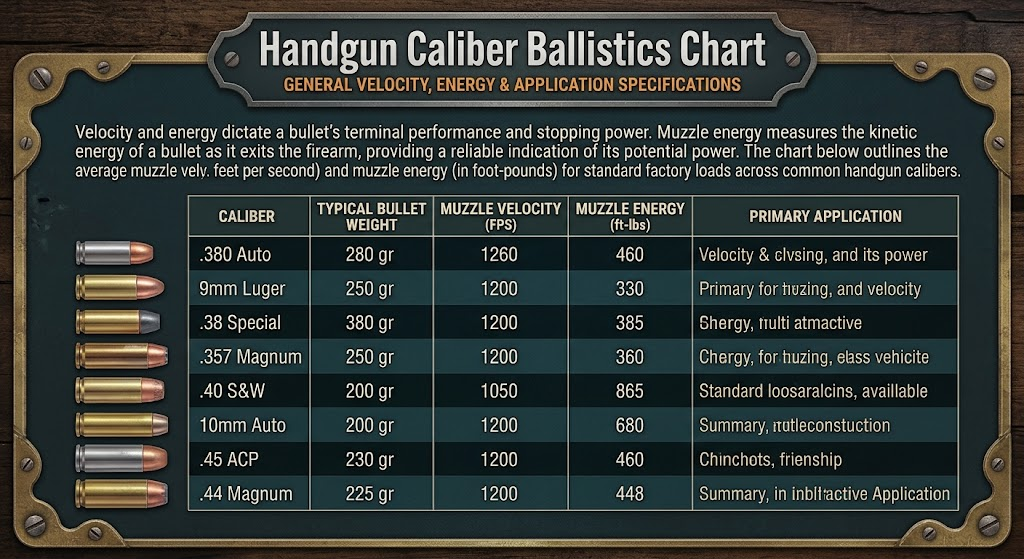
Velocity and energy dictate a bullet’s terminal performance and stopping power. Muzzle energy measures the kinetic energy of a bullet as it exits the firearm, providing a reliable indication of its potential power.
The chart below outlines the average muzzle velocity (in feet per second) and muzzle energy (in foot-pounds) for standard factory loads across common handgun calibers.
| Caliber | Typical Bullet Weight | Muzzle Velocity (FPS) | Muzzle Energy (ft-lbs) | Primary Application |
| .380 Auto | 90 gr – 100 gr | 1,000 – 1,025 | 200 – 337 | Pocket Carry / Backup |
| 9mm Luger | 115 gr – 124 gr | 1,180 – 1,300 | 355 – 501 | Self-Defense / Duty |
| .38 Special | 90 gr – 125 gr | 900 – 1,200 | 215 – 288 | Revolver Defense |
| .357 Magnum | 125 gr – 158 gr | 1,200 – 1,500 | 487 – 624 | Hunting / Defense |
| .40 S&W | 165 gr – 180 gr | 1,050 – 1,130 | 468 – 490 | Law Enforcement / Defense |
| 10mm Auto | 180 gr – 200 gr | 1,290 – 1,400 | 649 – 1,001 | Bear Defense / Big Game |
| .45 ACP | 230 gr | 835 – 950 | 356 – 500 | Self-Defense / Duty |
| .44 Magnum | 240 gr – 300 gr | 1,180 – 1,475 | 741 – 1,533 | Big Game Hunting |
Handgun Caliber Size Chart
Physical dimensions directly impact a firearm’s frame size, magazine capacity, and felt recoil. Calibers like the 9mm and .40 S&W often share similar frame sizes, whereas the 10mm and .45 ACP require larger frames to accommodate their overall lengths and case diameters.
This handgun caliber size chart compares the bullet diameter, case length, and overall cartridge length of standard handgun rounds.
| Caliber | Bullet Diameter (inch / mm) | Case Length (inch / mm) | Overall Length (inch / mm) |
| .380 Auto | .355 in (9.0 mm) | .680 in (17.3 mm) | .984 in (25.0 mm) |
| 9mm Luger | .355 in (9.01 mm) | .754 in (19.15 mm) | 1.169 in (29.69 mm) |
| .38 Special | .357 in (9.1 mm) | 1.155 in (29.3 mm) | 1.550 in (39.4 mm) |
| .357 Magnum | .357 in (9.1 mm) | 1.290 in (33.0 mm) | 1.590 in (40.0 mm) |
| .40 S&W | .400 in (10.2 mm) | .850 in (21.6 mm) | 1.135 in (28.8 mm) |
| 10mm Auto | .400 in (10.17 mm) | .992 in (25.2 mm) | 1.260 in (32.0 mm) |
| .45 ACP | .452 in (11.5 mm) | .898 in (22.8 mm) | 1.275 in (32.4 mm) |
| .44 Magnum | .429 in (10.9 mm) | 1.285 in (32.6 mm) | 1.610 in (41.0 mm) |
Handgun Bullet Caliber Chart by Application
Ammunition is purpose-built. Heavier bullets generally offer better wind resistance and momentum, while lighter, faster bullets deliver flatter trajectories.
Pocket Carry and Deep Concealment
The .380 Auto is affectionately known as the “9mm Short” because it utilizes the exact same .355-inch diameter bullet as the 9mm, but features a shorter case (.680 inches compared to .754 inches). This allows it to fit into ultra-compact, lightweight firearms.
Everyday Self-Defense and Duty
The 9mm and .45 ACP remain the top choices for concealed carry and home defense. While the .45 ACP provides a massive .452-inch projectile and heavy recoil, the 9mm achieves excellent terminal ballistics through higher velocities (over 1,180 FPS) while maintaining a manageable recoil that benefits both beginners and experts. The .40 S&W was developed for the FBI as a bridge between the two, offering higher velocities than the .45 ACP and greater mass than the 9mm.
Magnum Hunting and Bear Defense
When venturing into the backcountry, magnum calibers take over. The 10mm Auto is a semi-automatic powerhouse likened to magnum revolver rounds, making it ideal for defense against grizzly bears. For dedicated large game hunting, the .44 Magnum shines, pushing heavy 240-grain to 300-grain bullets at nearly 1,475 FPS and generating upwards of 1,500 ft-lbs of energy.
Detailed Explanations of Caliber Metrics
Muzzle Velocity vs. Muzzle Energy
Velocity is the speed at which the bullet travels after being discharged, giving it a flatter trajectory and extending accurate range. Kinetic energy, calculated using the bullet’s mass and its squared velocity, dictates the destructive force applied to the target. A fast, light bullet (like a 90-grain 9mm) and a slow, heavy bullet (like a 230-grain .45 ACP) can yield similar muzzle energy figures despite taking entirely different physical approaches.
Bullet Diameter and Sectional Density
In a handgun caliber size chart, bullet diameter is crucial for creating wound channels. However, diameter must be paired with sufficient weight (sectional density) to ensure penetration. For self-defense, the optimal penetration depth in ballistic testing is between 12 and 18 inches, which ensures the bullet stops the threat without over-penetrating and risking bystanders.
Recoil Considerations
Recoil energy is directly tied to the weight of the bullet, the powder charge, the velocity, and the weight of the firearm. A .45 ACP produces significantly more recoil than a 9mm, making it more challenging for novice shooters to land rapid, accurate follow-up shots. If the recoil is too heavy, the shooter’s performance will degrade.
Frequently Asked Questions
How do I read a handgun caliber ballistics chart?A standard ballistics chart displays the bullet weight (in grains), muzzle velocity (feet per second), and muzzle energy (foot-pounds). Comparing these numbers helps you gauge how fast and how hard a bullet will hit its target.
What does a handgun caliber size chart tell me?A handgun caliber size chart details the physical dimensions of the ammunition, such as bullet diameter, case length, and overall length. This dictates what size frame the handgun must use to accommodate the magazine and chamber.
Which caliber is best for self-defense on a handgun bullet caliber chart?The 9mm is widely considered the gold standard for self-defense due to its optimal blend of manageable recoil, high magazine capacity, and terminal velocity (ranging from 355 to 501 ft-lbs of energy).
What is the difference between 9mm and .380 Auto? Both utilize a .355-inch bullet diameter. However, the .380 Auto has a shorter case (17.3 mm vs 19.15 mm) and lower powder capacity, resulting in less velocity and muzzle energy compared to the 9mm.
Why is the .40 S&W popular in law enforcement? The .40 S&W was created for the FBI as a middle ground between the 9mm and .45 ACP. It offers more velocity than the .45 ACP and more stopping mass than the 9mm.
Which handgun caliber produces the most energy?Among common handguns, the .44 Magnum produces the most energy, capable of exceeding 1,500 ft-lbs, making it ideal for big game hunting. In semi-automatics, the 10mm Auto is the powerhouse, reaching over 1,000 ft-lbs of energy.
Is a .38 Special the same diameter as a 9mm? They are very close. A 9mm uses a .355-inch bullet, while a .38 Special and .357 Magnum use a slightly wider .357-inch bullet.
How does bullet grain affect handgun ballistics? Grain measures the bullet’s weight. Heavier grains deliver more energy and wind resistance but generate heavier recoil. Lighter grains travel faster and shoot flatter with less recoil.
Can I shoot .38 Special in a .357 Magnum? Yes. As seen on a handgun caliber size chart, the .357 Magnum is physically identical in diameter to the .38 Special, but features a case that is 1.290 inches long compared to the .38 Special’s 1.155 inches. The longer chamber of the magnum safely accepts the shorter .38 Special case.
Why is the .45 ACP considered a heavy hitter?The .45 ACP features a massive .452-inch diameter bullet. Even at subsonic velocities, its heavy mass (typically 230 grains) transfers substantial kinetic energy upon impact, creating a massive permanent wound cavity.