The 100-yard zero serves as the ultimate baseline for precision shooters, hunters, and tactical rifle owners running magnified optics. By calibrating the rifle so the bullet never climbs above the reticle, shooters can easily dial elevation for long-distance impacts. This complete ballistics guide covers 100-yard targets, short-range zeroing offsets, and MRAD principles.
Table of Contents
[Click to minimize]
100 Yard Zero Target
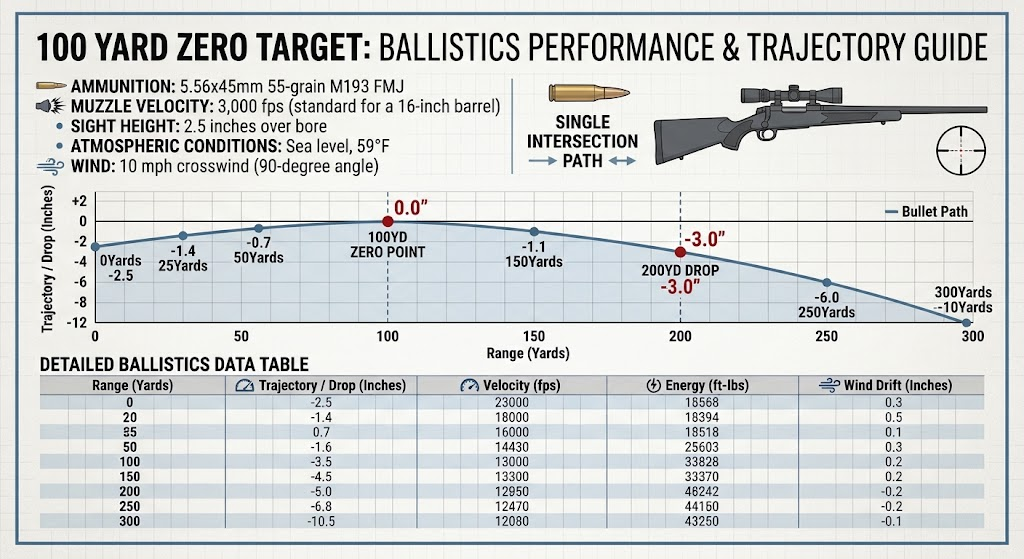
Establishing a 100-yard zero means your projectile aligns with the center of your optic glass exactly at the 100-yard mark.
This specific zero creates a single point of intersection, as the bullet reaches the crosshairs and immediately starts its downward arc.
Because the round never travels higher than your aiming point, you never have to calculate hold-unders for mid-range targets.
It is the preferred method for scoped bolt-action rifles, Low Power Variable Optics (LPVOs), and reticles featuring bullet drop compensators (BDC).
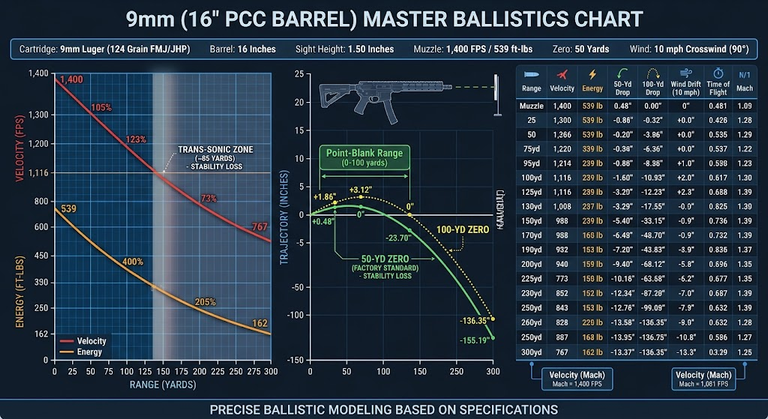
While extremely precise at 100 yards, hitting targets at 200 yards and beyond requires you to hold high or dial your elevation turrets.
Ammunition: 5.56x45mm 55-grain M193 FMJ
Muzzle Velocity: 3,000 fps (standard for a 16-inch barrel)
If you only have access to a 25-yard shooting range, you must use a calculated offset to replicate a true 100-yard trajectory.
At a distance of 25 yards, the bullet has just left the muzzle and is still climbing toward your optic’s line of sight.
For a standard AR-15 with a 2.5-inch scope height, your group must land exactly 1.4 inches lower than your center aiming point at 25 yards.
Utilizing a specialized 100-yard zero at 25 yards target simplifies this process by providing a primary aiming point and a dedicated lower impact zone.
If you mistakenly zero directly on the bullseye at 25 yards, your rifle will shoot drastically high when you finally move to a 100-yard range.
Target Distance: 25 Yards
Zero Distance Goal: 100 Yards
Ammunition / Load
Sight Height (Over Bore)
Muzzle Velocity (fps)
Required Point of Impact (POI) Offset at 25 Yards
5.56x45mm 55-grain M193
1.5 inches (Standard Iron Sights)
3,000
-0.7 inches (Low)
5.56x45mm 55-grain M193
2.5 inches (Standard AR-15 Optic)
3,000
-1.4 inches (Low)
5.56x45mm 55-grain M193
3.5 inches (Tall / NVG Mount)
3,000
-2.2 inches (Low)
100 Yard Zero at 50 Yards
Confirming your 100-yard zero on a 50-yard target is generally more accurate than using a 25-yard target because it reduces extreme angular errors.
Because the bullet is much closer to crossing your line of sight at 50 yards, the required offset hold is noticeably smaller.
When zeroing a standard AR-15 at 50 yards, your bullets need to strike roughly 0.7 inches directly below your crosshairs.
This 50-yard offset serves as an excellent preliminary step to ensure you are on paper before moving your target back to the 100-yard line.
Minor trajectory shifts caused by different bullet weights become slightly visible at 50 yards, so always zero with your intended duty or match ammo.
Target Distance: 50 Yards
Zero Distance Goal: 100 Yards
Ammunition / Load
Sight Height (Over Bore)
Muzzle Velocity (fps)
Required Point of Impact (POI) Offset at 50 Yards
5.56x45mm 55-grain M193
1.5 inches (Standard Iron Sights)
3,000
-0.3 inches (Low)
5.56x45mm 55-grain M193
2.5 inches (Standard AR-15 Optic)
3,000
-0.7 inches (Low)
5.56x45mm 55-grain M193
3.5 inches (Tall / NVG Mount)
3,000
-1.1 inches (Low)
MRAD 100 Yard Zero Target
Long-range precision shooters heavily rely on a 100-yard zero combined with MRAD (Milliradian) scopes to manage extreme distances.
Setting a 100-yard baseline zero means that every subsequent shot past 100 yards will require a positive, upward elevation adjustment on the turrets.
A dedicated MRAD 100-yard zero target is designed with a specific grid consisting of 0.1 MRAD squares, which translates to roughly 0.36 inches at 100 yards.
This grid layout perfectly matches the clicks on a tactical scope, entirely removing the need to convert inches into Minute of Angle (MOA) measurements.
If your impact is exactly two grid squares below the bullseye, you simply adjust your elevation dial up by 0.2 MRAD to achieve center zero.
Ammunition: .308 Winchester 175-grain Sierra MatchKing
Muzzle Velocity: 2,600 fps
Sight Height: 2.0 inches over bore
Atmospheric Conditions: Sea level, 59°F
Range (Yards)
Trajectory (Inches)
Elevation Hold / Dial (MRAD)
Velocity (fps)
Energy (ft-lbs)
100
0.0
0.0
2,427
2,289
200
-4.5
+0.6
2,261
1,987
300
-15.5
+1.4
2,101
1,716
400
-34.0
+2.4
1,948
1,475
500
-61.5
+3.4
1,803
1,263
Frequently Asked Questions
1. What does a 100-yard zero accomplish?
It calibrates your optic so the projectile strikes the exact center of your crosshairs at 100 yards, providing a flat baseline where the bullet never arcs high.
2. How do I get a 100-yard zero at a 25-yard range?
Aim directly at the bullseye, but adjust your turrets until the rounds impact approximately 1.4 inches low (assuming a 2.5-inch optic mount).
3. Why is the 100-yard zero preferred for precision shooting?
It creates a clean zero baseline. The bullet immediately drops after 100 yards, meaning shooters only need to calculate drop and dial upward for long-distance impacts.
4. Is the 100-yard zero good for an AR-15?
Yes, especially if the rifle is equipped with an LPVO or a magnifier, because this zero perfectly aligns with most commercial BDC (Bullet Drop Compensator) reticles.
5. What is the required offset at 50 yards for a 100-yard zero?
For a standard AR-15 setup (2.5 inches over bore), your point of impact needs to be about 0.7 inches lower than your point of aim at 50 yards.
6. How does a 100-yard zero differ from a 50-yard zero?
A 50-yard zero crosses the sights twice (at 50 and 200 yards) by arcing high, while a 100-yard zero only intersects the sights once and never rises above them.
7. Does my scope mount height change my 25-yard offset?
Yes, significantly. A 1.5-inch iron sight requires a 0.7-inch low offset at 25 yards, whereas a 3.5-inch tactical mount requires a massive 2.2-inch low offset.
8. What makes an MRAD 100-yard zero target unique?
It features a grid mapped in 0.1 milliradian squares, allowing shooters to adjust their tactical scope turrets by simply counting the grid squares between their impact and the bullseye.
9. Will I ever need to hold under the target with this zero?
No, that is the primary advantage of a 100-yard zero. Because the bullet never travels higher than your crosshairs, you will always hold dead-on or hold high.
10. Should I use a 100-yard zero for a .22LR rifle?
It is generally not recommended. A .22LR round drops heavily past 50 yards, so forcing a 100-yard zero requires an extreme upward trajectory that complicates mid-range shots.