12 Gauge Slug Ballistics: Trajectory and Bullet Drop Chart
Understanding 12 gauge slug ballistics is essential for hunters and shooters looking to maximize the performance of their shotguns. A comprehensive 12 gauge slug ballistics chart reveals how different slug designs, ammunition specifications, and barrel types influence velocity, energy, bullet drop, and trajectory downrange.
Table of Contents [Click to minimize]
12 Gauge Slug Ballistics Chart
Ballistic figures vary significantly based on the specific ammunition load, firearm setup, barrel length, environmental conditions, and chosen sight-in distance. The trajectory figures below assume a 100-yard zero. Values marked with an asterisk (*) are calculated estimates for downrange performance where official factory data is unavailable for those specific distances.
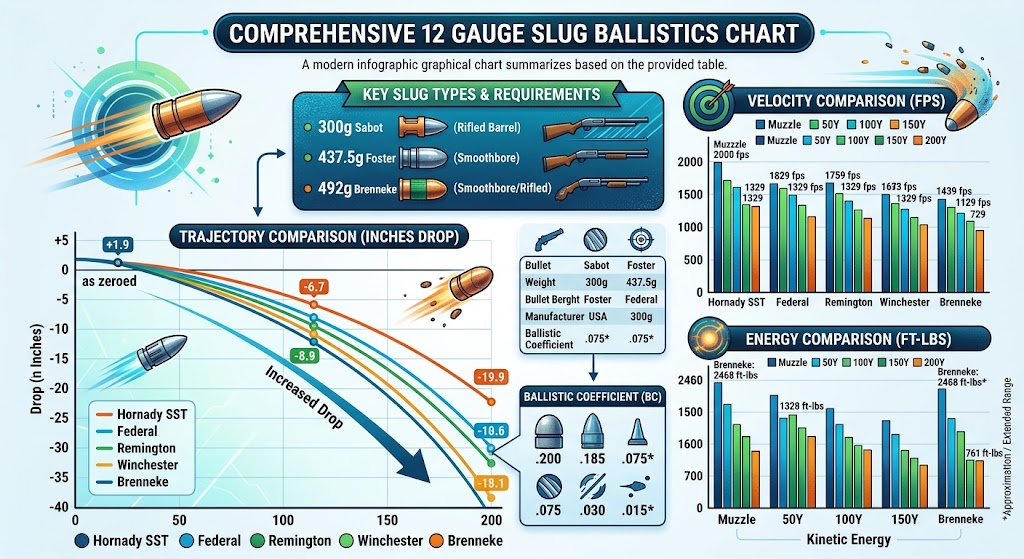
| Bullet Weight | Bullet Type (Barrel Requirement) | Manufacturer | Muzzle Velocity | Velocity At 50 Yards | Velocity At 100 Yards | Velocity At 150 Yards | Velocity At 200 Yards | Muzzle Energy | Energy At 50 Yards | Energy At 100 Yards | Energy At 150 Yards | Energy At 200 Yards | Trajectory At 50 Yards | Trajectory At 100 Yards | Trajectory At 150 Yards | Trajectory At 200 Yards | Ballistic Coefficient |
| 300 grains | Sabot (Rifled Barrel) | Hornady SST | 2000 fps | 1816 fps | 1641 fps | 1478 fps | 1329 fps | 2664 ft-lbs | 2197 ft-lbs | 1794 ft-lbs | 1455 ft-lbs | 1176 ft-lbs | +1.9 inches | 0.0 inches | -6.7 inches | -19.9 inches | .200 |
| 300 grains | Sabot (Rifled Barrel) | Federal Trophy Copper | 1900 fps | 1715 fps | 1542 fps | 1381 fps | 1235 fps | 2405 ft-lbs | 1959 ft-lbs | 1583 ft-lbs | 1270 ft-lbs | 1016 ft-lbs | +2.2 inches | 0.0 inches | -7.5 inches | -22.5 inches* | .185 |
| 437.5 grains | Foster (Smoothbore) | Remington Slugger | 1560 fps | 1175 fps | 977 fps | 860 fps* | 775 fps* | 2361 ft-lbs | 1341 ft-lbs | 927 ft-lbs | 718 ft-lbs* | 583 ft-lbs* | +2.8 inches | 0.0 inches | -11.5 inches* | -33.0 inches* | .075* |
| 437.5 grains | Foster (Smoothbore) | Winchester Super-X | 1600 fps | 1180 fps | 985 fps | 865 fps* | 780 fps* | 2487 ft-lbs | 1353 ft-lbs | 943 ft-lbs | 725 ft-lbs* | 590 ft-lbs* | +2.7 inches | 0.0 inches | -11.2 inches* | -32.5 inches* | .078* |
| 492 grains | Brenneke (Smoothbore or Rifled) | Brenneke Classic Mag | 1502 fps | 1233 fps | 1046 fps | 925 fps* | 835 fps* | 2468 ft-lbs | 1661 ft-lbs | 1195 ft-lbs | 935 ft-lbs* | 761 ft-lbs* | +3.1 inches | 0.0 inches | -12.4 inches* | -35.2 inches* | .110* |
Understanding 12 Gauge Slug Ballistics
Analyzing 12 gauge slug ballistics requires understanding several key measurements that dictate a projectile’s flight path and terminal performance.
Muzzle velocity measures the speed of the slug in feet per second the moment it leaves the barrel. Retained velocity indicates how fast the slug is traveling at specific distances downrange. Because shotgun slugs are generally large and not highly aerodynamic, they lose velocity rapidly.
Muzzle energy represents the destructive force or kinetic energy of the slug at the muzzle, measured in foot-pounds. Retained energy shows how much of that power remains upon impact at various distances.
Trajectory and bullet drop describe the arc the slug takes as gravity pulls it downward. Trajectory accounts for the line of sight through a scope or bead, while absolute bullet drop measures how far gravity pulls the slug below the actual bore line of the barrel.
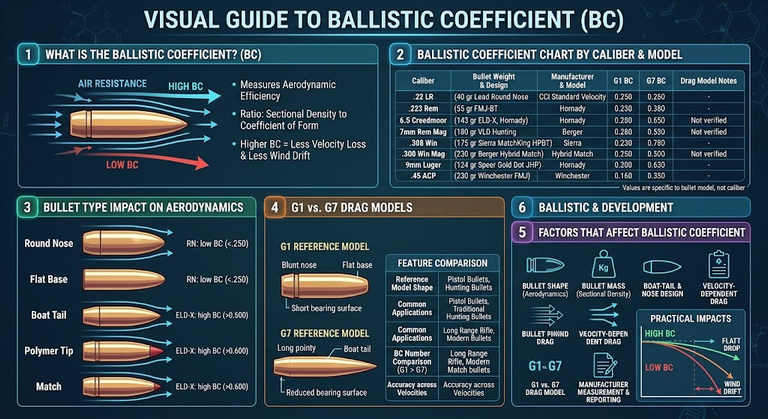
Ballistic coefficient is a numerical value representing the projectile’s ability to overcome air resistance in flight. A higher ballistic coefficient means the slug retains velocity and energy better. Manufacturers do not always publish ballistic coefficients for shotgun slugs because older designs are not intended for long-range precision, making direct comparisons difficult.
Types of 12 Gauge Slugs
Foster-Style Rifled Slugs
Foster slugs feature a hollow base that pushes the center of mass forward, helping the projectile remain stable in flight like a badminton shuttlecock. They have angled grooves on the outside. This external rifling is designed to allow the slug to swage down safely when passing through a shotgun choke, not to impart a stabilizing spin. These slugs are designed for smoothbore shotguns.
Sabot Slugs
Sabot slugs use a plastic sleeve called a sabot to hold a smaller, aerodynamic projectile inside the 12-gauge barrel. When fired in a rifled shotgun barrel, the rifling grips the sabot and spins the entire package. The plastic sabot falls away after exiting the muzzle, leaving the bullet to travel to the target. Sabot slugs typically offer superior aerodynamics, better accuracy, and flatter trajectories.
Brenneke-Style Slugs
Brenneke slugs use a solid lead body attached to a wad that remains connected to the projectile during flight. This attached wad provides drag stabilization and ensures the slug maintains a straight path. Brenneke designs offer deep penetration and are widely compatible with both smoothbore and rifled barrels, depending on the specific product specifications provided by the manufacturer.
12 Gauge Slug Velocity Chart
| Manufacturer and Load | Slug Weight | Muzzle Velocity | Velocity At 50 Yards | Velocity At 100 Yards | Velocity At 150 Yards | Velocity At 200 Yards |
| Hornady SST Sabot | 300 grains | 2000 fps | 1816 fps | 1641 fps | 1478 fps | 1329 fps |
| Federal Trophy Copper Sabot | 300 grains | 1900 fps | 1715 fps | 1542 fps | 1381 fps | 1235 fps |
| Remington Slugger Foster | 437.5 grains | 1560 fps | 1175 fps | 977 fps | 860 fps* | 775 fps* |
| Brenneke Classic Mag | 492 grains | 1502 fps | 1233 fps | 1046 fps | 925 fps* | 835 fps* |
Velocity decreases continuously as the slug travels due to atmospheric drag. Sabot slugs retain their velocity much better than Foster or Brenneke slugs because of their pointed, aerodynamic shapes.
12 Gauge Slug Energy Chart
| Manufacturer and Load | Slug Weight | Muzzle Energy | Energy At 50 Yards | Energy At 100 Yards | Energy At 150 Yards | Energy At 200 Yards |
| Hornady SST Sabot | 300 grains | 2664 ft-lbs | 2197 ft-lbs | 1794 ft-lbs | 1455 ft-lbs | 1176 ft-lbs |
| Federal Trophy Copper Sabot | 300 grains | 2405 ft-lbs | 1959 ft-lbs | 1583 ft-lbs | 1270 ft-lbs | 1016 ft-lbs* |
| Remington Slugger Foster | 437.5 grains | 2361 ft-lbs | 1341 ft-lbs | 927 ft-lbs | 718 ft-lbs* | 583 ft-lbs* |
| Brenneke Classic Mag | 492 grains | 2468 ft-lbs | 1661 ft-lbs | 1195 ft-lbs | 935 ft-lbs* | 761 ft-lbs* |
Projectile weight and velocity dictate energy. Heavy slugs moving at moderate speeds can generate massive energy close to the muzzle, but poor aerodynamics cause them to shed that energy quickly. Retained energy alone does not guarantee effectiveness, as penetration and expansion depend heavily on the slug’s physical construction.
12 Gauge Slug Bullet Drop Chart
Unlike trajectory, which factors in how a shotgun’s sights are adjusted to angle the barrel upward, absolute bullet drop measures exactly how far gravity pulls the projectile below the physical bore line of the barrel.
| Manufacturer and Load | Slug Weight | Drop At 50 Yards | Drop At 100 Yards | Drop At 150 Yards | Drop At 200 Yards |
| Hornady SST Sabot | 300 grains | -1.5 inches* | -6.5 inches* | -15.8 inches* | -30.5 inches* |
| Federal Trophy Copper Sabot | 300 grains | -1.7 inches* | -7.3 inches* | -17.5 inches* | -34.0 inches* |
| Winchester Super-X Foster | 437.5 grains | -2.4 inches* | -10.5 inches* | -25.2 inches* | -48.5 inches* |
| Remington Slugger Foster | 437.5 grains | -2.5 inches* | -11.0 inches* | -26.5 inches* | -50.2 inches* |
| Brenneke Classic Mag | 492 grains | -2.7 inches* | -11.8 inches* | -28.0 inches* | -53.5 inches* |
As the bullet drop chart illustrates, slugs drop significantly once they leave the muzzle. A fast, aerodynamic sabot slug may drop 6.5 inches from the bore line at 100 yards, while a slower, heavy lead Foster slug can drop nearly double that amount over the same distance. This is why properly zeroing a shotgun is critical to counteract gravity’s effect.
12 Gauge Slug Trajectory and Bullet Drop
Trajectory changes continuously as a projectile moves away from the barrel. While absolute bullet drop reveals the harsh reality of gravity, practical trajectory accounts for the line of sight through the shooter’s optic or bead.
If a shotgun is zeroed at 100 yards, the barrel is angled slightly upward relative to the shooter’s line of sight. The slug starts below the line of sight, crosses upward to a positive trajectory at 50 yards, and falls back to zero at 100 yards. Past 100 yards, the trajectory values become increasingly negative. Heavy, blunt Foster slugs will display severe negative numbers past 100 yards, while lighter, faster sabot rounds fly considerably flatter.
Hornady SST 12 Gauge Slug Ballistics Chart
Projectile Specifications: 300 Grain FTX® Sabot Slug | BC (G1): 0.200 | Sectional Density: 0.171
Factory Muzzle Velocity: 2,000 FPS | Muzzle Energy: 2,664 ft-lbs
Sight Height: 1.50 inches above bore | Crosswind Baseline: 10 mph at 90°
| Range (Yards) | Velocity (FPS) | Velocity Retained (%) | Energy (ft-lbs) | Energy Retained (%) | Trajectory (150-Yd Zero) | Trajectory (100-Yd Zero) | Time of Flight (Sec) | Wind Drift (10 mph) | Velocity (Mach) |
| Muzzle (0) | 2,000 | 100.0% | 2,664 | 100.0% | -1.50 in | -1.50 in | 0.000 s | 0.00 in | 1.79 Mach |
| 25 | 1,906 | 95.3% | 2,420 | 90.8% | +0.72 in | +0.28 in | 0.038 s | 0.20 in | 1.71 Mach |
| 50 | 1,814 | 90.7% | 2,192 | 82.3% | +2.40 in | +1.90 in | 0.078 s | 0.81 in | 1.63 Mach |
| 75 | 1,725 | 86.3% | 1,982 | 74.4% | +2.95 in | +1.52 in | 0.120 s | 1.86 in | 1.55 Mach |
| 100 | 1,641 | 82.1% | 1,793 | 67.3% | +2.70 in | 0.00 in (Zero) | 0.165 s | 3.38 in | 1.47 Mach |
| 125 | 1,560 | 78.0% | 1,621 | 60.8% | +1.71 in | -1.92 in | 0.212 s | 5.37 in | 1.40 Mach |
| 150 | 1,483 | 74.2% | 1,465 | 55.0% | 0.00 in (Zero) | -4.56 in | 0.261 s | 7.87 in | 1.33 Mach |
| 175 | 1,410 | 70.5% | 1,324 | 49.7% | -2.48 in | -7.97 in | 0.313 s | 10.90 in | 1.26 Mach |
| 200 | 1,342 | 67.1% | 1,199 | 45.0% | -6.70 in | -12.12 in | 0.367 s | 14.47 in | 1.20 Mach |
| 225 | 1,277 | 63.9% | 1,086 | 40.8% | -12.11 in | -17.46 in | 0.424 s | 18.61 in | 1.14 Mach |
| 250 | 1,217 | 60.9% | 986 | 37.0% | -19.34 in | -24.62 in | 0.484 s | 23.33 in | 1.09 Mach |
| 275 | 1,161 | 58.1% | 897 | 33.7% | -28.10 in | -33.31 in | 0.547 s | 28.66 in | 1.04 Mach |
| 300 | 1,110 | 55.5% | 821 | 30.8% | -38.60 in | -43.74 in | 0.613 s | 34.61 in | 0.99 Mach |
How Far Can a 12 Gauge Slug Travel?
The practical accuracy range of a 12-gauge slug is vastly different from its maximum travel distance. A sabot slug fired from a rifled barrel may maintain practical hunting accuracy and energy out to 150 or 200 yards. A Foster slug fired from a smoothbore is typically limited to practical ranges of 50 to 75 yards.
Despite these practical limits, a 12-gauge slug can travel well over 1,000 yards if fired at an upward angle. There is no single effective range for every load, and shooters must always remember that the projectile remains dangerous long after it has surpassed its useful accuracy range.
Factors That Affect 12 Gauge Slug Ballistics
Slug Weight and Design
Heavier slugs hit with tremendous force at close range but often suffer from steep trajectories. Aerodynamic sabot designs use lighter projectiles to achieve higher velocities and flatter trajectories over longer distances.
Muzzle Velocity
Higher starting velocities generally result in less bullet drop over a given distance. Faster slugs arrive at the target sooner, giving gravity less time to pull the projectile downward.
Barrel Type and Compatibility
Firing a sabot slug through a smoothbore barrel will result in erratic flight and poor accuracy. Firing a traditional lead Foster slug through a rifled barrel can lead to severe lead fouling. Ammunition must always be matched to the manufacturer’s barrel requirements to achieve the published ballistic results.
Sight-In Distance
Changing the sight-in distance alters the entire trajectory curve. A 50-yard zero will result in significantly more drop at 100 yards compared to a shotgun zeroed directly at 100 yards.
Weather and Environmental Conditions
Cold, dense air increases drag and slows projectiles down more quickly than warm, thin air. Strong crosswinds will also push slow-moving shotgun slugs off target much faster than high-velocity rifle bullets.
Differences Between Ammunition Manufacturers
Propellant types, wad designs, and exact bullet profiles vary between manufacturers. Two 1-ounce slugs from different companies may yield different velocities and energy retention based on their unique aerodynamic shapes and powder charges.
12 Gauge Slugs Compared With Other Slug Types
| Slug Type | Typical Design | Barrel Compatibility | Ballistic Characteristics | Important Considerations |
| Foster | Hollow base, external grooves | Smoothbore | High drop, rapid energy loss | Excellent for short range applications |
| Sabot | Aerodynamic bullet in plastic sleeve | Rifled | Flat trajectory, high velocity | Requires a rifled barrel for accuracy |
| Brenneke | Solid lead body with attached wad | Smoothbore or Rifled | Deep penetration, moderate drop | Check specific load for barrel guidance |
Frequently Asked Questions
1. What is 12 gauge slug ballistics? It is the study of how 12-gauge shotgun slugs behave in flight, including their velocity, energy, trajectory, bullet drop, and accuracy downrange.
2. Where can I find a 12 gauge slug ballistics chart? A detailed 12 gauge slug ballistics chart is provided in the main section of this article, showcasing velocity, energy, and trajectory data for several common loads.
3. How fast does a 12-gauge slug travel? Muzzle velocities typically range from 1,500 feet per second for heavy lead slugs up to 2,000 feet per second for lighter sabot slugs.
4. How much energy does a 12-gauge slug produce? Most standard 12-gauge slugs generate between 2,300 and 3,000 foot-pounds of energy at the muzzle.
5. How much does a 12-gauge slug drop at 50 yards? If measured as absolute bullet drop from the bore line, gravity pulls most slugs down 1.5 to 3 inches at 50 yards. However, if zeroed at 100 yards, a typical 12-gauge slug will strike 2 to 3 inches high relative to the line of sight.
6. How much does a 12-gauge slug drop at 100 yards? If sighted in for 50 yards, traditional Foster slugs can drop an additional 2 to 5 inches by the time they reach 100 yards. Without compensation, absolute drop from the bore line ranges from 6.5 to 12 inches at 100 yards.
7. How far can a 12-gauge slug travel? While their practical hunting range is usually under 200 yards, a 12-gauge slug can travel well over 1,000 yards if fired at an optimal upward angle.
8. What is the difference between a rifled slug and a sabot slug? A rifled slug is a full-bore lead projectile designed for smoothbore barrels, whereas a sabot slug uses a smaller projectile encased in a plastic sleeve designed to be spun by a rifled barrel.
9. Does slug weight affect 12-gauge ballistics? Yes. Heavier slugs retain momentum for deep penetration but generally have slower velocities and steeper bullet drop trajectories compared to lighter slugs.
10. Do all 12-gauge slugs have the same trajectory? No. Sabot slugs fly much flatter over long distances compared to blunt Foster or Brenneke slugs.