22 WMR Ballistics: Bullet Drop and Trajectory Chart
Understanding 22 WMR (22 Magnum) ballistics depends on bullet weight, muzzle velocity, and aerodynamics. The tables below detail the expected velocities, energies, and flight paths for popular 22 WMR (22 Magnum) ammunition.
Table of Contents [Click to minimize]
22 WMR Ballistics Chart
| Bullet Weight | Bullet Type | Manufacturer and Load | Test Barrel Length | Muzzle Velocity (fps) | Velocity at 50 Yards (fps) | Velocity at 100 Yards (fps) | Velocity at 150 Yards (fps) | Velocity at 200 Yards (fps) | Muzzle Energy (ft-lbs) | Energy at 50 Yards (ft-lbs) | Energy at 100 Yards (ft-lbs) | Energy at 150 Yards (ft-lbs) | Energy at 200 Yards (ft-lbs) | Bullet Drop at 50 Yards (inches)* | Bullet Drop at 100 Yards (inches)* | Bullet Drop at 150 Yards (inches)* | Bullet Drop at 200 Yards (inches)* | Ballistic Coefficient |
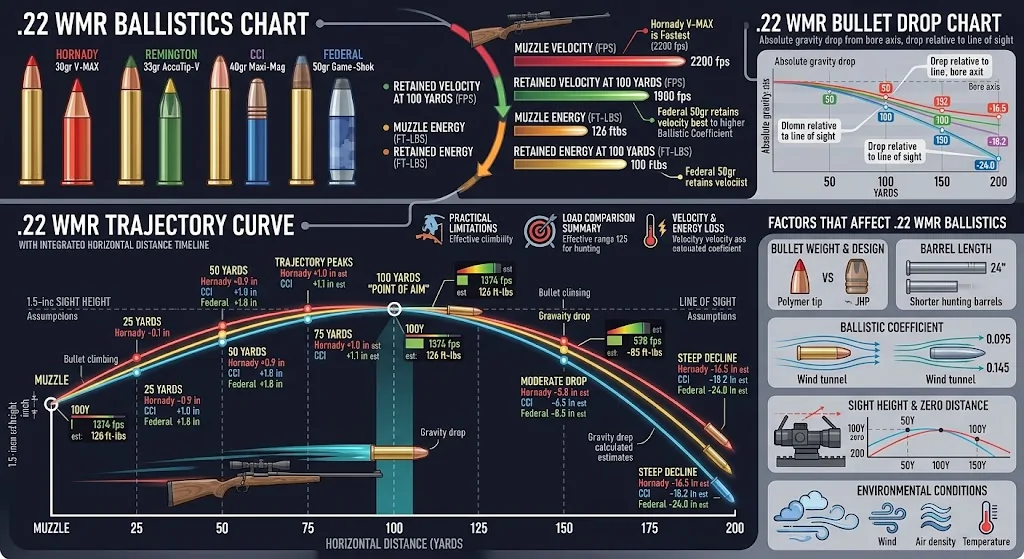
| 30 grain | Polymer Tip | Hornady V-MAX | 24 inches | 2200 | 1754 | 1374 | 1109 (est) | Not verified | 322 | 205 | 126 | 82 (est) | Not verified | +0.9 | 0.0 | -5.8 (est) | -16.5 (est) | 0.095 |
| 40 grain | JHP | CCI Maxi-Mag | 24 inches | 1875 | 1563 | 1318 | 1133 (est) | Not verified | 312 | 217 | 154 | 114 (est) | Not verified | +1.0 | 0.0 | -6.5 (est) | -18.2 (est) | 0.114 |
| 50 grain | JHP | Federal Game-Shok | 24 inches | 1530 | 1320 | 1146 | 1025 (est) | Not verified | 260 | 193 | 146 | 116 (est) | Not verified | +1.8 | 0.0 | -8.5 (est) | -24.0 (est) | 0.145 |
*Bullet drop is modeled with a 100-yard zero and a 1.5-inch sight height. Values marked (est) are calculated trajectory estimates.
Analyzing the Ballistics Data
- Muzzle velocities range widely, from 1,530 fps (50-grain) to 2,200 fps (30-grain).
- The heavier 50-grain bullet has a higher ballistic coefficient (0.145), helping it retain velocity better over distance despite starting slower.
- Speed and energy fall off rapidly, resulting in significant bullet drop for all loads once they pass 100 yards.
22 WMR Ammo Ballistics
| Manufacturer and Load | Bullet Weight | Bullet Type | Test Barrel Length | Muzzle Velocity (fps) | Velocity at 100 Yards (fps) | Muzzle Energy (ft-lbs) | Energy at 100 Yards (ft-lbs) | Ballistic Coefficient |
| Hornady V-MAX | 30 grain | Polymer Tip | 24 inches | 2200 | 1374 | 322 | 126 | 0.095 |
| Remington Magnum Rimfire | 33 grain | AccuTip-V | 24 inches | 2000 | 1344 | 293 | 132 | 0.084 |
| CCI Maxi-Mag | 40 grain | JHP | 24 inches | 1875 | 1318 | 312 | 154 | 0.114 |
| Federal Game-Shok | 50 grain | JHP | 24 inches | 1530 | 1146 | 260 | 146 | 0.145 |
Comparing Ammunition Loads
- Lighter bullets (30-33 grain) utilize polymer tips for aerodynamics, while standard 40-50 grain options rely on jacketed hollow point designs.
- The 40-grain CCI load retains the highest energy at 100 yards (154 ft-lbs).
- These 22 WMR (22 Magnum) ammo ballistics rely on 24-inch test barrels; firing from shorter rifles will lower these numbers.
22 WMR Trajectory Chart
| Distance (Yards) | Trajectory Relative to Line of Sight (Inches) | Remaining Velocity (fps) | Remaining Energy (ft-lbs) | Ammunition Load | Sight-In and Calculation Assumptions |
| 25 | -0.1 | 1968 | 258 | Hornady 30gr V-MAX | 100-yard zero, 1.5-inch sight height |
| 50 | +0.9 | 1754 | 205 | Hornady 30gr V-MAX | 100-yard zero, 1.5-inch sight height |
| 75 | +1.0 (est) | 1555 (est) | 161 (est) | Hornady 30gr V-MAX | 100-yard zero, 1.5-inch sight height |
| 100 | 0.0 | 1374 | 126 | Hornady 30gr V-MAX | 100-yard zero, 1.5-inch sight height |
| 125 | -2.1 (est) | 1230 (est) | 101 (est) | Hornady 30gr V-MAX | 100-yard zero, 1.5-inch sight height |
| 150 | -5.8 (est) | 1109 (est) | 82 (est) | Hornady 30gr V-MAX | 100-yard zero, 1.5-inch sight height |
| 200 | -16.5 (est) | Not verified | Not verified | Hornady 30gr V-MAX | 100-yard zero, 1.5-inch sight height |
Understanding the Trajectory Curve
- With a 100-yard zero, the 22 WMR (22 Magnum) trajectory peaks about 1.0 inch high at 75 yards.
- By 150 yards, the lightweight 30-grain projectile drops an estimated 5.8 inches below the crosshairs.
- At 200 yards, the modeled trajectory plummets rapidly, dropping 16.5 inches.
22 WMR Ballistics Bullet Drop Chart
| Distance (Yards) | Bullet Drop (Inches) | Remaining Velocity (fps) | Remaining Energy (ft-lbs) | Bullet Weight | Reference and Assumptions |
| 25 | 0.0 | 1714 | 261 | 40 grain | CCI Maxi-Mag JHP, 100-yard zero, 1.5-inch sight height |
| 50 | +1.0 | 1563 | 217 | 40 grain | CCI Maxi-Mag JHP, 100-yard zero, 1.5-inch sight height |
| 75 | +1.1 (est) | 1435 (est) | 183 (est) | 40 grain | CCI Maxi-Mag JHP, 100-yard zero, 1.5-inch sight height |
| 100 | 0.0 | 1318 | 154 | 40 grain | CCI Maxi-Mag JHP, 100-yard zero, 1.5-inch sight height |
| 125 | -2.4 (est) | 1218 (est) | 132 (est) | 40 grain | CCI Maxi-Mag JHP, 100-yard zero, 1.5-inch sight height |
| 150 | -6.5 (est) | 1133 (est) | 114 (est) | 40 grain | CCI Maxi-Mag JHP, 100-yard zero, 1.5-inch sight height |
| 200 | -18.2 (est) | Not verified | Not verified | 40 grain | CCI Maxi-Mag JHP, 100-yard zero, 1.5-inch sight height |
Evaluating Bullet Drop
- With a 100-yard zero, the 40-grain load impacts 1.0 inch high at 50 yards.
- At 100 yards, the 22 WMR (22 Magnum) ballistics bullet drop brings the projectile perfectly to the point of aim with 154 ft-lbs of energy remaining.
- At 200 yards, the estimated 18.2-inch drop limits the practical long-range application of the cartridge.
Factors That Affect 22 WMR Ballistics
Bullet weight and design dictate speed and downrange energy. Lighter 22 WMR (22 Magnum) bullets are faster initially, but heavier bullets with higher ballistic coefficients retain momentum better and resist wind deflection.
Barrel length directly impacts performance. Ammunition is tested in 24-inch barrels; shooting from a shorter rifle will lower muzzle velocity. Additionally, environmental conditions (like temperature and air density) and your chosen sight height and zero distance will completely alter the projectile’s final trajectory.
Frequently Asked Questions
What is the muzzle velocity of a 22 WMR (22 Magnum) bullet? It typically ranges from 1,530 fps for heavy 50-grain loads to 2,200 fps for light 30-grain loads when fired from a 24-inch test barrel.
What is a 22 WMR (22 Magnum) ballistics chart? It is a data table showing the velocity, energy, and trajectory of a specific ammunition load as it travels away from the muzzle.
How far can a 22 WMR (22 Magnum) bullet travel? While it can physically travel over a mile, its practical effective range for accurate shooting is limited to 125 to 150 yards.
How much does a 22 WMR (22 Magnum) bullet drop at 100 yards? With a 100-yard zero, it drops zero inches; with a 50-yard zero, a standard 40-grain load will drop roughly 1.5 to 2.0 inches at 100 yards.
How much does a 22 WMR (22 Magnum) bullet drop at 200 yards? When zeroed at 100 yards, a standard 40-grain 22 WMR (22 Magnum) bullet drops an estimated 16 to 19 inches at 200 yards.
What is the trajectory of a 22 WMR (22 Magnum) bullet? It travels in a parabolic curve, peaking slightly above the line of sight around 75 yards before dropping rapidly past 100 yards.
How does bullet weight affect 22 WMR (22 Magnum) ballistics? Lighter bullets offer flatter short-range trajectories, while heavier bullets resist wind drift and retain more energy at longer distances.
How much energy does 22 WMR (22 Magnum) retain at 100 yards? Depending on the specific ammunition, it typically retains between 120 and 160 ft-lbs of energy at 100 yards.
Does barrel length affect 22 WMR (22 Magnum) velocity? Yes, shorter barrels will generally produce lower velocities than the standard 24-inch factory test barrels.
What factors affect 22 WMR (22 Magnum) bullet drop? Starting velocity, ballistic coefficient, target distance, zero distance, optic height, and environmental conditions all significantly influence bullet drop.