50 Caliber Muzzleloader Ballistics
Modern 50 caliber muzzleloader ballistics depend on projectile weight, bullet design, and the powder charge used. Understanding how these factors influence velocity, retained energy, and trajectory is critical for accurate shot placement.
Table of Contents [Click to minimize]
50 Caliber Muzzleloader Ballistics Chart
| Projectile Weight | Projectile Type | Manufacturer and Product | Powder Type and Published Charge | Muzzle Velocity | Velocity at 50 Yds | Velocity at 100 Yds | Velocity at 200 Yds | Muzzle Energy | Energy at 100 Yds | Energy at 200 Yds | Bullet Drop at 100 Yds | Bullet Drop at 200 Yds | Ballistic Coefficient |
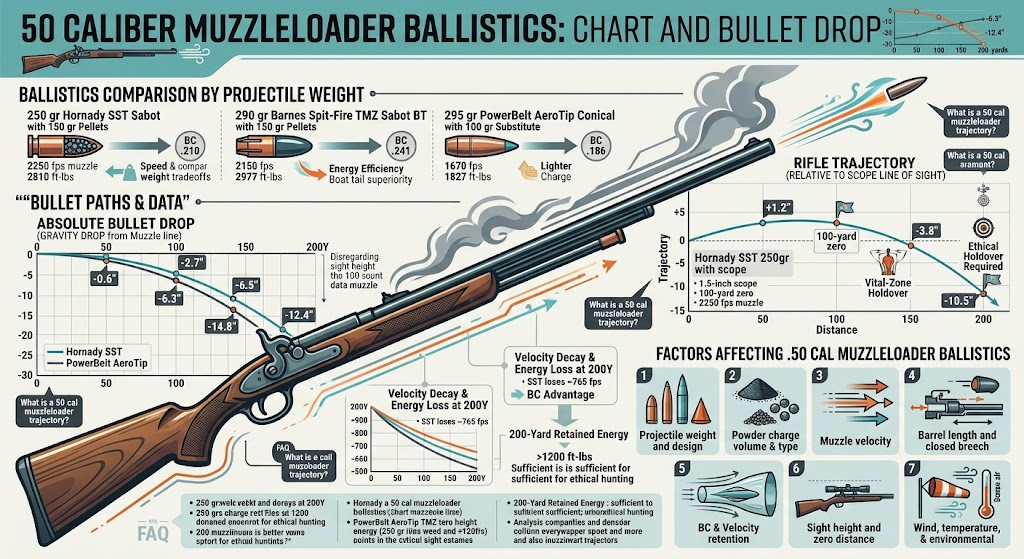
| 250 gr | Sabot | Hornady SST-ML | 150 gr Pellets | 2250 fps | 2038 fps | 1838 fps | 1485 fps | 2810 ft-lbs | 1874 ft-lbs | 1224 ft-lbs | -2.7 in | -12.4 in | .210 |
| 295 gr | Conical | PowerBelt AeroTip | 100 gr Substitute | 1670 fps | 1501 fps | 1350 fps | 1102 fps | 1827 ft-lbs | 1194 ft-lbs | 796 ft-lbs | -6.3 in | -28.2 in | .186 |
Analyzing the Ballistics Data
- Muzzle velocity range: The listed configurations range from a moderate 1,670 fps to a high of 2,250 fps.
- Projectile differences: Lighter sabot bullets achieve higher velocities, while heavier conicals travel slower but often offer deeper penetration.
- Velocity and energy loss: The 250-grain sabot loses approximately half its kinetic energy by 200 yards.
- Ballistic coefficient impact: Higher BC projectiles retain velocity better across distances.
- Bullet drop changes: Gravity causes the 250-grain bullet to drop 12.4 inches at 200 yards, compared to 28.2 inches for the slower 295-grain conical.
50 Caliber Muzzleloader Bullet Drop Chart
| Distance | Bullet Drop | Remaining Velocity | Remaining Energy | Projectile Weight | Sight-In Distance and Assumptions |
| 50 Yards | -0.6 in | 2038 fps | 2305 ft-lbs | 250 gr | Modeled drop from level bore |
| 100 Yards | -2.7 in | 1838 fps | 1874 ft-lbs | 250 gr | 2250 fps muzzle velocity |
| 150 Yards | -6.5 in | 1653 fps | 1517 ft-lbs | 250 gr | .210 BC |
| 200 Yards | -12.4 in | 1485 fps | 1224 ft-lbs | 250 gr | Standard atmospheric conditions |
Understanding Bullet Drop Measurements
- These figures show absolute gravity drop without factoring in a scoped sight-in angle.
- Gravity affects the 250-grain bullet minimally at 50 yards, dropping only 0.6 inches.
- At 100 yards, the total gravity drop is 2.7 inches.
- By 200 yards, the decelerating bullet drops a full 12.4 inches from the line of departure.
50 Caliber Muzzleloader Trajectory Chart
| Distance | Trajectory Relative to Line of Sight | Remaining Velocity | Remaining Energy | Projectile and Load | Sight-In Assumptions |
| 50 Yards | +1.2 in | 2038 fps | 2305 ft-lbs | Hornady SST 250 gr | 100-yard zero |
| 100 Yards | +0.0 in (Zero) | 1838 fps | 1874 ft-lbs | 150 gr Pellets | 1.5-inch scope height |
| 150 Yards | -3.8 in | 1653 fps | 1517 ft-lbs | Muzzle Velocity: 2250 fps | Level terrain |
| 200 Yards | -10.5 in | 1485 fps | 1224 ft-lbs | BC: .210 | Standard conditions |
Practical Trajectory Insights
- Trajectory accounts for scope height and upward barrel angle to hit a specific zero.
- With a 100-yard zero, the projectile peaks 1.2 inches high at 50 yards.
- At 150 yards, shooters need to aim slightly high to compensate for a 3.8-inch drop.
- A 200-yard shot requires a deliberate 10.5-inch holdover.
50 Caliber Muzzleloader Ballistics by Projectile Weight
| Projectile Weight | Projectile Type | Manufacturer | Published Muzzle Velocity | Muzzle Energy | Ballistic Coefficient | Test Conditions |
| 250 gr | Sabot | Hornady SST-ML | 2250 fps | 2810 ft-lbs | .210 | 150 gr Pellets |
| 290 gr | Sabot | Barnes Spit-Fire TMZ | 2150 fps | 2977 ft-lbs | .241 | 150 gr Pellets |
| 295 gr | Conical | PowerBelt AeroTip | 1670 fps | 1827 ft-lbs | .186 | 100 gr Substitute Powder |
Comparing Projectile Weights
- Lighter 250-grain bullets yield the highest velocities in identical powder configurations.
- The 290-grain Barnes sabot produces the highest muzzle energy due to its optimal balance of mass and velocity.
- Boat-tail designs like the Barnes provide a superior ballistic coefficient compared to flat-base or conical alternatives.
Factors That Affect 50 Caliber Muzzleloader Ballistics
Projectile weight and design Heavier projectiles fly slower but retain momentum well, while aerodynamic polymer tips reduce drag compared to flat-nosed designs.
Powder type and manufacturer-approved charge Using magnum 150-grain charges drastically increases velocity compared to 100-grain charges, provided the firearm is rated for them.
Muzzle velocity Higher muzzle velocities reduce the time the bullet spends in the air, creating a flatter trajectory.
Barrel length and firearm configuration Longer barrels allow more time for powder gases to expand, maximizing the speed of the exiting projectile.
Ballistic coefficient and velocity retention A higher ballistic coefficient allows a bullet to slip through the air efficiently and retain its speed downrange.
Sight height and zero distance The height of your optic and the distance at which you zero dictate the precise arc of your trajectory.
Wind, temperature, air density, and other environmental conditions Dense, cold air slows bullets faster, while crosswinds physically push the relatively slow muzzleloader projectiles off target.
Frequently Asked Questions
What is the muzzle velocity of a .50-caliber muzzleloader? A .50-caliber muzzleloader typically produces muzzle velocities between 1,500 and 2,250 fps depending on the powder charge and bullet weight.
What is a 50 caliber muzzleloader ballistics chart? It is a reference table showing velocity, energy, and trajectory metrics for a specific bullet and powder combination at various distances.
How much does a .50-caliber muzzleloader bullet drop at 100 yards? A 250-grain bullet fired at 2,250 fps drops about 2.7 inches in absolute terms, but strikes dead center if zeroed at 100 yards.
How much does a .50-caliber muzzleloader bullet drop at 200 yards? With a 100-yard zero, a 250-grain sabot fired at 2,250 fps will drop roughly 10.5 inches below the line of sight at 200 yards.
What is the trajectory of a .50-caliber muzzleloader? The trajectory is a curved arc. A common 150-grain load zeroed at 100 yards will hit about 1 inch high at 50 yards and 10 inches low at 200 yards.
How does projectile weight affect muzzleloader ballistics? Lighter bullets shoot faster and flatter at short ranges, while heavier bullets start slower but carry more momentum for deep penetration.
How much energy does a .50-caliber muzzleloader projectile retain at 100 yards? A 250-grain sabot starting at 2,250 fps retains approximately 1,874 ft-lbs of kinetic energy at 100 yards.
How does powder charge affect muzzleloader velocity? Increasing the powder charge increases muzzle velocity, which flattens the trajectory and increases downrange energy.
What factors affect muzzleloader bullet drop? Bullet drop is influenced by muzzle velocity, projectile weight, ballistic coefficient, and environmental conditions.
Does every .50-caliber muzzleloader have the same ballistic performance? No. Performance varies significantly based on barrel length, the specific projectile chosen, and the powder charge used.