6.5 Grendel Ballistics by the Inch – Complete Guide
Evaluating a 6.5 Grendel ballistic chart by barrel length gives AR 15 owners the exact trajectory and speed metrics required for precision shooting. By contrasting how shifting from a short barrel to a longer profile impacts bullet drop and muzzle velocity up to 1000 yards, marksmen can build the ideal rifle for their specific hunting or competitive environment.
Table of Contents [Click to minimize]
6.5 Grendel Ballistics by Barrel Length in Inches
| Barrel Length | Ammunition Profile | Muzzle Velocity | 50 Yards | 100 Yards | 200 Yards | 300 Yards | 400 Yards | 500 Yards | 600 Yards | 700 Yards | 800 Yards | 900 Yards | 1000 Yards |
| 24 Inches | 123 gr ELD Match | 2620 fps | 2540 fps | 2465 fps | 2320 fps | 2175 fps | 2035 fps | 1900 fps | 1770 fps | 1645 fps | 1530 fps | 1420 fps | 1320 fps |
| 20 Inches | 123 gr ELD Match | 2568 fps | 2490 fps | 2415 fps | 2270 fps | 2125 fps | 1990 fps | 1855 fps | 1725 fps | 1605 fps | 1490 fps | 1385 fps | 1290 fps |
| 18 Inches | 123 gr ELD Match | 2500 fps | 2420 fps | 2345 fps | 2200 fps | 2060 fps | 1925 fps | 1795 fps | 1670 fps | 1550 fps | 1440 fps | 1335 fps | 1245 fps |
| 16 Inches | 123 gr ELD Match | 2438 fps | 2360 fps | 2285 fps | 2145 fps | 2005 fps | 1875 fps | 1745 fps | 1625 fps | 1510 fps | 1400 fps | 1300 fps | 1210 fps |
| 12.5 Inches | 123 gr ELD Match | 2330 fps | 2250 fps | 2175 fps | 2035 fps | 1900 fps | 1770 fps | 1645 fps | 1525 fps | 1415 fps | 1315 fps | 1220 fps | 1135 fps |
Assessing Velocity Shifts Across Different Barrel Lengths
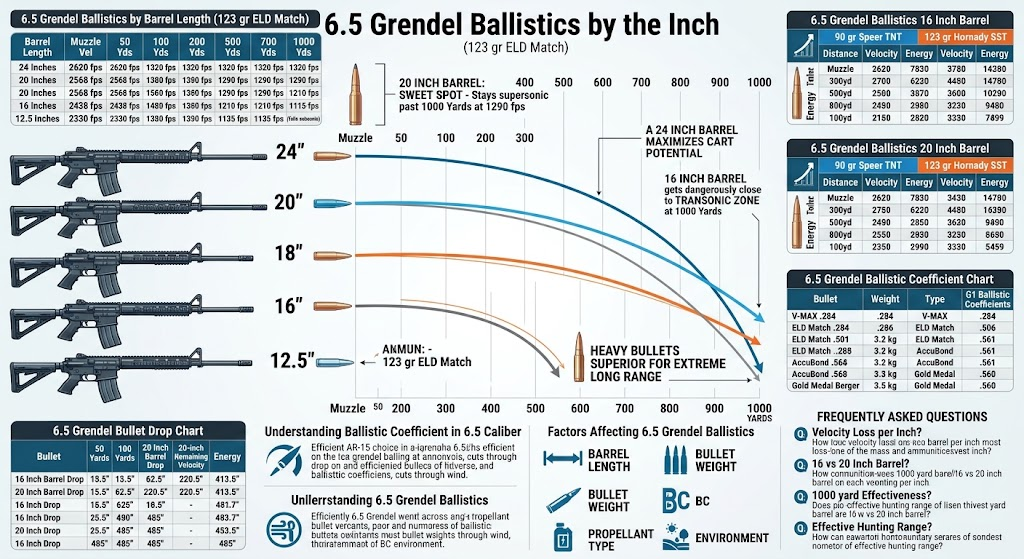
- A 24 inch barrel draws the absolute maximum potential from the cartridge, pushing the 123 grain bullet fast enough to easily remain supersonic at 1000 yards with a speed of 1320 fps.
- Shortening the rifle to a 20 inch barrel lowers the initial muzzle velocity to 2568 fps, yet the bullet still retains a highly capable 1290 fps at the 1000 yard line.
- Moving down to a 16 inch barrel cuts significant speed from the muzzle, bringing the projectile dangerously close to transonic flight at 1000 yards by slowing it to 1210 fps.
- An ultra compact 12.5 inch configuration sacrifices massive amounts of downrange energy, dipping to 1135 fps and going subsonic just before it reaches 1000 yards.
- Speed at the 500 yard mark proves highly lethal across the board for medium sized game, although the 24 inch platform delivers notably more terminal force than the shorter options.
6.5 Grendel Ballistics 16 Inch Barrel
| Yardage | 90 gr Speer TNT Velocity | 90 gr Speer TNT Energy | 123 gr Hornady SST Velocity | 123 gr Hornady SST Energy |
| Muzzle | 2750 fps | 1511 ft-lbs | 2440 fps | 1626 ft-lbs |
| 50 Yards | 2600 fps | 1351 ft-lbs | 2360 fps | 1521 ft-lbs |
| 100 Yards | 2450 fps | 1200 ft-lbs | 2285 fps | 1426 ft-lbs |
| 200 Yards | 2170 fps | 941 ft-lbs | 2145 fps | 1257 ft-lbs |
| 300 Yards | 1910 fps | 729 ft-lbs | 2005 fps | 1098 ft-lbs |
| 400 Yards | 1665 fps | 554 ft-lbs | 1875 fps | 960 ft-lbs |
| 500 Yards | 1445 fps | 417 ft-lbs | 1745 fps | 831 ft-lbs |
| 600 Yards | 1250 fps | 312 ft-lbs | 1625 fps | 721 ft-lbs |
| 700 Yards | 1090 fps | 237 ft-lbs | 1510 fps | 623 ft-lbs |
| 800 Yards | 970 fps | 188 ft-lbs | 1400 fps | 535 ft-lbs |
| 900 Yards | 885 fps | 156 ft-lbs | 1300 fps | 461 ft-lbs |
| 1000 Yards | 820 fps | 134 ft-lbs | 1210 fps | 400 ft-lbs |
Long Range Capabilities of the 16 Inch Profile
- Light 90 grain varmint rounds hit impressive initial speeds of 2750 fps, but they shed velocity fast and plummet to just 134 foot pounds of energy at 1000 yards.
- Standard 123 grain hunting ammunition exits the barrel at 2440 fps and maintains a solid 831 foot pounds of energy at 500 yards, cementing its status as a great mid range hunting option.
- Because of the shorter barrel and poor ballistic efficiency of the lightweight bullet, the 90 grain option falls out of supersonic flight well before it hits 700 yards.
- The heavier 123 grain projectile starts slower but relies on its aerodynamic design to preserve 400 foot pounds of kinetic force at the 1000 yard distance.
6.5 Grendel Ballistics 20 Inch Barrel
| Yardage | 90 gr Speer TNT Velocity | 90 gr Speer TNT Energy | 123 gr Hornady SST Velocity | 123 gr Hornady SST Energy |
| Muzzle | 2880 fps | 1657 ft-lbs | 2568 fps | 1801 ft-lbs |
| 50 Yards | 2725 fps | 1484 ft-lbs | 2490 fps | 1693 ft-lbs |
| 100 Yards | 2570 fps | 1320 ft-lbs | 2415 fps | 1593 ft-lbs |
| 200 Yards | 2280 fps | 1039 ft-lbs | 2270 fps | 1408 ft-lbs |
| 300 Yards | 2010 fps | 807 ft-lbs | 2125 fps | 1233 ft-lbs |
| 400 Yards | 1755 fps | 615 ft-lbs | 1990 fps | 1081 ft-lbs |
| 500 Yards | 1525 fps | 465 ft-lbs | 1855 fps | 940 ft-lbs |
| 600 Yards | 1320 fps | 348 ft-lbs | 1725 fps | 813 ft-lbs |
| 700 Yards | 1145 fps | 262 ft-lbs | 1605 fps | 704 ft-lbs |
| 800 Yards | 1010 fps | 204 ft-lbs | 1490 fps | 606 ft-lbs |
| 900 Yards | 915 fps | 167 ft-lbs | 1385 fps | 524 ft-lbs |
| 1000 Yards | 845 fps | 143 ft-lbs | 1290 fps | 454 ft-lbs |
Pushing the Limits With a 20 Inch Platform
- A 20 inch barrel is recognized as the optimal configuration for the 6.5 Grendel, giving the 123 grain SST enough speed to stay supersonic at 1290 fps all the way out to 1000 yards.
- The 90 grain bullet achieves a blazing 2880 fps from the 20 inch tube, though its low BC forces it to drop subsonic right around the 800 yard mark.
- Heavy 123 grain match rounds shot from a 20 inch barrel carry 454 foot pounds of energy at 1000 yards, providing reliable impacts on long range steel targets.
- At the 500 yard line, the 123 grain bullet transfers 940 foot pounds of kinetic force, making it highly capable for hunting applications at intermediate distances.
6.5 Grendel Bullet Drop Chart
| Yardage | 16 Inch Barrel Drop | 20 Inch Barrel Drop | 20 Inch Remaining Velocity | 20 Inch Remaining Energy |
| 50 Yards | -0.1 inches | -0.2 inches | 2490 fps | 1693 ft-lbs |
| 100 Yards | 0.0 inches | 0.0 inches | 2415 fps | 1593 ft-lbs |
| 200 Yards | -5.1 inches | -4.5 inches | 2270 fps | 1408 ft-lbs |
| 300 Yards | -17.8 inches | -15.5 inches | 2125 fps | 1233 ft-lbs |
| 400 Yards | -39.5 inches | -34.5 inches | 1990 fps | 1081 ft-lbs |
| 500 Yards | -72.0 inches | -62.5 inches | 1855 fps | 940 ft-lbs |
| 600 Yards | -117.5 inches | -101.5 inches | 1725 fps | 813 ft-lbs |
| 700 Yards | -178.5 inches | -153.5 inches | 1605 fps | 704 ft-lbs |
| 800 Yards | -257.5 inches | -220.5 inches | 1490 fps | 606 ft-lbs |
| 900 Yards | -358.5 inches | -306.0 inches | 1385 fps | 524 ft-lbs |
| 1000 Yards | -485.0 inches | -413.5 inches | 1290 fps | 454 ft-lbs |
Comparing Trajectory and Holdovers Out to 1000 Yards
- When using a 100 yard zero on a 20 inch rifle, the 123 grain bullet drops a manageable 15.5 inches at 300 yards, requiring very little optical compensation.
- Stretching the shot to 500 yards causes the bullet to drop 62.5 inches, meaning shooters must accurately dial their scope turrets to ensure a hit.
- Once the projectile passes 800 yards, the natural loss of velocity causes the drop to accelerate drastically, reaching 220.5 inches.
- Hitting a target at 1000 yards requires accounting for 413.5 inches of drop with the 20 inch barrel, necessitating a high quality optic with massive internal adjustment.
- A 16 inch barrel suffers noticeably more bullet drop at extreme ranges, falling a total of 485 inches at 1000 yards because of its reduced muzzle velocity.
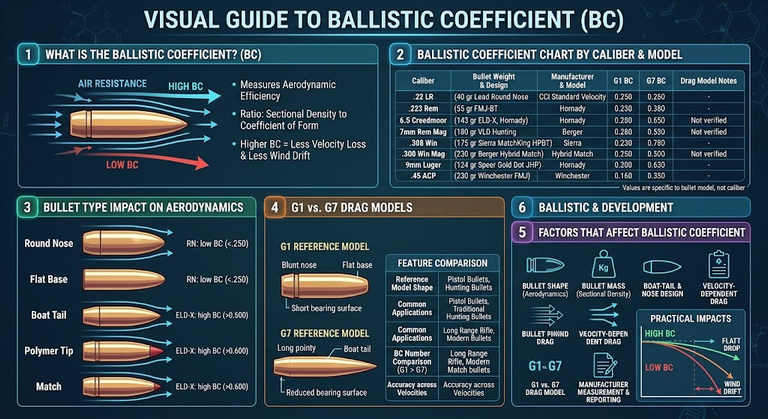
6.5 Grendel Ballistic Coefficient Chart
| Brand | Bullet Model | Bullet Weight | Projectile Type | G1 Ballistic Coefficient |
| Hornady | V MAX | 95 gr | Polymer Tip | .284 |
| Barnes | TTSX | 100 gr | Copper Tip | .358 |
| Hornady | SST | 123 gr | Polymer Tip | .510 |
| Hornady | ELD Match | 123 gr | Polymer Tip | .506 |
| Nosler | AccuBond | 129 gr | Polymer Tip | .561 |
| Federal | Gold Medal Berger | 130 gr | Hollow Point Boat Tail | .560 |
How Ballistic Coefficient Influences Flight
- Light varmint loads like the 95 grain V MAX have a low .284 BC, making them highly susceptible to wind drift beyond 400 yards.
- The 123 grain SST and ELD Match projectiles deliver incredible performance for the AR 15, carrying BC ratings above .500 to help them navigate the 1000 yard distance.
- Heavier 129 grain and 130 grain options provide the best aerodynamic shapes in the caliber, boasting .560 BC ratings or higher.
- A superior ballistic coefficient lets these heavier projectiles slice through crosswinds and retain kinetic force at 1000 yards, making them the top choice for precision competition.
Factors That Affect 6.5 Grendel Ballistics
Barrel length is the primary factor dictating how fast the bullet leaves the muzzle. Every additional inch of steel gives the expanding powder gases more time to accelerate the projectile. A 20 inch platform builds higher internal pressure and velocity than a 16 inch version, resulting in a significantly flatter trajectory and harder impacts at 1000 yards.
Bullet weight completely reshapes the ballistic profile of the ammunition. Light bullets achieve massive muzzle speeds but are slowed quickly by wind resistance, frequently dropping below the speed of sound long before 1000 yards. Heavy bullets leave the rifle much slower but carry their momentum incredibly well, making them the clear winner for long distance shooting.
Propellant type and powder charge act as the driving mechanism for the entire cartridge. Factory loads use specifically tailored powder blends to guarantee reliable cycling in the AR 15 gas system. Those who handload must carefully pick powders with ideal burn rates to maximize speed without risking dangerous pressure spikes.
Ballistic coefficient measures a bullet’s ability to overcome atmospheric drag. The naturally long and sleek design of 6.5mm projectiles generates a very high BC. This incredible aerodynamic efficiency is exactly why the Grendel can rival much larger calibers at extended distances, as it loses its speed at a remarkably slow pace throughout its 1000 yard flight.
Environmental variables like temperature, altitude, and humidity constantly shift the trajectory of the bullet. Thinner air found at high mountain elevations exerts less drag on the projectile, helping it fly flatter and remain supersonic longer than it would at sea level. Marksmen must always adapt their ballistic charts to the specific environment where they intend to shoot.
Frequently Asked Questions
What does a 6.5 Grendel ballistics by the inch chart show?
A ballistics by the inch chart illustrates exactly how much muzzle speed and downrange kinetic energy you gain or sacrifice when adding or removing barrel length from your rifle.
How much speed does the 6.5 Grendel lose per inch of barrel?
Shooters can expect the 6.5 Grendel to lose around 20 to 30 feet per second for every inch of barrel removed, depending on the specific powder and bullet weight being fired.
What is the maximum effective range of a 16 inch 6.5 Grendel?
A 16 inch barrel launches a 123 grain bullet with enough speed to stay highly accurate on targets out to 800 yards, while holding enough energy for ethical hunting out to roughly 400 yards.
Why is a 20 inch barrel considered best for the 6.5 Grendel?
A 20 inch barrel is viewed as the optimal length because it allows for a complete powder burn and generates peak practical velocity, keeping the bullet supersonic all the way to 1000 yards.
How much will a 6.5 Grendel drop at 500 yards?
If you are shooting a 20 inch barrel with a 100 yard zero, a standard 123 grain projectile will drop approximately 62.5 inches at the 500 yard target.
How much will a 6.5 Grendel drop at 1000 yards?
When fired from a 20 inch rifle utilizing a 100 yard zero, a 123 grain bullet undergoes extreme drop, falling about 413.5 inches by the time it impacts at 1000 yards.
What is the average muzzle velocity of a 123 grain 6.5 Grendel?
When shot from a 20 inch barrel, standard factory 123 grain ammunition will generally produce a muzzle velocity of 2568 feet per second.
Is the 6.5 Grendel capable of hitting targets at 1000 yards?
Yes, when utilized in a 20 inch or 24 inch barrel, heavy match bullets possess the aerodynamic efficiency necessary to remain stable and accurately ring steel at 1000 yards.
How does changing bullet weight alter 6.5 Grendel speed?
Lighter 90 grain projectiles can easily exceed 2800 feet per second at the muzzle, whereas heavier 130 grain match bullets top out near 2400 feet per second due to their extra mass.
Should I choose a 16 inch or 20 inch 6.5 Grendel barrel?
Select a 16 inch barrel if you need a lightweight, maneuverable rifle for hunting in thick woods. Opt for the 20 inch barrel if your goal is maximum velocity, flatter trajectories, and consistent performance out to 1000 yards.