450 Bushmaster Ballistics: Bullet Drop and Trajectory Chart
Studying a 450 Bushmaster ballistic chart is crucial for hunters utilizing this hard hitting straight wall cartridge. By examining speed retention, downrange energy, and trajectory arcs, marksmen can perfectly calibrate their AR 15 or bolt action rifles to secure clean harvests on large game.
Table of Contents [Click to minimize]
450 Bushmaster Ballistic Chart
| Ammunition Type | Bullet Mass | Muzzle Speed | 50 Yards | 100 Yards | 200 Yards | 300 Yards | 400 Yards | 500 Yards | Muzzle Energy | 100 Yds Energy | 300 Yds Energy |
| Hornady Custom FTX | 250 gr | 2200 fps | 2013 fps | 1836 fps | 1515 fps | 1251 fps | 1069 fps | 955 fps | 2686 ft-lbs | 1871 ft-lbs | 869 ft-lbs |
| Remington AccuTip | 260 gr | 2180 fps | 1995 fps | 1820 fps | 1505 fps | 1245 fps | 1060 fps | 950 fps | 2743 ft-lbs | 1912 ft-lbs | 895 ft-lbs |
| Winchester Deer Season XP | 250 gr | 2200 fps | 2010 fps | 1830 fps | 1510 fps | 1248 fps | 1065 fps | 952 fps | 2686 ft-lbs | 1859 ft-lbs | 864 ft-lbs |
| Hornady Subsonic Sub-X | 395 gr | 1050 fps | 1010 fps | 975 fps | 915 fps | 865 fps | 825 fps | 790 fps | 967 ft-lbs | 834 ft-lbs | 656 ft-lbs |
Interpreting Velocity and Energy Metrics
- Typical 250 grain hunting rounds leave the barrel at an impressive 2200 fps while packing more than 2600 foot pounds of initial force.
- Because of the wide bullet profile, speed sheds rapidly. The popular 250 grain FTX loses almost 1000 fps by the time it crosses the 300 yard mark.
- Impact energy at 100 yards remains devastating, with most factory loads carrying well over 1800 foot pounds of kinetic power.
- Trying to push the cartridge out to 400 or 500 yards exposes its aerodynamic limits, as speeds drop below the sound barrier and energy falls too low for ethical hunting.
- The massive 395 grain subsonic option operates entirely differently, starting at just 1050 fps to provide a quiet, suppressed hunting experience at close range.
450 Bushmaster Ballistics by Bullet Weight
| Manufacturer | Projectile Model | Bullet Weight | Muzzle Velocity | Initial Energy | Ballistic Coefficient | Best Application |
| Federal Premium | Non-Typical Soft Point | 245 gr | 2200 fps | 2633 ft-lbs | .205 | Whitetail Hunting |
| Hornady | Custom FTX | 250 gr | 2200 fps | 2686 ft-lbs | .210 | Deer and Hogs |
| Remington | Premier AccuTip | 260 gr | 2180 fps | 2743 ft-lbs | .195 | Heavy Medium Game |
| Hornady | Black InterLock | 245 gr | 2200 fps | 2633 ft-lbs | .175 | General Hunting |
| Hornady | Subsonic Sub-X | 395 gr | 1050 fps | 967 ft-lbs | .300 | Suppressed Use |
How Bullet Mass Alters Downrange Power
- Bullets in the 245 grain to 250 grain range represent the industry standard, providing an optimal mix of velocity and manageable recoil for lightweight rifles.
- Stepping up to a 260 grain projectile yields a minor speed reduction to 2180 fps but actually increases muzzle energy past 2740 foot pounds.
- Transitioning to the 395 grain Sub-X radically shifts the performance envelope, keeping the bullet subsonic for specialized stealth applications.
- Because most traditional hunting rounds in this caliber share identical velocity ratings, shooters should select ammunition based on the bullet’s expansion characteristics rather than raw speed.
450 Bushmaster Bullet Drop Chart
| Yardage | 250 gr Hornady FTX Drop | 260 gr Remington AccuTip Drop | 395 gr Hornady Subsonic Drop | Sight-In Distance |
| 50 Yards | +0.5 inches | +0.6 inches | +2.5 inches | 100 Yards |
| 100 Yards | 0.0 inches | 0.0 inches | 0.0 inches | 100 Yards |
| 150 Yards | -2.8 inches | -3.0 inches | -8.5 inches | 100 Yards |
| 200 Yards | -8.4 inches | -8.8 inches | -23.5 inches | 100 Yards |
| 250 Yards | -17.5 inches | -18.2 inches | -45.0 inches | 100 Yards |
| 300 Yards | -30.6 inches | -31.8 inches | -74.5 inches | 100 Yards |
| 400 Yards | -72.5 inches | -75.0 inches | -158.0 inches | 100 Yards |
| 500 Yards | -138.0 inches | -142.5 inches | -275.5 inches | 100 Yards |
Evaluating the Flight Path
- Utilizing a standard 100 yard zero causes a 250 grain bullet to strike roughly 8.4 inches low at the 200 yard line, requiring only a modest optical holdover.
- Stretching the shot out to 300 yards forces the projectile to fall over 30 inches, demanding careful scope adjustments or a specialized ballistic reticle.
- Once the straight wall bullet reaches 400 and 500 yards, it plummets aggressively, showing drops of 72.5 inches and 138.0 inches respectively.
- The 395 grain subsonic load drops off a cliff immediately past 100 yards, falling 23.5 inches by the time it reaches 200 yards due to its extremely low starting speed.
450 Bushmaster Trajectory Chart
| Yardage | 150 Yard Zero Flight Path | 200 Yard Zero Flight Path | Retained Speed (250gr) | Retained Energy (250gr) |
| 50 Yards | +1.4 inches | +2.8 inches | 2013 fps | 2249 ft-lbs |
| 100 Yards | +1.8 inches | +4.6 inches | 1836 fps | 1871 ft-lbs |
| 150 Yards | 0.0 inches | +4.1 inches | 1670 fps | 1548 ft-lbs |
| 200 Yards | -4.7 inches | 0.0 inches | 1515 fps | 1274 ft-lbs |
| 250 Yards | -12.8 inches | -6.5 inches | 1375 fps | 1049 ft-lbs |
| 300 Yards | -25.0 inches | -17.5 inches | 1251 fps | 869 ft-lbs |
Modifying the Trajectory Curve
- Setting a 150 yard zero forces the bullet to hit a maximum of 1.8 inches high at 100 yards, keeping the flight path incredibly tight to the crosshairs.
- A 200 yard zero raises the mid flight arc to 4.6 inches high at 100 yards, meaning hunters must remember to aim lower on targets that appear at close range.
- Opting for the longer 200 yard zero reduces the 300 yard bullet drop to just 17.5 inches, offering an advantage for shooters hunting over open fields.
- The 150 yard zero remains the most popular choice for timber hunting, as it allows for a point and shoot approach on deer sized vitals anywhere inside 175 yards.
450 Bushmaster Ballistic Coefficient Chart
| Bullet Maker | Projectile Model | Weight | Bullet Style | G1 Ballistic Coefficient |
| Hornady | InterLock | 245 gr | Soft Point | .175 |
| Remington | AccuTip | 260 gr | Polymer Tipped | .195 |
| Federal | Non-Typical | 245 gr | Soft Point | .205 |
| Hornady | FTX | 250 gr | Polymer Tipped | .210 |
| Barnes | TSX | 275 gr | Copper Solid | .213 |
| Hornady | Sub-X | 395 gr | Polymer Tip Hollow Point | .300 |
The Role of Aerodynamics
- Basic soft point ammunition like the 245 grain InterLock carries a remarkably low .175 BC, resulting in rapid speed loss through the air.
- Upgrading to a polymer tipped round such as the 250 grain FTX boosts the BC to .210, providing slightly better wind resistance and energy retention.
- Monolithic copper solids like the Barnes TSX retain weight perfectly upon impact but max out at a .213 BC because of the wide caliber constraints.
- The massive 395 grain Sub-X secures the highest BC in the category at .300, achieved entirely through its extreme length and heavy mass rather than a sleek profile.
- Straight wall regulations require blunt, wide projectiles, permanently preventing this caliber from reaching the aerodynamic efficiency of bottleneck rifle cartridges.
Factors That Affect 450 Bushmaster Ballistics
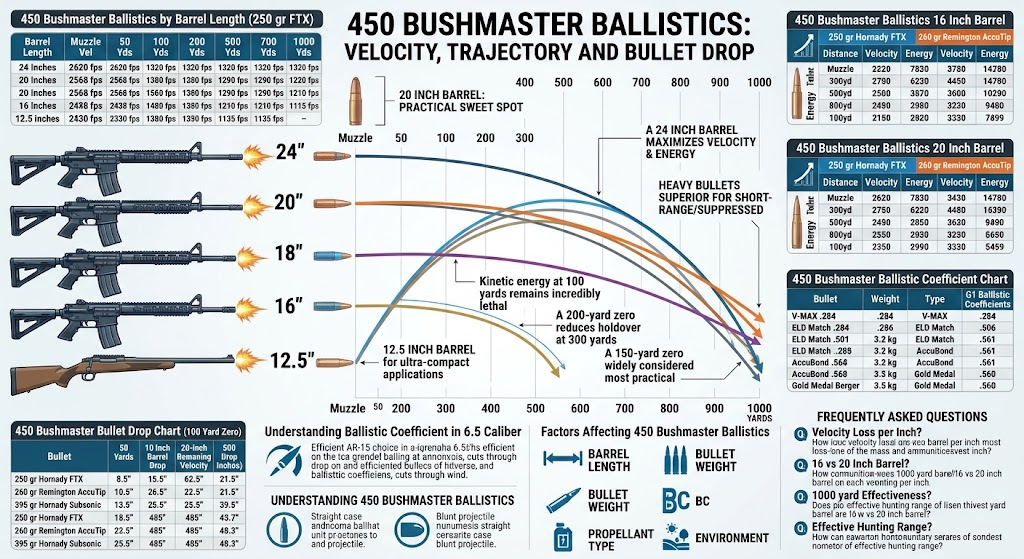
Barrel length directly impacts the muzzle velocity of the rifle. The heavy charges of pistol powder used in these cartridges perform best when given enough space to completely burn. A 20 inch bolt action barrel will consistently extract slightly higher speeds and flatter flight paths compared to a compact 16 inch AR 15 upper receiver.
Bullet weight completely changes how the cartridge performs at a distance. The standard 250 grain bullets are engineered to shoot as flat as physically possible for this specific caliber. Switching to a heavy 300 grain or 395 grain projectile introduces a severe rainbow trajectory, requiring precise rangefinding to guarantee an accurate hit.
Propellant choices dictate the internal pressure curve of the straight wall case. Factory loads feature carefully blended powders designed to maximize speed without stressing the firearm. Handloaders must strictly adhere to published load data, as straight wall cartridges can experience dangerous pressure spikes very quickly if loaded improperly.
Ballistic coefficient serves as the primary limiting factor for downrange performance. The blunt nose and wide .452 inch diameter essentially turn the bullet into a flying parachute. This unavoidable lack of aerodynamic efficiency is the exact reason the cartridge bleeds off speed and energy so rapidly once it passes the 200 yard line.
Environmental conditions heavily alter the flight path of low BC projectiles. A stiff crosswind will blow a 250 grain FTX significantly off course at 200 yards, far more than it would affect a sleek modern rifle bullet. Marksmen must pay close attention to wind drift values when setting up shots across open clearcuts or agricultural fields.
Frequently Asked Questions
What does a 450 Bushmaster ballistic chart display?
A ballistic chart details the specific flight characteristics of the cartridge, illustrating how fast the bullet travels, how much force it carries, and how far it drops at various distances.
What is the maximum effective range of a 450 Bushmaster?
For ethical hunting on large game, the cartridge is highly effective out to 200 or 250 yards. Beyond that distance, energy levels and trajectories deteriorate rapidly.
How much bullet drop does a 450 Bushmaster have at 200 yards?
If your rifle is zeroed at 100 yards, a standard 250 grain projectile will drop approximately 8.4 inches when it reaches the 200 yard target.
How much will a 450 Bushmaster drop at 300 yards?
Using a 100 yard zero, a 250 grain bullet will experience significant drop, falling roughly 30.6 inches at the 300 yard mark.
What is the standard muzzle velocity of the 450 Bushmaster?
Most factory loaded 250 grain hunting ammunition achieves a standard muzzle velocity of 2200 feet per second.
How much kinetic energy does a 450 Bushmaster deliver at 100 yards?
A quality 250 grain polymer tipped round retains massive stopping power, delivering over 1870 foot pounds of energy at 100 yards.
Is the 450 Bushmaster effective at 500 yards?
No. While the bullet can technically reach 500 yards, it drops over 130 inches and lacks the terminal energy required for ethical hunting at that extreme distance.
Why are ballistic coefficients so low for the 450 Bushmaster?
The caliber requires a wide .452 inch diameter bullet with a blunt nose profile, which creates immense air resistance compared to the needle like shapes of standard rifle calibers.
What is the best zero distance for a 450 Bushmaster rifle?
A 150 yard zero is widely considered ideal because it keeps the bullet’s flight path within two inches of the crosshairs out to 175 yards, allowing hunters to point and shoot without calculating holdovers.
Does barrel length change 450 Bushmaster velocity?
Yes, a longer 20 inch barrel will generate slightly more muzzle velocity than a 16 inch barrel because it provides the powder charge more time to fully ignite and accelerate the bullet.