BAE Systems Ballistics: Bullet Drop and Trajectory Chart
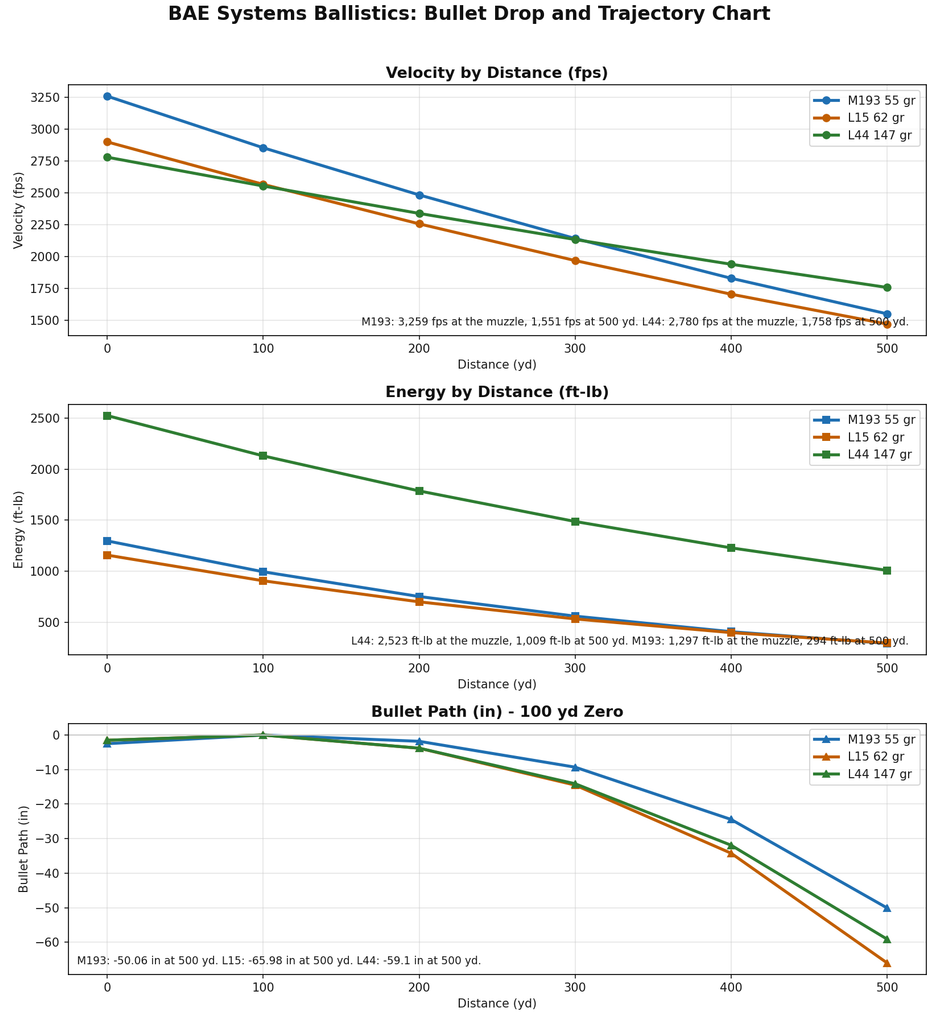
From 5.56mm rifle ammunition to 155mm artillery shells, BAE Systems covers the full spread of British military calibres, yet the company prints no ballistics chart for any of them. This article charts the three small arms ball loads with full published trajectory data, the 5.56mm M193 and L15 and the 7.62mm L44, zeroed at 100 yards and traced to 500 yards.
At the muzzle the 5.56mm M193 is quickest at 3,259 fps, while the 7.62mm L44 carries the most energy at 2,523 ft-lb. The M193 also falls least at 500 yards, 50.06 inches low. Heavy munitions follow in a second table, with tank, artillery, mortar and 40mm rounds, and the sniper, tracer and blank loads are listed after that.
Table of Contents [Click to minimize]
BAE Systems Ballistics: Bullet Drop and Trajectory Chart: 5.56mm and 7.62mm Ball to 500 Yards
Each load in this chart is zeroed at 100 yards, with sight heights of 2.5 inches for the M193 and 1.5 inches for the L15 and L44. The table gives velocity, energy and bullet path at the muzzle and every 100 yards to 500.
| Load | Bullet Weight (gr) | BC (G1) | Sight Height (in) | Velocity Muzzle (fps) | Velocity 100 yd (fps) | Velocity 200 yd (fps) | Velocity 300 yd (fps) | Velocity 400 yd (fps) | Velocity 500 yd (fps) | Energy Muzzle (ft-lb) | Energy 100 yd (ft-lb) | Energy 200 yd (ft-lb) | Energy 300 yd (ft-lb) | Energy 400 yd (ft-lb) | Energy 500 yd (ft-lb) | Bullet Path Muzzle (in) | Bullet Path 100 yd (in) | Bullet Path 200 yd (in) | Bullet Path 300 yd (in) | Bullet Path 400 yd (in) | Bullet Path 500 yd (in) |
|---|---|---|---|---|---|---|---|---|---|---|---|---|---|---|---|---|---|---|---|---|---|
| 5.56mm Ball M193 | 55 | 0.243 | 2.5 | 3259 | 2854 | 2484 | 2142 | 1830 | 1551 | 1297 | 995 | 753 | 561 | 409 | 294 | -2.50 | 0.00 | -1.81 | -9.30 | -24.44 | -50.06 |
| 5.56mm Ball L15 (SS109) | 62 | 0.274 | 1.5 | 2900 | 2567 | 2257 | 1969 | 1705 | 1471 | 1158 | 907 | 701 | 534 | 400 | 298 | -1.50 | 0.01 | -3.81 | -14.49 | -34.22 | -65.98 |
| 7.62mm Ball L44 (M80) | 147 | 0.398 | 1.5 | 2780 | 2554 | 2339 | 2134 | 1940 | 1758 | 2523 | 2129 | 1786 | 1487 | 1229 | 1009 | -1.5 | 0.0 | -3.8 | -14.1 | -31.9 | -59.1 |
BAE Systems Heavy Munitions: 120mm, 155mm, 105mm, 81mm and 40mm
The heavy end of the range covers tank, artillery, mortar and 40mm cannon ammunition. Weights, muzzle velocities and ranges below are given in metric units, as published for these natures.
| Round | Caliber | Projectile Weight | Muzzle Velocity | Maximum / Effective Range |
|---|---|---|---|---|
| 155mm L15 HE | 155 mm | 43.7 kg | 800-810 m/s | 24,700 m |
| 105mm L31 HE | 105 mm | 16.1 kg | 708 m/s | 17,200 m |
| 120mm APFSDS L23 | 120 mm | 8 kg | 1,534 m/s | 3,500 m |
| 120mm APDS L15 | 120 mm | 10.36 kg | 1,370 m/s | Not published |
| 120mm HESH L31 | 120 mm | 17.1 kg | 670 m/s | 8,500 m |
| 81mm L41 HE Bomb | 81 mm | 4.2 kg | 225 m/s | 5,650 m |
| 40mm APFSDS-T | 40 mm | 550 g | >1,500 m/s | >2,500 m |
| 40mm GPR-PD-T | 40 mm | 980 g | 1,000 m/s | 2,500 m |
| 40mm KE-AB P33 | 40 mm | 1,400 g | 900 m/s | 3,000 m |
More BAE Systems Small Arms Loads: Sniper, Tracer and Blank Rounds
The remaining small arms natures have no published downrange data. Only the L42 sniper round carries published muzzle figures, and the tracer, blank and enhanced performance rounds are listed by role.
| Load | Caliber | Notes |
|---|---|---|
| L42 Sniper | 7.62 mm | 155 gr FMJ sniper round, 2,750 fps from the L42A1 rifle; no published downrange table |
| L59 High Performance Ball | 7.62 mm | Premier 7.62mm ball round; no published figures |
| L31 Enhanced Performance Ball | 5.56 mm | Lead-free enhanced penetration round; no published figures |
| L16 Tracer | 5.56 mm | Tracer for assault rifles and belt-fed weapons; no published figures |
| L45 Tracer | 7.62 mm | Tracer matched to the L44 Ball and L59; no published figures |
| L18 Blank | 5.56 mm | Blank training round with extended case; no published figures |
| L43 Blank | 7.62 mm | Berdan primed blank training round; no published figures |
Reading the BAE Systems Ballistics Chart
M193 Against L15 in 5.56mm
Two 5.56mm ball rounds sit side by side in the chart, and they behave differently. The 55 grain M193 starts at 3,259 fps and is the flattest load at 500 yards, 50.06 inches low. The 62 grain L15 starts slower at 2,900 fps and drops 65.98 inches at 500 yards, yet it arrives with 298 ft-lb, a little more energy than the M193 with 294 ft-lb.
L44 Ball in 7.62mm
The 7.62mm L44 Ball is the heavyweight of the small arms chart. Its 147 grain bullet leaves at 2,780 fps with 2,523 ft-lb, the highest muzzle energy of the three loads. It still carries 1,487 ft-lb at 300 yards and 1,009 ft-lb at 500 yards, where it is 59.1 inches low on a 100 yard zero.
L42 Sniper Ammunition
BAE Systems sniper round is the L42, a 7.62mm load with a 155 grain full metal jacket bullet and a solid lead alloy core. Fired from the L42A1 rifle it reaches 2,750 fps. It is built to strict UK specifications for long range accuracy, but no downrange velocity, energy or drop table is published for it, so only its muzzle figures appear here.
120mm Tank Ammunition
BAE Systems 120mm tank rounds serve the Challenger fleet. The APFSDS L23 armour piercing round is the quickest in the whole range at 1,534 metres per second and is effective to 3,500 metres. The APDS L15 reaches 1,370 metres per second and is credited with 355 mm of penetration at 1,000 metres. The HESH L31 general purpose round travels at 670 metres per second to 8,500 metres, and the DS/T Prac L20A1 training round runs at 1,451 metres per second.
Artillery, Mortar and 40mm
The 155mm L15 high explosive shell flies furthest, to 24,700 metres at 800 to 810 metres per second. Behind it sit the 105mm L31 shell at 17,200 metres and the 81mm L41 mortar bomb at 5,650 metres. The 40mm cased telescoped APFSDS-T round is the fastest of the smaller natures, passing 1,500 metres per second with a 550 gram projectile.
Zero and Sight Height
The main chart is built on a 100 yard zero for all three loads. Sight height is the one difference: the M193 uses 2.5 inches and the L15 and L44 use 1.5 inches. That is why the M193 path reads 2.50 inches low at the muzzle while the other two read 1.50 inches low, and all three read zero at 100 yards.
BAE Systems Ballistics: Frequently Asked Questions
Is there an official BAE Systems ballistics chart?
No official chart exists. BAE Systems prints no muzzle velocity, energy or drop figures for its ammunition, so this article charts each round from its published figures.
Which calibres of small arms ammunition does BAE Systems produce?
The company produces 5.56mm and 7.62mm NATO rounds at Radway Green, in ball, tracer and blank types, along with a sniper round and an enhanced performance ball load. Daily output can pass one million rounds.
Which BAE small arms load is quickest?
The 5.56mm M193 Ball leads at 3,259 fps at the muzzle. The L15 Ball runs at 2,900 fps and the 7.62mm L44 Ball at 2,780 fps.
Which BAE small arms load hits hardest?
The 7.62mm L44 Ball, with 2,523 ft-lb of muzzle energy. It keeps 1,009 ft-lb at 500 yards.
How much does the M193 fall at 500 yards?
It falls 50.06 inches with a 100 yard zero, less than either of the other two loads. It is still doing 1,551 fps and 294 ft-lb at 500 yards.
How much does the L44 Ball fall at 500 yards?
It falls 59.1 inches with a 100 yard zero, while travelling at 1,758 fps and carrying 1,009 ft-lb.
What round is the L42?
The L42 is the 7.62mm sniper round, firing a 155 grain full metal jacket bullet at 2,750 fps from the L42A1 rifle. No published downrange figures exist for it.
Which 120mm tank rounds are in the range?
The armour piercing APFSDS L23 at 1,534 metres per second, the APDS L15 at 1,370 metres per second, and the general purpose HESH L31 at 670 metres per second, with training and smoke rounds alongside.
How far can BAE artillery shells reach?
The 155mm L15 high explosive shell reaches 24,700 metres. The 105mm L31 shell reaches 17,200 metres, and the 81mm mortar bomb reaches 5,650 metres.
What is 40mm cased telescoped ammunition?
It is the telescoped 40mm ammunition for the CTAS cannon, a BAE Systems and Nexter joint venture, with British rounds assembled at ROF Glascoed. Its APFSDS-T round exceeds 1,500 metres per second.