
22lr Ballistics Chart and Calculator – 50 Yards Zero
QUICK ACCESS PANEL
The .22 Long Rifle (LR) is the most popular rimfire cartridge in the world, typically firing a 36 to 40-grain bullet. The short answer to .22 LR ballistics is this: A standard high-velocity 40-grain bullet leaves the muzzle at approximately 1,235 feet per second (fps) with 135 foot-pounds (ft-lbs) of energy. When zeroed at 50 yards, it will drop roughly 5.5 inches at 100 yards, maintaining an effective hunting range of 75 to 100 yards before bullet drop and wind drift become too severe to manage.
Ballistics Chart of 27 Cartridges
Below is reference Chart for 22lr Ballistics
| Load Identity | Bullet Weight (Grains) | Ballistic Coefficient | Muzzle Velocity (fps) | 100 Yds. Velocity (fps) | 200 Yds. Velocity (fps) | Muzzle Energy (ft. lbs.) | 100 Yds. Energy (ft. lbs.) | 200 Yds. Energy (ft. lbs.) | Zero (50 Yds.) | Bullet Drop (75 Yds.) | Bullet Drop (100 Yds.) | Bullet Drop (150 Yds.) | Bullet Drop (200 Yds.) |
| .22LR/(C)/ Mini Mag | 36 | .126 | 1,260 | 1,003 | 874 | 127 | 80 | 61 | 0 | -1.8″ | -5.6″ | -19.9″ | -44.1″ |
| .22LR/(C)/Stinger | 32 | .084 | 1,640 | 1,065 | 857 | 191 | 81 | 52 | 0 | -1.1″ | -3.8″ | -15.2″ | -36.4″ |
| .22LR/(C)/Velocitor | 40 | .126 | 1,435 | 1,084 | 921 | 183 | 104 | 75 | 0 | -1.3″ | -4.3″ | -15.9″ | -36.4″ |
| .22LR/(R)/C-Bee | 33 | .084 | 740 | 637 | 550 | 40 | 30 | 22 | 0 | -6.0″ | -17.0″ | -55.4″ | -118.6″ |
| .22LR/(R)/Cyclone | 36 | .125 | 1,280 | 1,010 | 878 | 131 | 82 | 62 | 0 | -1.8″ | -5.5″ | -19.4″ | -43.4″ |
| .22LR/(R)/ Game Load | 36 | .125 | 1,280 | 1,010 | 878 | 131 | 82 | 62 | 0 | -1.8″ | -5.5″ | -19.4″ | -43.4″ |
| .22LR/(R)/Golden Bullet | 40 | .139 | 1,255 | 1,016 | 892 | 140 | 92 | 71 | 0 | -1.8″ | -5.5″ | -19.5″ | -43.1″ |
| .22LR/(R)/Golden Bullet | 36 | .125 | 1,280 | 1,010 | 878 | 131 | 82 | 62 | 0 | -1.8″ | -5.5″ | -19.4″ | -43.4″ |
| .22LR/(R)/Golden Bullet | 29 | .106 | 1,095 | 903 | 789 | 77 | 53 | 40 | 0 | -2.5″ | -7.5″ | -25.7″ | -56.1″ |
| .22LR/(R)/Sub Sonic | 38 | .125 | 1,050 | 901 | 803 | 93 | 68 | 54 | 0 | -2.7″ | -7.8″ | -26.4″ | -57.0″ |
| .22LR/(R)/Target | 40 | .149 | 1,150 | 975 | 872 | 117 | 84 | 67 | 0 | -2.1″ | -6.4″ | -22.0″ | -47.8″ |
| .22LR/(R)/Thunderbolt | 40 | .139 | 1,255 | 1,016 | 892 | 140 | 92 | 71 | 0 | -1.8″ | -5.5″ | -19.5″ | -43.1″ |
| .22LR/(R)/Viper | 36 | .117 | 1,410 | 1,055 | 896 | 159 | 89 | 64 | 0 | -1.4″ | -4.6″ | -16.9″ | -38.6″ |
| .22LR/(R)/Yellow Jacket | 33 | .107 | 1,500 | 1,075 | 895 | 165 | 85 | 59 | 0 | -1.2″ | -4.1″ | -15.7″ | -36.6″ |
| .22LR/(W)/X22LR SUBA | 40 | .138 | 1,065 | 920 | 826 | 101 | 75 | 61 | 0 | -2.5″ | -7.5″ | -25.3″ | -54.5″ |
| .22LR/(W)/XT22LR | 40 | .148 | 1,150 | 974 | 870 | 117 | 84 | 67 | 0 | -2.1″ | -6.4″ | -22.0″ | -47.9″ |
| .22LR/(W)/WD22LRB | 40 | .148 | 1,150 | 974 | 870 | 117 | 84 | 67 | 0 | -2.1″ | -6.4″ | -22.0″ | -47.9″ |
| .22LR/(W)/WW22LR | 40 | .138 | 1,255 | 1,015 | 891 | 140 | 91 | 71 | 0 | -1.8″ | -5.5″ | -19.5″ | -43.1″ |
| .22LR/(W)/X22LRPP | 40 | .117 | 1,280 | 998 | 863 | 146 | 89 | 66 | 0 | -1.8″ | -5.6″ | -19.9″ | -44.4″ |
| .22LR/(W)/XT22LRS1 | 40 | .138 | 1,300 | 1,036 | 904 | 150 | 95 | 73 | 0 | -1.6″ | -5.1″ | -18.4″ | -41.0″ |
| .22LR/(W)/X22LRH | 37 | .128 | 1,280 | 1,014 | 883 | 135 | 84 | 64 | 0 | -1.7″ | -5.4″ | -19.3″ | -43.0″ |
| .22LR/(W)/22LR222HP | 36 | .084 | 1,280 | 937 | 787 | 131 | 70 | 49 | 0 | -2.0″ | -6.2″ | -22.3″ | -50.4″ |
| .22LR/(W)/XPERT22 | 36 | .084 | 1,280 | 937 | 787 | 131 | 70 | 49 | 0 | -2.0″ | -6.2″ | -22.3″ | -50.4″ |
| .22LR/(W)/22LR333HP | 36 | .084 | 1,280 | 937 | 787 | 131 | 70 | 49 | 0 | -2.0″ | -6.2″ | -22.3″ | -50.4″ |
| .22LR/(W)/S22LRUHV | 32 | .076 | 1,640 | 1,033 | 827 | 191 | 76 | 49 | 0 | -1.2″ | -4.0″ | -16.1″ | -38.7″ |
| .22LR/(W)/X22LRCBMA | 29 | .104 | 770 | 682 | 605 | 38 | 30 | 24 | 0 | -5.3″ | -15.1″ | -48.9″ | -103.9″ |
| .22LR/(W)/X22LRHLF | 26 | .072 | 1,650 | 1,019 | 812 | 157 | 60 | 38 | 0 | -1.2″ | -4.1″ | -16.5″ | -39.7″ |
.22 LR Ballistics Chart (Standard vs High Velocity 40 gr)
| Ammo | Range | Velocity | Energy | Drop |
|---|---|---|---|---|
| Standard Velocity 40 gr | Muzzle | 1,070 fps | 102 ft-lbs | -1.5″ |
| 50 yd | 980 fps | 85 ft-lbs | 0″ | |
| 75 yd | 940 fps | 79 ft-lbs | -2.5″ | |
| 100 yd | 910 fps | 74 ft-lbs | -7.5″ | |
| High Velocity 40 gr | Muzzle | 1,235 fps | 135 ft-lbs | -1.5″ |
| 50 yd | 1,095 fps | 107 ft-lbs | 0″ | |
| 75 yd | 1,045 fps | 97 ft-lbs | -1.2″ | |
| 100 yd | 1,000 fps | 89 ft-lbs | -5.5″ |
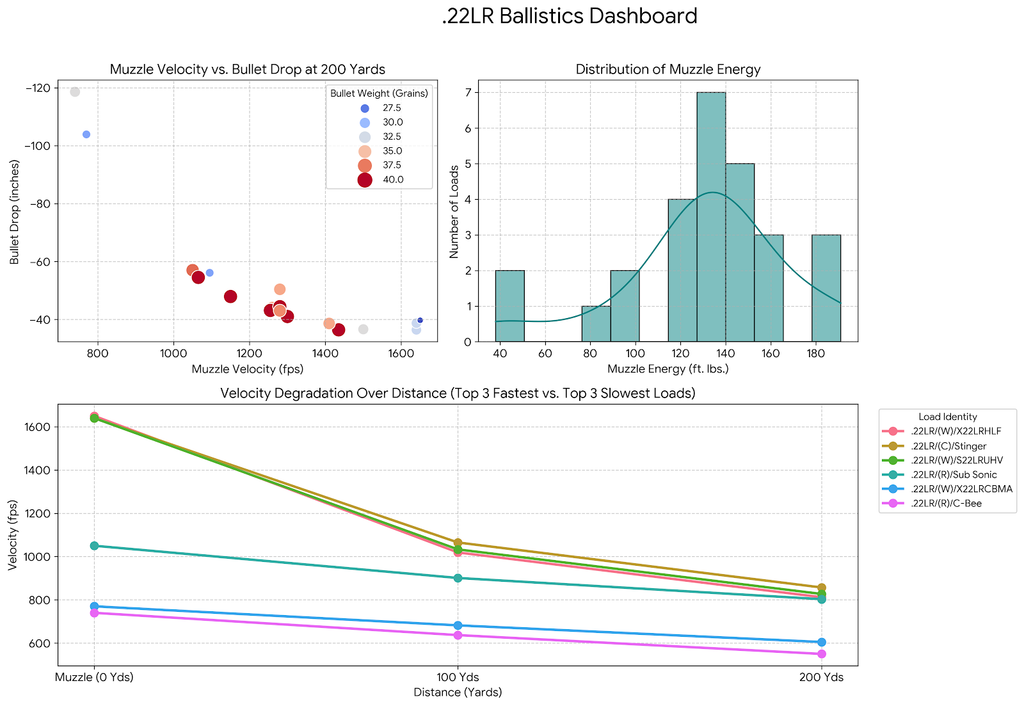
.22 LR Ballistics Calculator
The .22 Long Rifle (.22 LR) relies on a rimfire primer, a 1- to 2-grain powder charge, and a low-mass projectile. While it lacks the flat trajectory of centerfire cartridges, its external ballistics are highly predictable. With the recent explosion of precision rimfire competitions (like NRL22 and PRS Rimfire) pushing the cartridge past 300 yards, understanding its specific velocity thresholds, energy retention, and atmospheric sensitivity is critical.
Here is the technical breakdown of .22 LR external ballistics, updated with current precision rimfire data.
1. Velocity Classes and Transonic Disruption
.22 LR ammunition is categorized by velocity. The speed of the bullet dictates not only its trajectory but whether it suffers from transonic destabilization—a critical factor in rimfire accuracy.
- Standard Velocity / Subsonic (1,050 – 1,080 fps): This is the standard for precision shooting. The speed of sound at sea level (59°F) is roughly 1,116 fps. Standard Velocity (SV) 40-grain rounds leave the muzzle subsonic and remain subsonic. This prevents the bullet from crossing the transonic barrier (Mach 1.2 to 0.8), a phase where the center of aerodynamic pressure shifts ahead of the center of gravity, causing yaw and destroying accuracy.
- High Velocity (1,200 – 1,310 fps): The standard for small game hunting. Typically utilizing a 36- to 40-grain bullet, High Velocity (HV) rounds leave the muzzle supersonic but drop back down to subsonic speeds around the 50- to 75-yard mark. This transonic transition causes groups to open up significantly past 50 yards.
- Hyper-Velocity (1,400 – 1,640+ fps): Engineered for maximum short-range energy. Loads like the CCI Stinger (1,640 fps) use a 32-grain bullet and a slightly longer casing. While they shoot extremely flat inside 75 yards, their poor Ballistic Coefficient (BC) causes rapid velocity bleed-off, making them highly susceptible to wind drift and transonic yaw at extended ranges.
2. Kinetic Energy and Terminal Performance
Ethical hunting and target steel activation require specific kinetic energy thresholds. The established baseline for cleanly harvesting small game (squirrels, rabbits) is 40 ft-lbs, while tougher game (raccoons, groundhogs) requires 50 to 60 ft-lbs.
| Ammunition Type (40-grain standard) | Muzzle Energy | 50-Yard Energy | 100-Yard Energy | 150-Yard Energy |
| Standard Velocity (1,070 fps) | 102 ft-lbs | 84 ft-lbs | 72 ft-lbs | 61 ft-lbs |
| High Velocity (1,235 fps) | 135 ft-lbs | 104 ft-lbs | 83 ft-lbs | 68 ft-lbs |
| Hyper-Velocity (32gr @ 1,640 fps) | 191 ft-lbs | 114 ft-lbs | 78 ft-lbs | 57 ft-lbs |
Data based on a standard 0.120 G1 Ballistic Coefficient.
Despite the massive initial advantage of Hyper-Velocity rounds, their light weight and poor aerodynamics cause them to lose energy so rapidly that a heavy Standard Velocity round actually impacts with more kinetic energy at 150 yards. The effective hunting range for a .22 LR is capped at 75 to 100 yards.
3. Trajectory and Extreme Bullet Drop
The .22 LR has a pronounced parabolic arc due to low velocities and poor G1 Ballistic Coefficients (typically ranging from 0.110 to 0.150). Assuming a standard 50-yard zero and a scope height of 1.5 inches over bore, the drop is severe as distance increases.
Drop Data for Standard Velocity (1,070 fps, 40gr, BC: 0.120):
- 25 Yards: -0.1 inches
- 50 Yards: ZERO
- 75 Yards: -2.6 inches
- 100 Yards: -7.4 inches (approx. 7.1 MOA dial)
- 150 Yards: -24.8 inches (approx. 15.8 MOA dial)
- 200 Yards: -54.5 inches (approx. 26.0 MOA dial)
- 300 Yards: -158.0 inches (approx. 50.3 MOA dial)
Shooting a .22 LR at 300 yards requires dialing over 50 Minutes of Angle (MOA) into the scope—the ballistic equivalent of shooting a .308 Winchester at 1,200 yards. A range estimation error of just 5 yards at the 150-yard line will result in a 3-inch vertical miss.
4. Wind Deflection Profiles
Because a 40-grain bullet traveling at 1,070 fps has a long time-of-flight, wind is the primary limiting factor for rimfire accuracy. A standard 10 mph full-value (90-degree) crosswind yields the following drift for a Standard Velocity round:
- 50 Yards: 1.0 inches
- 100 Yards: 4.2 inches
- 150 Yards: 9.6 inches
- 200 Yards: 17.5 inches
Counterintuitively, High Velocity rounds often experience more wind drift at 100+ yards than Standard Velocity rounds. This happens because aerodynamic drag increases exponentially as a bullet approaches the speed of sound, causing the HV round to bleed speed faster and spend roughly the same amount of time in the wind, but with a less stable flight profile.
10 Technical FAQs About .22 LR Ballistics
1. Why do precision shooters only use Standard Velocity ammunition?
Standard Velocity ammunition stays below the speed of sound (approx. 1,116 fps) from the muzzle to the target. It never crosses the transonic barrier, avoiding the aerodynamic turbulence that causes supersonic bullets to yaw and lose accuracy when they slow down.
2. What is the actual Ballistic Coefficient (BC) of a .22 LR bullet?
Most 40-grain round-nose .22 LR bullets have a G1 BC between 0.110 and 0.130. High-end match ammunition (like Lapua Center-X or SK Standard Plus) hovers around 0.150 to 0.172, while ultra-light hyper-velocity bullets can drop below 0.100.
3. At what barrel length does a .22 LR achieve maximum velocity?
A .22 LR powder charge fully burns within the first 14 to 16 inches of the barrel. Barrels longer than 16 inches (e.g., 20 or 24 inches) do not increase velocity; in fact, bore friction often causes the bullet to slow down slightly before exiting. Longer barrels are used solely for increased sight radius with iron sights and to add stabilizing weight.
4. What is the maximum ethical hunting range for a .22 LR?
The maximum ethical range is generally 75 to 100 yards. Beyond 100 yards, the bullet drops below the 50 ft-lb kinetic energy threshold required to reliably and cleanly harvest tough small game, and wind drift makes precise brain/heart shot placement highly unpredictable.
5. How does cold weather affect .22 LR ballistics?
Temperature impacts rimfire ballistics in two ways: cold air is denser, increasing drag and bullet drop; and cold temperatures lower the speed of sound. If the speed of sound drops from 1,116 fps (at 59°F) to 1,050 fps (at 0°F), a “subsonic” round traveling at 1,070 fps will suddenly become supersonic and suffer transonic destabilization.
6. Why is a 50-yard zero the industry standard for .22 LR?
With a 1.5-inch scope height, a 50-yard zero keeps the bullet’s trajectory within a 1-inch vertical window from 15 yards out to roughly 60 yards. This allows a hunter to aim dead-on at a 1-inch target anywhere inside that envelope without holding over or under.
7. Can a .22 LR shoot accurately at 300 yards?
Yes, but it requires specialized equipment. Competitors in NRL22/PRS regularly shoot out to 300+ yards. It requires a 20 to 30 MOA canted scope base, a scope with massive internal elevation travel (to dial the necessary ~50 MOA of drop), match-grade standard velocity ammunition, and exact wind-reading skills.
8. Do hyper-velocity rounds wear out a .22 LR barrel faster?
No. .22 LR bullets are soft lead (sometimes thinly copper-washed), and the powder charge is too small to cause throat erosion. You cannot “shoot out” a .22 LR barrel with hyper-velocity ammunition. Barrel damage in rimfires is almost exclusively caused by improper cleaning rod use, not firing wear.
9. Why do my groups open up drastically when shooting High Velocity ammo past 75 yards?
High velocity ammunition (e.g., 1,250 fps) enters the transonic zone (Mach 1.2 to 0.8) exactly around the 50- to 75-yard mark. The shockwave passing over the bullet physically buffets it, destabilizing its flight path just before it reaches a 100-yard target.
10. How much does barrel twist rate matter for a .22 LR?
The industry standard is a 1:16 twist rate, perfectly optimized to stabilize a traditional 40-grain bullet. If you shoot ultra-heavy 60-grain subsonic rounds (like Aguila Sniper Subsonic), a 1:16 barrel cannot stabilize them; they will keyhole. Heavy 60-grain bullets require a specialized 1:9 twist barrel.