300 Weatherby Magnum Ballistics
The .300 Weatherby Magnum stands as a titan among big game hunting cartridges, renowned for delivering blistering speeds and crushing kinetic energy. Analyzing a 300 Weatherby Magnum ballistics profile reveals exactly why this classic belted magnum remains a premier choice for long-range hunters targeting elk, moose, and bear. This comprehensive guide breaks down the precise velocity, bullet drop, and energy retention of modern factory ammunition to help you maximize your rifle’s downrange potential.
Table of Contents [Click to minimize]
300 Weatherby Magnum Ballistics Chart
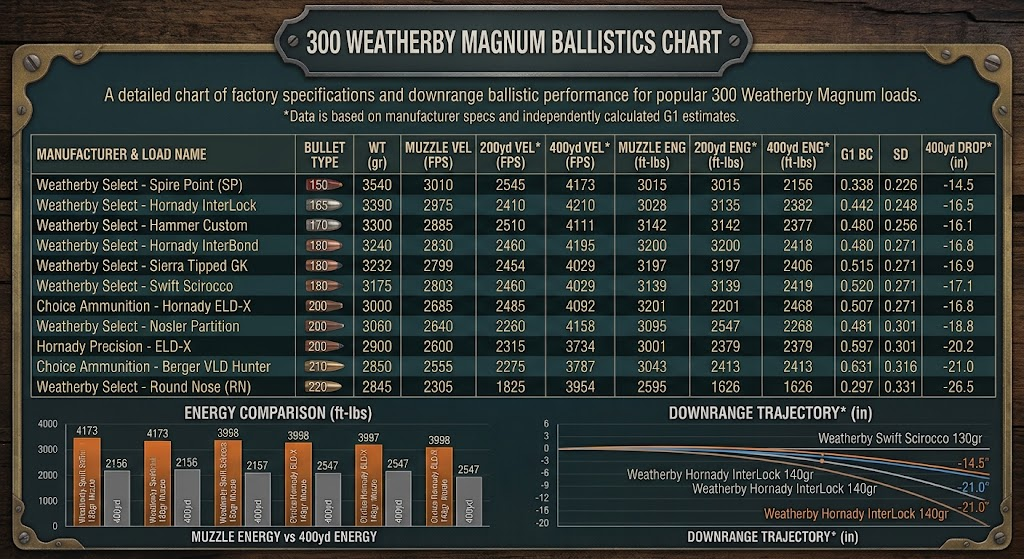
The extensive table below details factory specifications alongside calculated downrange ballistic performance for popular ammunition choices.
Data Note: Muzzle velocity, muzzle energy, bullet weight, and Sectional Density (SD) represent published manufacturer specifications. Columns marked with an asterisk (*) are independently calculated estimates utilizing standard G1 Ballistic Coefficients (BC) under standard atmospheric conditions. Trajectory and bullet drop calculations assume a 200-yard zero with a 1.5-inch scope height over bore. Test barrel length is 26 inches.
| Manufacturer & Load | Bullet Type | Wt (gr) | Muzzle Vel (FPS) | 200yd Vel* (FPS) | 400yd Vel* (FPS) | Muzzle Eng (ft-lbs) | 200yd Eng* (ft-lbs) | 400yd Eng* (ft-lbs) | G1 BC | SD | 400yd Drop* (in) |
| Weatherby Select | Spire Point (SP) | 150 | 3,540 | 3,010 | 2,545 | 4,173 | 3,015 | 2,156 | 0.338 | 0.226 | -14.5 |
| Weatherby Select | Barnes TTSX | 165 | 3,330 | 2,925 | 2,550 | 4,061 | 3,135 | 2,382 | 0.442 | 0.248 | -16.2 |
| Weatherby Select | Hornady InterLock | 165 | 3,390 | 2,875 | 2,410 | 4,210 | 3,028 | 2,128 | 0.387 | 0.248 | -16.5 |
| Weatherby Select | Hammer Custom | 170 | 3,300 | 2,885 | 2,510 | 4,111 | 3,142 | 2,377 | 0.480 | 0.256 | -16.1 |
| Weatherby Select | Hornady InterBond | 180 | 3,240 | 2,830 | 2,460 | 4,195 | 3,200 | 2,418 | 0.480 | 0.271 | -16.8 |
| Weatherby Select | Barnes TTSX | 180 | 3,232 | 2,828 | 2,459 | 4,175 | 3,197 | 2,417 | 0.484 | 0.271 | -16.9 |
| Weatherby Select | Swift Scirocco | 180 | 3,175 | 2,803 | 2,460 | 4,029 | 3,139 | 2,419 | 0.520 | 0.271 | -17.1 |
| Weatherby Select | Sierra Tipped GK | 180 | 3,175 | 2,799 | 2,454 | 4,029 | 3,132 | 2,406 | 0.515 | 0.271 | -17.2 |
| Choice Ammunition | Nosler AccuBond | 180 | 3,200 | 2,830 | 2,485 | 4,092 | 3,201 | 2,468 | 0.507 | 0.271 | -16.8 |
| Weatherby Select | Nosler Partition | 200 | 3,060 | 2,640 | 2,260 | 4,158 | 3,095 | 2,268 | 0.481 | 0.301 | -18.8 |
| Choice Ammunition | Hornady ELD-X | 200 | 3,000 | 2,685 | 2,395 | 3,998 | 3,201 | 2,547 | 0.597 | 0.301 | -18.2 |
| Hornady Precision | ELD-X | 200 | 2,900 | 2,600 | 2,315 | 3,734 | 3,001 | 2,379 | 0.597 | 0.301 | -20.2 |
| Choice Ammunition | Berger VLD Hunter | 210 | 2,850 | 2,555 | 2,275 | 3,787 | 3,043 | 2,413 | 0.631 | 0.316 | -21.0 |
| Weatherby Select | Round Nose (RN) | 220 | 2,845 | 2,305 | 1,825 | 3,954 | 2,595 | 1,626 | 0.297 | 0.331 | -26.5 |
(Warning: The .300 Weatherby Magnum operates at highly elevated chamber pressures, generally up to 65,000 PSI. Factory velocities are heavily dependent on utilizing a full 26-inch barrel.)
Supplemental Ballistics Tables
To fully grasp the capabilities of this magnum round for long-range hunting, analyzing how it sheds velocity and elevation across extended distances is critical.
Velocity and Energy Retention at Extended Ranges
Because of the immense powder column pushing heavy, aerodynamic bullets, the .300 Weatherby carries its kinetic energy across vast distances, easily exceeding the minimum threshold required for large game well past 500 yards.
| Load Specification | Wt (gr) | Vel Muzzle | Vel 100yd | Vel 300yd | Vel 500yd | Eng Muzzle | Eng 100yd | Eng 300yd | Eng 500yd |
| Weatherby Spire Point | 150 | 3,540 | 3,265 | 2,770 | 2,330 | 4,173 | 3,550 | 2,555 | 1,808 |
| Hornady InterBond | 180 | 3,240 | 3,030 | 2,640 | 2,285 | 4,195 | 3,669 | 2,785 | 2,087 |
| Swift Scirocco | 180 | 3,175 | 2,985 | 2,628 | 2,298 | 4,029 | 3,560 | 2,760 | 2,111 |
| Hornady ELD-X | 200 | 3,000 | 2,840 | 2,540 | 2,255 | 3,998 | 3,581 | 2,865 | 2,258 |
Bullet Drop and Trajectory Over 600 Yards
This chart maps the trajectory curve assuming a practical hunting setup: a 200-yard zero with optics mounted 1.5 inches above the bore.
| Ammunition Type | 100 Yds | 200 Yds | 300 Yds | 400 Yds | 500 Yds | 600 Yds |
| 150gr Spire Point (3,540 fps) | +1.0″ | 0.0″ | -5.2″ | -14.5″ | -29.5″ | -52.2″ |
| 170gr Hammer Custom (3,300 fps) | +1.2″ | 0.0″ | -5.5″ | -16.1″ | -32.5″ | -56.5″ |
| 180gr Swift Scirocco (3,175 fps) | +1.4″ | 0.0″ | -6.2″ | -17.1″ | -34.8″ | -59.5″ |
| 200gr Nosler Partition (3,060 fps) | +1.5″ | 0.0″ | -6.8″ | -18.8″ | -38.5″ | -67.2″ |
Analyzing 300 Weatherby Magnum Performance
Extreme Velocities and Bullet Weights
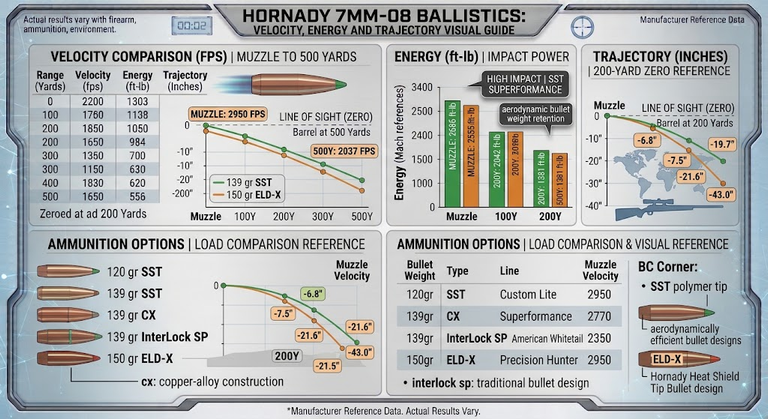
A glance at any 300 Weatherby Magnum ballistics chart immediately highlights its defining characteristic: sheer speed. By utilizing a massively blown-out casing with a unique double-radius shoulder, Roy Weatherby created a powder chamber capable of pushing a 150-grain .30-caliber bullet to 3,540 FPS. Even heavy 200-grain bullets, traditionally sluggish in standard rifles, are launched at roughly 3,000 FPS. This hyper-velocity minimizes target lead times and defies wind deflection.
Uncompromising Downrange Energy
Kinetic energy is the byproduct of mass and velocity, and the .300 Weatherby has both in abundance. Generating upwards of 4,200 ft-lbs of energy at the muzzle, it is one of the hardest-hitting commercially loaded .30-caliber magnums available. More importantly, heavily constructed 180-grain hunting bullets will still impact with over 2,000 ft-lbs of force at 500 yards, ensuring devastating terminal performance on thick-skinned game like moose and elk at ranges where lesser cartridges fail to expand.
Mastering the Trajectory Arc
Before the modern era of custom dial turrets and ballistic applications, hunters favored 300 Weatherby Magnum ballistics because the trajectory was inherently forgiving. If you zero a 180-grain load at 200 yards, it reaches a maximum height of just 1.4 inches above the line of sight at 100 yards and drops only about 6 inches at 300 yards. This allows a hunter to confidently aim directly at the center of an elk’s vitals from 0 to 325 yards and guarantee a lethal hit.
Sectional Density and Ballistic Coefficients
To survive these extreme velocities without disintegrating upon impact, hunters must select premium projectiles. Standard flat-base bullets shed speed quickly due to low Ballistic Coefficients (around 0.330). Modern long-range hunters opt for sleek boattail designs like the Hornady ELD-X or Berger VLD, which boast BCs exceeding 0.590. Furthermore, the long .308-caliber bullets offer excellent Sectional Density (0.271 for 180gr; 0.301 for 200gr), which guarantees the deep, straight-line penetration necessary to break heavy bone.
The Role of Barrel Length
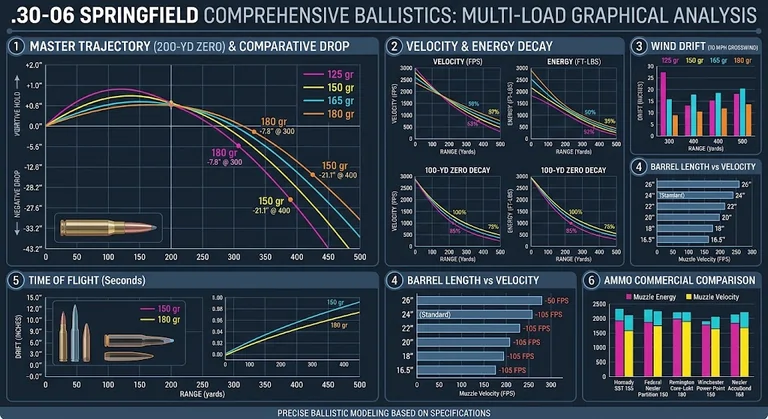
The 65,000 PSI chamber pressure and immense volume of slow-burning powder require a long runway to combust fully. The factory velocities recorded in a standard 300 Weatherby Magnum ballistics profile are achieved using a 26-inch barrel. Firing this cartridge from a 22-inch or 24-inch barrel will generally result in a velocity penalty of 35 to 50 FPS per lost inch. It will also produce severe muzzle blast, as the unburnt powder ignites outside the bore.
Frequently Asked Questions
What are the standard ballistics for a 300 Weatherby Magnum?
Standard performance generally revolves around a 180-grain hunting projectile leaving the muzzle between 3,175 and 3,240 FPS, generating approximately 4,100 foot-pounds of muzzle energy and offering an exceptionally flat trajectory.
How much more powerful is the 300 Weatherby Magnum than the 300 Win Mag?
While both utilize .308-inch bullets, the Weatherby case holds more powder. On average, the .300 Weatherby Magnum will push the exact same bullet 100 to 150 FPS faster than the .300 Winchester Magnum, resulting in roughly 300 to 400 more foot-pounds of muzzle energy.
What is the best bullet weight for the 300 Weatherby Magnum?
The 180-grain bullet is universally praised as the “sweet spot” for this cartridge. It offers the perfect equilibrium of high ballistic coefficient, wind resistance, flat trajectory, and bone-crushing sectional density for hunting deer, elk, and bear.
How much does a 300 Weatherby Magnum drop at 400 yards?
If the rifle is zeroed at 200 yards, a standard 180-grain premium hunting bullet (like a Swift Scirocco or Nosler AccuBond) will drop roughly 16.5 to 17.5 inches at the 400-yard mark.
What is the maximum effective range of a 300 Weatherby Magnum on elk?
Because elk require approximately 1,500 ft-lbs of impact energy for an ethical kill, studying a 300 Weatherby Magnum ballistics chart reveals that a 180-grain or 200-grain bullet will maintain this required energy past 600 yards.
Does barrel length severely affect 300 Weatherby ballistics?
Yes. To achieve peak factory velocities, a 26-inch barrel is highly recommended to burn the heavy magnum powder charges. Shorter barrels sacrifice speed and increase muzzle concussion dramatically.
Can you shoot 300 H&H Magnum ammo in a 300 Weatherby?
Yes, but with caveats. Because the .300 Weatherby case was designed by blowing out the .300 H&H, you can safely fire .300 H&H ammunition in a Weatherby chamber (a process called fire-forming). However, accuracy may suffer, and you will lose velocity. You can never fire .300 Weatherby in a .300 H&H rifle.
How severe is the recoil on a 300 Weatherby Magnum?
The recoil is substantial. Pushing heavy bullets at 3,200+ FPS generates over 30 foot-pounds of free recoil energy in a standard hunting rifle, which is significantly heavier than a standard .30-06 Springfield. Muzzle brakes are strongly recommended.
What is the parent case for the 300 Weatherby Magnum?
Roy Weatherby designed the cartridge in the 1940s by utilizing the .300 H&H Magnum case, straightening the body taper to increase powder capacity, and adding his trademark double-radius shoulder.
Is the 300 Weatherby Magnum overkill for deer hunting?
At close ranges, it is generally considered overkill and can cause massive meat damage if a fragile bullet strikes bone. However, for hunters taking cross-canyon shots on deer at 400+ yards, the flat trajectory and high energy retention make it highly effective.