Hornady 22 Creedmoor Ballistics Chart
The Hornady 22 Creedmoor is a high-velocity rifle cartridge designed around .224-caliber bullets and a modern Creedmoor case. Its factory ammunition lineup includes options for predator hunting, general hunting, and precision shooting.
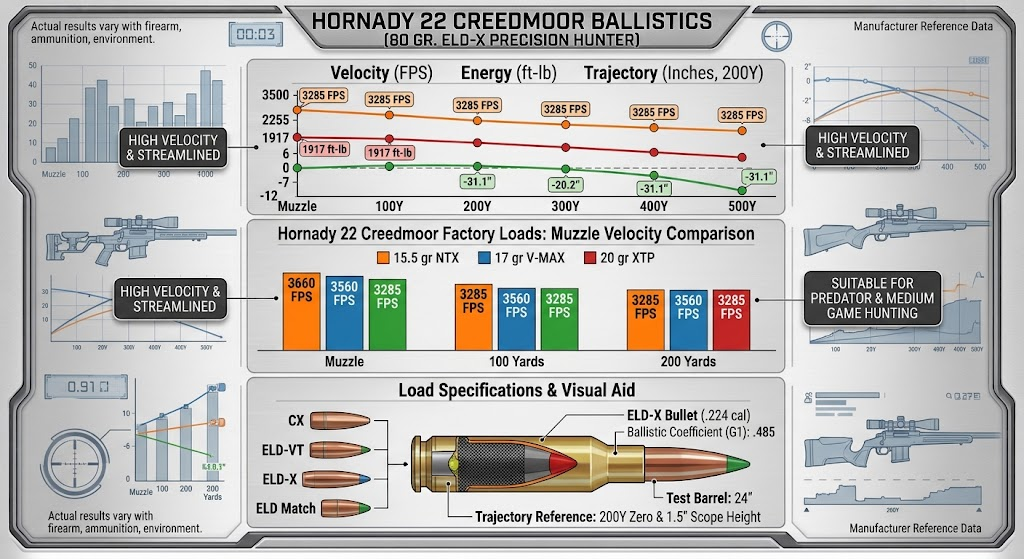
This Hornady 22 Creedmoor Ballistics Chart examines the published performance of the 80-grain ELD-X load at multiple distances. It also provides an overview of Hornady’s other factory ammunition choices, including their bullet weights and muzzle velocities.
Table of Contents [Click to minimize]
22 Creedmoor Ballistics Data: Hornady 80 gr. ELD-X
Hornady’s Precision Hunter 80-grain ELD-X ammunition has a listed muzzle velocity of 3,285 FPS. The manufacturer’s ballistic chart provides measurements at 100-yard intervals through 500 yards.
| Range | Bullet Velocity (FPS) | Remaining Energy (ft-lb) | Trajectory (inches) |
|---|---|---|---|
| 0 Yards | 3,285 | 1,917 | -1.5 |
| 100 Yards | 3,076 | 1,680 | +1.1 |
| 200 Yards | 2,877 | 1,470 | 0 |
| 300 Yards | 2,687 | 1,282 | -5.3 |
| 400 Yards | 2,505 | 1,114 | -15.4 |
| 500 Yards | 2,330 | 964 | -31.1 |
Factory load information:
| Specification | Hornady 22 Creedmoor |
|---|---|
| Ammunition Series | Precision Hunter |
| Bullet Type | ELD-X® |
| Bullet Weight | 80 grains |
| Product Number | 83412 |
| Muzzle Velocity | 3,285 FPS |
| Ballistic Coefficient | G1 .485 |
| Test Barrel Length | 24 inches |
| Zero Distance | 200 yards |
| Scope Height | 1.5 inches |
Hornady 22 Creedmoor Ammunition Comparison
The cartridge is available in multiple Hornady product lines. Each one uses a different bullet design or weight, giving shooters several factory ammunition choices.
| Hornady Product Line | Bullet Weight | Bullet Design | Item Number | Muzzle Velocity |
|---|---|---|---|---|
| Superformance | 65 gr. | CX® | 83413 | 3,660 FPS |
| V-Match | 69 gr. | ELD-VT® | 83414 | 3,560 FPS |
| Precision Hunter | 80 gr. | ELD-X® | 83412 | 3,285 FPS |
| Match | 80 gr. | ELD® Match | 83411 | 3,285 FPS |
Hornady positions these products for different shooting applications. V-Match is designed for varmint and predator hunting, Precision Hunter for hunting applications, Superformance uses a monolithic copper-alloy bullet, and Match is intended for competition and long-range shooting.
How Fast Does a Hornady 22 Creedmoor Travel?
The Hornady 80-grain ELD-X load starts with a published muzzle velocity of 3,285 FPS. As the bullet travels farther, its velocity decreases.
The manufacturer’s chart lists 3,076 FPS at 100 yards and 2,877 FPS at 200 yards. At 300 yards, the listed velocity is 2,687 FPS, dropping to 2,330 FPS at 500 yards.
These measurements provide a reference for understanding how the published load retains velocity downrange. They should not be assumed to apply to every 22 Creedmoor bullet or factory load.
Hornady 22 Creedmoor Energy Retention
Energy figures help describe the kinetic energy of a bullet at different distances. The 80-grain ELD-X has a listed muzzle energy of 1,917 ft-lb.
The published energy measurements are:
- 1,680 ft-lb at 100 yards
- 1,470 ft-lb at 200 yards
- 1,282 ft-lb at 300 yards
- 1,114 ft-lb at 400 yards
- 964 ft-lb at 500 yards
The figures show a gradual reduction in energy as the bullet travels downrange. Bullet weight and velocity both contribute to the energy measurement.
22 Creedmoor Trajectory at 100 to 500 Yards
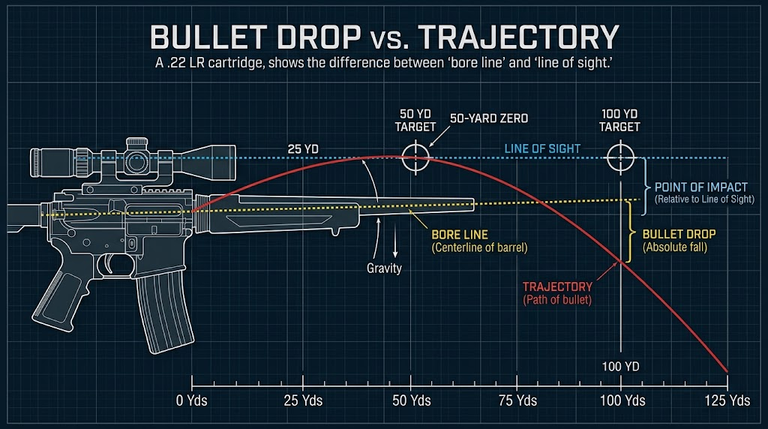
The trajectory values in Hornady’s chart use a 200-yard zero and a 1.5-inch scope height. The listed value is +1.1 inches at 100 yards and 0 inches at 200 yards.
At longer distances, the chart records -5.3 inches at 300 yards, -15.4 inches at 400 yards, and -31.1 inches at 500 yards.
Trajectory figures are dependent on the stated test and sighting conditions. Different rifles, barrel lengths, sight heights, and atmospheric conditions can produce different results.
22 Creedmoor Cartridge Specifications
The 22 Creedmoor is a .224-caliber centerfire rifle cartridge based on the 6.5 Creedmoor case design. SAAMI published standardized cartridge and chamber specifications in 2024.
The SAAMI introduction document lists a maximum average pressure of 62,000 PSI and an instrumental velocity reference of 3,250 FPS for an 80-grain bullet. These are standardization figures, not a replacement for the specific factory ammunition data published by Hornady.
The cartridge’s design supports the use of longer, streamlined bullets intended for high-velocity and long-range applications.
Frequently Asked Questions
1. How accurate is the Hornady 22 Creedmoor ballistics chart?
The chart presents manufacturer-published ballistic figures for a specific factory load and stated conditions. Actual results can vary depending on the rifle, barrel, ammunition, and environment.
2. What is the Hornady 22 Creedmoor 80-grain ELD-X velocity?
Hornady lists the 80-grain ELD-X Precision Hunter load at 3,285 FPS at the muzzle.
3. How much energy does the 22 Creedmoor have at 300 yards?
The Hornady 80-grain ELD-X chart lists 1,282 ft-lb at 300 yards.
4. What is the 22 Creedmoor trajectory at 500 yards?
The listed trajectory is -31.1 inches at 500 yards, based on a 200-yard zero and 1.5-inch scope height.
5. Does Hornady make a 22 Creedmoor 69-grain load?
Yes. Hornady lists a 69-grain ELD-VT V-Match factory load with a published muzzle velocity of 3,560 FPS.
6. Does Hornady offer a 22 Creedmoor copper bullet?
Yes. Hornady lists a 65-grain CX bullet in its Superformance 22 Creedmoor ammunition line, with a published muzzle velocity of 3,660 FPS.
7. What is the Hornady 22 Creedmoor 80-grain ELD Match velocity?
Hornady lists the 80-grain ELD Match factory load at a muzzle velocity of 3,285 FPS.
8. What is the G1 ballistic coefficient of the 80-grain ELD-X?
The published G1 ballistic coefficient is .485.
9. What is the standard barrel length for Hornady’s ballistic data?
Hornady states that its standard ballistics data is based on a 24-inch barrel unless a different barrel length is specified.
10. Is the 22 Creedmoor suitable for long-range shooting?
Hornady describes the cartridge as suitable for long-range target shooting and hunting applications. Its factory lineup includes bullet designs intended for match, hunting, and predator-focused uses.
Source & Reference
Official manufacturer information
Used for cartridge specifications, factory ammunition details, bullet options and published muzzle velocity information.