45 Colt Ballistics: 45 Long Chart, Trajectory & Bullet Drop
When examining 45 Colt ballistics, shooters uncover a cartridge with immense versatility, bridging the gap between vintage revolver loads and high-powered lever-action performance. This guide breaks down essential 45 Long Colt ballistics, providing detailed trajectory, energy, and velocity data across a wide spectrum of standard and +P ammunition. Whether you are running a classic wheelgun or a modern carbine, the 45 Colt ammo ballistics detailed below will help you maximize your firearm’s potential and understand its precise downrange capabilities.
Table of Contents [Click to minimize]
45 Colt Ballistics Chart
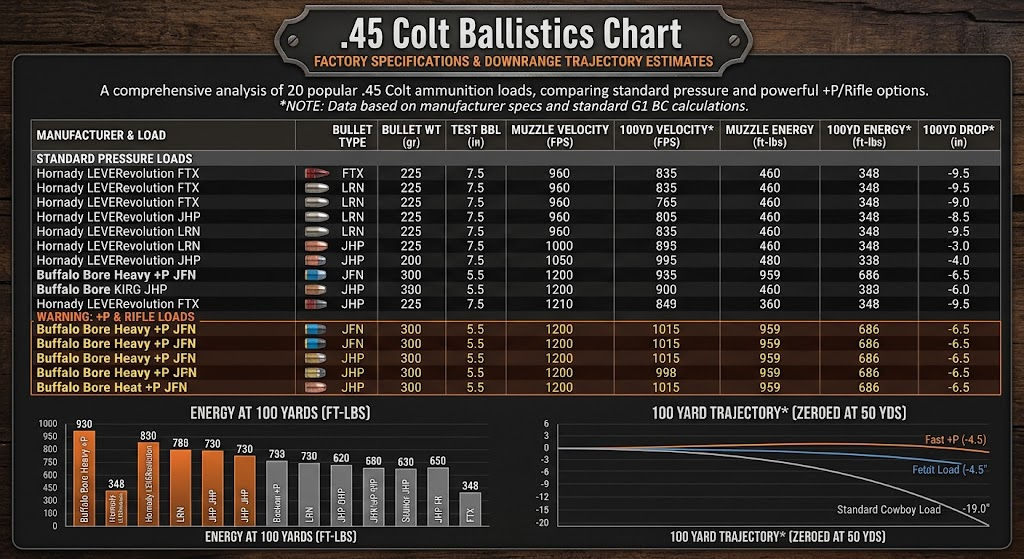
The comprehensive table below provides factory specifications alongside calculated downrange trajectory and energy estimates for 20 distinct factory loads.
Data Note: Muzzle velocity, muzzle energy, bullet weight, and Sectional Density (SD) are based on published manufacturer specifications. Columns with an asterisk (*) are independently calculated using standard G1 Ballistic Coefficients under standard atmospheric conditions. Handgun trajectories use a 50-yard zero and 0.75-inch sight height; rifle trajectories use a 50-yard zero and 1.5-inch sight height.
| Manufacturer & Load Name | Bullet Type | Wt (gr) | Bbl (in) | Muzzle Vel (FPS) | 50yd Vel* (FPS) | 100yd Vel* (FPS) | Muzzle Eng (ft-lbs) | 50yd Eng* (ft-lbs) | 100yd Eng* (ft-lbs) | G1 BC* | SD | 100yd Drop* (in) |
| Standard Pressure Loads | ||||||||||||
| Hornady LEVERevolution | FTX | 225 | 7.5 | 960 | 890 | 835 | 460 | 395 | 348 | 0.150 | 0.157 | -9.5 |
| Hornady Critical Defense | FTX | 185 | 3.0 | 920 | 850 | 790 | 348 | 297 | 256 | 0.115 | 0.129 | -11.0 |
| Winchester Super-X | LRN | 255 | 5.5 | 860 | 815 | 775 | 419 | 376 | 340 | 0.150 | 0.178 | -12.5 |
| Winchester Silvertip | JHP | 225 | 5.5 | 920 | 860 | 805 | 423 | 369 | 324 | 0.140 | 0.157 | -10.5 |
| Remington HTP | LRN | 250 | 5.5 | 860 | 815 | 775 | 411 | 369 | 333 | 0.150 | 0.175 | -12.5 |
| Federal Champion | SWCHP | 225 | 5.5 | 830 | 785 | 745 | 344 | 308 | 277 | 0.140 | 0.157 | -14.0 |
| Federal American Eagle | JSP | 225 | 5.5 | 860 | 815 | 775 | 369 | 332 | 300 | 0.150 | 0.157 | -12.5 |
| Buffalo Bore Standard | Keith GC | 255 | 5.5 | 1,000 | 940 | 890 | 566 | 500 | 448 | 0.160 | 0.178 | -8.5 |
| Barnes VOR-TX | XPB | 200 | 5.5 | 1,025 | 950 | 885 | 466 | 401 | 348 | 0.145 | 0.140 | -8.2 |
| Hornady Custom Cowboy | LRNFP | 255 | 5.5 | 725 | 690 | 660 | 298 | 270 | 247 | 0.150 | 0.178 | -19.0 |
| HSM Cowboy Action | LRNFP | 250 | 5.5 | 750 | 715 | 680 | 312 | 284 | 256 | 0.145 | 0.175 | -17.5 |
| Magtech Cowboy Action | LRNFP | 200 | 5.5 | 850 | 800 | 750 | 321 | 284 | 250 | 0.130 | 0.140 | -13.5 |
| Barnes Pioneer | Lead | 250 | 5.5 | 850 | 805 | 765 | 401 | 360 | 325 | 0.150 | 0.175 | -13.0 |
| +P & Rifle Loads (Warning) | ||||||||||||
| Buffalo Bore Heavy +P | LBT-LFN | 325 | 5.5 | 1,325 | 1,225 | 1,135 | 1,267 | 1,083 | 930 | 0.220 | 0.227 | -5.0 |
| Buffalo Bore Heavy +P | JFN | 300 | 5.5 | 1,200 | 1,100 | 1,015 | 959 | 806 | 686 | 0.200 | 0.210 | -6.5 |
| Underwood Heavy +P | XTP | 250 | 5.5 | 1,400 | 1,250 | 1,120 | 1,088 | 867 | 696 | 0.145 | 0.175 | -4.5 |
| Underwood Heavy +P | XTP | 300 | 5.5 | 1,300 | 1,185 | 1,085 | 1,126 | 935 | 784 | 0.200 | 0.210 | -5.2 |
| HSM Bear Load +P | JSP | 300 | 5.5 | 1,150 | 1,060 | 980 | 881 | 748 | 640 | 0.200 | 0.210 | -7.0 |
| Federal HammerDown (Rifle) | JHP | 250 | 18.0 | 1,400 | 1,255 | 1,125 | 1,088 | 875 | 702 | 0.150 | 0.175 | -4.5 |
| Buffalo Bore +P (Rifle) | LBT-LFN | 325 | 18.0 | 1,738 | 1,610 | 1,490 | 2,180 | 1,870 | 1,600 | 0.220 | 0.227 | -2.0 |
(Warning: The +P ammunition listed operates at approximately 30,000 PSI. These loads are engineered exclusively for heavy-frame firearms such as the Ruger Blackhawk, Thompson/Center handguns, and modern 1892 lever-action rifles. Firing +P loads in Colt Single Action Armies, toggle-link rifles, or imported clones can result in catastrophic firearm failure.)
Supplemental Ballistics Tables
To properly evaluate this cartridge, performance must be segmented by firearm platform and projectile weight.
45 Colt Handgun Ballistics
This table highlights how standard-pressure revolver ammunition behaves at practical handgun engagement distances (muzzle to 75 yards).
| Load / Ammunition | Wt (gr) | Vel Muzzle | Vel 25yd | Vel 50yd | Vel 75yd | Eng Muzzle | Eng 25yd | Eng 50yd | Eng 75yd |
| Winchester Super-X LRN | 255 | 860 | 837 | 815 | 794 | 419 | 397 | 376 | 357 |
| Hornady LEVERevolution FTX | 225 | 960 | 924 | 890 | 861 | 460 | 426 | 395 | 370 |
| Federal Champion SWCHP | 225 | 830 | 807 | 785 | 764 | 344 | 325 | 308 | 292 |
| Buffalo Bore Standard GC | 255 | 1,000 | 969 | 940 | 914 | 566 | 532 | 500 | 473 |
45 Colt Rifle Ballistics
Lever-action rifles dramatically alter 45 Colt rifle ballistics. A closed breech and longer barrel allow the powder to fully combust, adding substantial velocity.
| Load / Ammunition | Wt (gr) | Vel Muzzle | Vel 50yd | Vel 100yd | Vel 150yd | Eng Muzzle | Eng 50yd | Eng 100yd | Eng 150yd |
| Federal HammerDown (Rifle) | 250 | 1,400 | 1,255 | 1,125 | 1,020 | 1,088 | 875 | 702 | 578 |
| Buffalo Bore +P LBT-LFN (Rifle) | 325 | 1,738 | 1,610 | 1,490 | 1,375 | 2,180 | 1,870 | 1,600 | 1,365 |
| Hornady LEVERevolution (Rifle)* | 225 | 1,150 | 1,065 | 985 | 915 | 661 | 567 | 485 | 418 |
(Note: Velocity figures for standard factory loads fired from an 18-inch barrel typically see a 150–250 FPS boost over their handgun ratings.)
45 Long Colt Ammo Ballistics by Bullet Weight
This breakdown averages factory specifications to establish a baseline for 45 Colt ammo ballistics categorized by projectile mass.
| Bullet Weight | Average Muzzle Velocity (FPS) | Average Muzzle Energy (ft-lbs) | Sectional Density (SD) | Primary Application |
| 185 Grain | 920 – 1,000 | 345 – 400 | 0.129 | Concealed Carry / Defense |
| 200 Grain | 850 – 1,050 | 320 – 460 | 0.140 | Cowboy Action / Target |
| 225 Grain | 830 – 960 | 340 – 460 | 0.157 | Personal Defense / Hunting |
| 250 Grain | 750 – 860 | 310 – 410 | 0.175 | General Purpose / Medium Game |
| 255 Grain | 725 – 1,000 | 300 – 566 | 0.178 | Woods Carry / Medium Game |
45 Colt Bullet Drop and Trajectory Chart
This trajectory chart assumes a 50-yard zero. Handgun loads calculate with a 0.75″ sight height, while rifle and +P loads use a 1.5″ sight height.
| Ammunition Type | 25 Yds | 50 Yds | 75 Yds | 100 Yds | 125 Yds | 150 Yds |
| Standard 250gr LRN (860 fps) | +0.6″ | 0.0″ | -4.8″ | -12.5″ | -23.5″ | -38.2″ |
| Standard 225gr FTX (960 fps) | +0.5″ | 0.0″ | -3.5″ | -9.5″ | -18.2″ | -30.0″ |
| Standard 255gr GC (1,000 fps) | +0.4″ | 0.0″ | -3.2″ | -8.5″ | -16.5″ | -27.1″ |
| Heavy +P 300gr XTP (1,300 fps) | +0.1″ | 0.0″ | -1.8″ | -5.2″ | -10.5″ | -18.0″ |
| Rifle 250gr JHP (1,400 fps) | -0.1″ | 0.0″ | -1.4″ | -4.5″ | -9.5″ | -16.5″ |
Analyzing the Data
45 Colt Bullet Weights and Muzzle Velocity
The traditional 45 Colt ballistics profile relies on a heavy 250 to 255-grain lead bullet. Fired from a 5.5-inch revolver, these loads usually generate muzzle velocities between 750 and 860 FPS. Modern ammunition manufacturers have introduced lighter 185 to 225-grain jacketed hollow points designed specifically for self-defense, pushing velocities up to 1,000 FPS to ensure reliable terminal expansion at standard pressures.
45 Long Colt Ammunition Performance
Because standard 45 Long Colt ballistics are restricted to a maximum chamber pressure of 14,000 PSI by SAAMI, the cartridge achieves its legendary stopping power through bullet mass and a wide frontal area (.452 caliber) rather than hydrostatic shock. It is a slow, heavy-hitting round that relies on deep penetration and crushing momentum to be effective.
45 Colt Rifle vs. Handgun Ballistics
The difference between handgun and 45 Colt rifle ballistics is staggering. A revolver bleeds pressure through the cylinder gap, limiting velocity. A sealed lever-action rifle chamber with a 16-to-20-inch barrel allows the slow-burning powders to maximize their push. A standard 250-grain load that struggles to hit 860 FPS in a handgun will easily reach 1,100 to 1,200 FPS in a carbine, drastically improving downrange energy.
Bullet Drop and Trajectory
Because standard loads are subsonic, 45 Colt ammo ballistics feature a highly pronounced trajectory arc. Sighted at 50 yards, a standard 250-grain bullet drops over a foot by the time it reaches 100 yards, requiring significant holdover. Conversely, when fired from a rifle at 1,400 FPS, the drop is mitigated to just 4.5 inches at 100 yards, turning the 45 Colt into a highly capable short-range brush rifle.
Muzzle Energy and Retained Energy
Standard pressure 45 Colt ballistics yield roughly 350 to 450 ft-lbs of muzzle energy. Due to the poor aerodynamics of a flat-nosed, heavy bullet, energy dissipates rapidly. A 250-grain standard load will lose about 20% of its kinetic energy by the 100-yard mark. However, heavy +P loads out of a rifle can start with over 2,100 ft-lbs and retain 1,600 ft-lbs at 100 yards, which is more than enough for elk or moose.
Ballistic Coefficient and Sectional Density
Aerodynamics are not this cartridge’s strong suit. The G1 Ballistic Coefficient (BC) of most standard bullets is quite low, ranging from 0.130 to 0.160. However, the Sectional Density (SD) is excellent. A 255-grain bullet has an SD of 0.178, while a massive 325-grain +P bullet boasts an SD of 0.227. This high sectional density is exactly why the 45 Colt is famous for deep, straight-line penetration through bone and heavy muscle.
How Barrel Length Affects Velocity
Any 45 Colt ballistics chart is heavily dependent on barrel length. Due to the voluminous case capacity, the powder needs time to burn. A snub-nose 3-inch revolver will handicap the cartridge, yielding minimal velocity and heavy unburnt powder flash. Moving to a 7.5-inch barrel ensures a complete burn and maximum handgun velocity, while a rifle barrel elevates the cartridge into an entirely different ballistic class.
Differences Between Standard-Pressure and +P Ammunition
Standard 45 Colt ammo is loaded to 14,000 PSI to ensure it is completely safe in antique revolvers and delicate replicas. “Ruger Only” or +P ammunition operates at roughly 30,000 PSI. These heavy-duty rounds turn the 45 Colt into a cartridge that rivals or exceeds the 44 Magnum in both velocity and energy, but they will physically destroy standard-frame firearms if fired by mistake.
Frequently Asked Questions
What is the baseline for 45 Colt ballistics? The traditional baseline for 45 Colt ballistics is a 250-grain or 255-grain lead projectile leaving a 5.5-inch barrel at approximately 800 to 860 FPS, resulting in about 400 ft-lbs of muzzle energy.
Are 45 Colt and 45 Long Colt ballistics identical? Yes. “45 Colt” is the proper technical name, while “45 Long Colt” is a common historical alias used to differentiate the cartridge from the shorter .45 Schofield round used by the military in the 1870s. Both names refer to the exact same cartridge and yield identical ballistics.
How much energy does 45 Colt ammo produce? Standard 45 Long Colt ballistics generate between 310 and 460 foot-pounds of muzzle energy. High-pressure +P loads shot from heavily reinforced handguns generate over 1,200 ft-lbs, and those same loads fired from a rifle can eclipse 2,100 ft-lbs.
What is the maximum effective range of a 45 Colt rifle? When analyzing 45 Colt rifle ballistics, a standard pressure load is generally effective out to 100 yards on medium game. If using heavy +P ammunition in a modern 1892 lever-action carbine, an ethical hunting range can be extended to 150 yards.
Is it safe to shoot +P ammo in any 45 Colt? No. Reviewing a 45 Colt ballistics chart will show that +P loads operate at more than double the pressure of standard rounds. They are exclusively designed for robust firearms like the Ruger Blackhawk, Redhawk, and modern lever-actions. Firing them in a Colt SAA or clone is highly dangerous.
Does barrel length change 45 Colt ammo ballistics? Yes, significantly. Because the 45 Colt has a very large case capacity, it requires longer barrels to fully combust the powder charge. A 20-inch lever-action rifle can easily add 200 to 300 FPS to a load’s muzzle velocity compared to a 4.75-inch revolver barrel.
How much does a 45 Colt bullet drop at 100 yards? If zeroed at 50 yards, a standard 250-grain handgun bullet will drop approximately 12.5 inches at 100 yards. A faster rifle load zeroed at 50 yards will experience a much flatter trajectory, dropping only about 4.5 inches at the 100-yard mark.
What is the optimal bullet weight for the 45 Colt? For historical authenticity, general target shooting, and medium game, the 250 to 255-grain bullet is optimal. For concealed carry and self-defense, shooters prefer 185 to 225-grain hollow points. For dangerous game defense in heavy revolvers, 300 to 325-grain hard cast lead bullets are the top choice.
Is the 45 Colt more powerful than the 44 Magnum? With standard factory ammunition, the 44 Magnum is substantially more powerful. However, custom reloaders and boutique ammo manufacturers can load the 45 Colt to +P pressures, allowing its wider bullet to deliver energy and momentum that can actually surpass standard 44 Magnum ballistics.
Is the 45 Colt a capable hunting cartridge? Absolutely. The 45 Colt ammo ballistics prove it is highly effective for hunting. Standard loads are perfect for deer and feral hogs within 50 yards, while heavy +P hard cast loads are routinely used to hunt black bear, elk, and moose at moderate distances.