9mm 16 Inch Barrel Ballistics
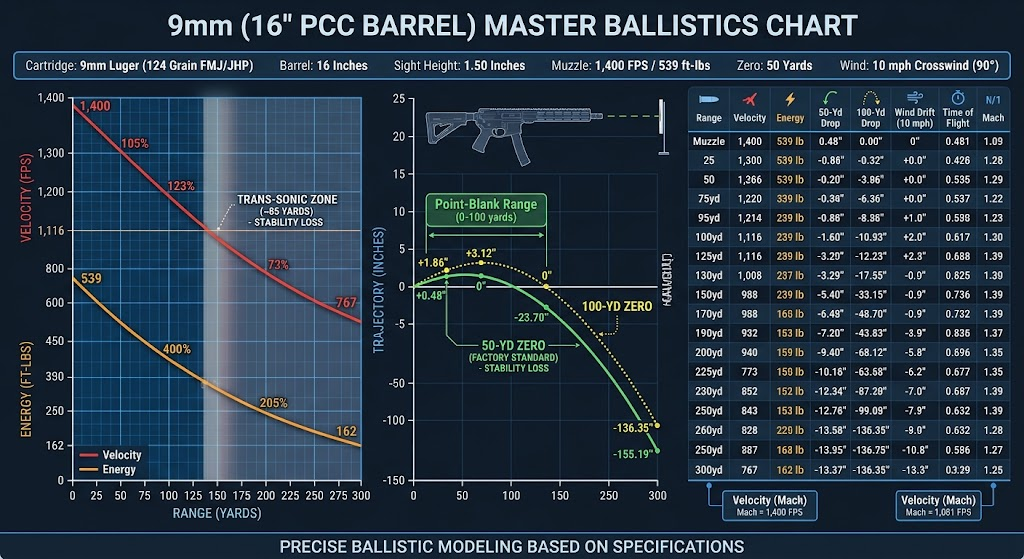
A 9mm Luger cartridge fired from a 16-inch barrel can produce higher muzzle velocity than the same ammunition fired from a typical handgun barrel. This 9mm 16 inch barrel ballistics chart uses a 124-grain FMJ or JHP bullet with an estimated muzzle velocity of 1,400 feet per second (FPS). The table covers velocity, energy, trajectory, wind drift and time of flight from the muzzle to 300 yards, with trajectory data for both 50-yard and 100-yard zeroes.
Table of Contents [Click to minimize]
9mm 16 Inch Barrel Ballistics Chart
The following table provides estimated ballistic data for a 16-inch pistol-calibre carbine (PCC) chambered in 9mm Luger. The calculations assume a 124-grain bullet, a G1 ballistic coefficient of approximately 0.145, and a 10 mph crosswind at 90 degrees.
| Ballistic Specification | Value |
|---|---|
| Cartridge | 9mm Luger |
| Barrel Length | 16 inches |
| Bullet Weight | 124 grains |
| Bullet Type | FMJ / JHP |
| Ballistic Coefficient (G1) | 0.145 |
| Muzzle Velocity | 1,400 FPS |
| Muzzle Energy | 539 ft-lbs |
| Primary Zero Distance | 50 yards |
| Secondary Zero Distance | 100 yards |
| Sight Height | 1.5 inches |
| Crosswind | 10 mph at 90 degrees |
9mm 16 Inch Barrel Master Ballistics Table
| Range (Yards) | Velocity (FPS) | Velocity Retained (%) | Energy (ft-lbs) | Energy Retained (%) | Trajectory (50-Yard Zero) | Trajectory (100-Yard Zero) | Time of Flight (Sec) | Wind Drift (10 mph) | Velocity (Mach) |
|---|---|---|---|---|---|---|---|---|---|
| Muzzle (0) | 1,400 | 100.0% | 539 | 100.0% | -1.50 in | -1.50 in | 0.000 s | 0.00 in | 1.25 |
| 25 | 1,295 | 92.5% | 461 | 85.5% | +0.48 in | +1.86 in | 0.056 s | 0.42 in | 1.16 |
| 50 | 1,202 | 85.9% | 398 | 73.8% | 0.00 in | +3.12 in | 0.116 s | 1.62 in | 1.08 |
| 75 | 1,123 | 80.2% | 347 | 64.4% | -2.31 in | +3.05 in | 0.181 s | 3.57 in | 1.01 |
| 100 | 1,059 | 75.6% | 309 | 57.3% | -6.84 in | 0.00 in | 0.250 s | 6.26 in | 0.95 |
| 125 | 1,006 | 71.9% | 279 | 51.8% | -13.89 in | -5.55 in | 0.323 s | 9.68 in | 0.90 |
| 150 | 960 | 68.6% | 254 | 47.1% | -23.70 in | -13.86 in | 0.400 s | 13.80 in | 0.86 |
| 175 | 920 | 65.7% | 233 | 43.2% | -36.52 in | -25.18 in | 0.480 s | 18.61 in | 0.82 |
| 200 | 884 | 63.1% | 215 | 39.9% | -52.62 in | -39.78 in | 0.563 s | 24.11 in | 0.79 |
| 225 | 851 | 60.8% | 199 | 36.9% | -72.26 in | -57.92 in | 0.650 s | 30.27 in | 0.76 |
| 250 | 821 | 58.6% | 185 | 34.3% | -95.72 in | -79.88 in | 0.740 s | 37.07 in | 0.74 |
| 275 | 793 | 56.6% | 173 | 32.1% | -123.27 in | -105.93 in | 0.833 s | 44.52 in | 0.71 |
| 300 | 767 | 54.8% | 162 | 30.1% | -155.19 in | -136.35 in | 0.929 s | 52.60 in | 0.69 |
Note: These are estimated figures supplied for this ballistic model, not guaranteed results for every 9mm load. The trajectory, wind drift, and time-of-flight values should be independently verified before being treated as precise ballistic predictions.
9mm 16 Inch Barrel Muzzle Velocity
Muzzle velocity describes how fast a bullet travels as it exits the barrel. For this chart, the assumed muzzle velocity is 1,400 FPS with a 124-grain bullet.
A 16-inch barrel provides a longer distance for expanding propellant gases to accelerate the bullet than a typical handgun barrel. However, the actual velocity gain depends on the ammunition, barrel characteristics and firearm design. A longer barrel does not guarantee the same velocity increase with every 9mm load.
As the bullet travels downrange, air resistance gradually reduces its velocity. In the supplied table, the estimated velocity decreases from 1,400 FPS at the muzzle to 1,059 FPS at 100 yards and 767 FPS at 300 yards.
9mm 16 Inch Barrel Energy Chart
Muzzle energy describes the bullet’s kinetic energy as it leaves the barrel. It depends on both bullet weight and velocity.
The supplied 124-grain load starts with an estimated muzzle energy of 539 foot-pounds. The model lists 398 ft-lbs at 50 yards, 309 ft-lbs at 100 yards and 162 ft-lbs at 300 yards.
The energy figures show how the bullet’s kinetic energy decreases as it loses velocity. Energy alone does not establish a projectile’s effectiveness, penetration or expansion. Bullet construction and the characteristics of a particular load also matter.
9mm 16 Inch Barrel Trajectory
Trajectory describes a bullet’s path relative to the line of sight. Because the sights sit above the bore, the bullet begins below the line of sight at the muzzle. Its path changes as gravity and forward velocity affect its flight.
The table includes two zeroing configurations:
50-Yard Zero
With a 50-yard zero, the supplied table lists the trajectory at 0.00 inches at 50 yards. It estimates the bullet at 6.84 inches below the line of sight at 100 yards and 23.70 inches below at 150 yards.
100-Yard Zero
With a 100-yard zero, the table lists the trajectory at 0.00 inches at 100 yards. The estimated trajectory is 5.55 inches below the line of sight at 125 yards and 13.86 inches below at 150 yards.
These figures are model-dependent. The exact trajectory changes with the actual muzzle velocity, sight height, ammunition and atmospheric conditions.
9mm 16 Inch Barrel Wind Drift
Wind drift is the sideways movement of a bullet caused by crosswind during flight. The provided table assumes a 10 mph wind at a 90-degree angle to the bullet’s path.
According to the supplied estimates, wind drift increases from 1.62 inches at 50 yards to 6.26 inches at 100 yards and 24.11 inches at 200 yards. At 300 yards, the table lists 52.60 inches of drift.
Wind effects accumulate during flight, so the estimated drift becomes more substantial as the distance increases. Actual wind drift varies with wind direction, wind speed, bullet characteristics and atmospheric conditions.
9mm 16 Inch Barrel Time of Flight
Time of flight measures how long the bullet takes to reach a given distance. The supplied table estimates 0.116 seconds to 50 yards, 0.250 seconds to 100 yards and 0.563 seconds to 200 yards.
At 300 yards, the estimated flight time is 0.929 seconds. As the bullet slows down, it takes progressively longer to cover each additional 25-yard interval. Longer flight times also allow gravity and crosswind to influence the bullet for more time.
Frequently Asked Questions
How fast is a 9mm bullet from a 16-inch barrel?
The supplied ballistics model assumes a muzzle velocity of 1,400 FPS with a 124-grain bullet. Actual velocity varies according to the ammunition and firearm.
What is the muzzle energy of a 9mm with a 16-inch barrel?
The supplied table lists muzzle energy at approximately 539 ft-lbs for a 124-grain bullet travelling at 1,400 FPS.
How far can a 9mm bullet travel from a 16-inch barrel?
The table provides estimated ballistic data out to 300 yards. However, that is the limit of this chart, not the maximum distance the bullet can travel. A bullet can travel farther, so a safe backstop and awareness of the full potential flight path are essential.
Does a 16-inch barrel increase 9mm velocity?
A 16-inch barrel can increase 9mm velocity compared with a shorter barrel, but the amount depends on the ammunition and firearm. The increase is not identical across all loads.
What is the best zero for a 9mm 16-inch barrel?
The appropriate zero depends on the firearm’s intended use, sighting system and expected distances. This chart presents both 50-yard and 100-yard zero configurations for comparison.
How much does a 9mm bullet drop at 100 yards?
The supplied table estimates 6.84 inches below the line of sight at 100 yards with a 50-yard zero. With a 100-yard zero, the bullet is at the zero point at 100 yards.
How much energy does a 9mm retain at 100 yards?
The supplied model lists 309 ft-lbs at 100 yards, equivalent to approximately 57.3% of the stated muzzle energy.
Does a 9mm bullet remain supersonic at 100 yards?
The supplied table estimates a velocity of 1,059 FPS at 100 yards, or Mach 0.95. That is below the approximate speed of sound under standard conditions, although the actual transition depends on atmospheric conditions and the load.
How does bullet weight affect 9mm ballistics?
Bullet weight affects velocity, energy and the way a bullet responds to air resistance. A 124-grain load may produce different ballistic results from lighter or heavier ammunition, even when fired from the same barrel.
Are these 9mm 16-inch barrel ballistics exact?
No. The values are estimates based on the stated assumptions. Actual results can differ, and the trajectory, time-of-flight and wind-drift figures should be checked against a validated ballistic calculator or measured data for the specific ammunition.