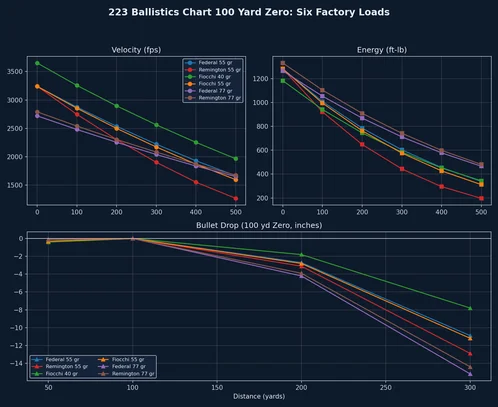
5.56 Ballistics Chart 100 Yard Zero
A 100 yard zero puts the crossing point of bullet and sight line at 100 yards, and this page gathers the 5.56 figures that follow that pattern. The opening tables lay out the bullet path for the standard 55 and 62 grain service loads, then add full velocity, energy and drop figures for three lighter loads. Below them sits the factory chart: 20 loads from nine makers, each with a published trajectory set that reads 0 at 100 yards.
Table of Contents [Click to minimize]
Bullet Path on a 100 Yard Zero
Each row below tracks one load against the line of sight with the sights set for 100 yards and a 2.6 inch sight height. At 25 yards the bullet is still climbing toward the sight line and prints roughly an inch and a half low. It crosses at 100 yards, and from there the fall steepens, reaching between 9.28 and 18.8 inches low at 300 yards depending on the load and the figures behind the row.
| Load | Path 25 yd (in) | Path 50 yd (in) | Path 100 yd (in) | Path 200 yd (in) | Path 300 yd (in) |
|---|---|---|---|---|---|
| 55 gr M193, 2.6 in sight height | -1.4 | -0.6 | 0 | -3.9 | -16.8 |
| 62 gr M855, 2.6 in sight height | -1.4 | -0.5 | 0 | -4.5 | -18.8 |
| 55 gr M193, 3,240 fps, BC 0.243, 2.6 in sight height | -1.60 | -0.82 | 0 | -1.76 | -9.28 |
| 62 gr XM855, 3,020 fps, BC 0.349, 2.6 in sight height | -1.56 | -0.78 | 0 | -2.04 | -9.68 |
Velocity, Energy and Drop on a 100 Yard Zero
Three lighter loads fill out the picture with speed and energy set next to the drop figures, all on the same 100 yard zero. One quirk stays exactly as printed: the 62 grain row shows its path at 1.6 inches at 100 yards and 0 at 200 yards, even though the chart it sits in is headed as a 100 yard zero.
| Load | BC | Velocity 0 yd (fps) | Velocity 100 yd (fps) | Velocity 200 yd (fps) | Velocity 300 yd (fps) | Energy 0 yd (ft-lb) | Energy 100 yd (ft-lb) | Energy 200 yd (ft-lb) | Energy 300 yd (ft-lb) | Drop 0 yd (in) | Drop 100 yd (in) | Drop 200 yd (in) | Drop 300 yd (in) |
|---|---|---|---|---|---|---|---|---|---|---|---|---|---|
| 45 gr Remington UMC (.223 Rem) | 0.173 | 3550 | 2953 | 2430 | 1963 | 1259 | 871 | 590 | 385 | -0.3 | 0 | -2.5 | -11.1 |
| 55 gr Federal American Eagle (.223 Rem) | 0.269 | 3240 | 2874 | 2536 | 2222 | 1282 | 1008 | 785 | 603 | -0.3 | 0 | -2.7 | -10.9 |
| 62 gr Hornady Black (.223 Rem) | 0.274 | 3100 | 2751 | 2428 | 2127 | 1323 | 1042 | 811 | 623 | -1.5 | 1.6 | 0 | -7.5 |
Factory Loads Published on a 100 Yard Zero
A factory row earns its place only when the maker’s own trajectory set crosses the sight line at 100 yards. Federal labels that set in its chart notes, Barnes prints a zero range beside every load, and the remaining sets all read 0 at the 100 yard mark before turning negative beyond it. Nothing here has been re-zeroed or worked out by hand. A hyphen marks a figure the maker does not publish. Velocity is in feet per second, energy in foot pounds, and trajectory in inches above or below the line of sight.
| Brand | Load | Product Line | SKU | BC | Test Barrel (in) | Velocity 0 yd (fps) | Velocity 100 yd (fps) | Velocity 200 yd (fps) | Velocity 300 yd (fps) | Velocity 400 yd (fps) | Velocity 500 yd (fps) | Energy 0 yd (ft-lb) | Energy 100 yd (ft-lb) | Energy 200 yd (ft-lb) | Energy 300 yd (ft-lb) | Energy 400 yd (ft-lb) | Energy 500 yd (ft-lb) | Trajectory 0 yd (in) | Trajectory 50 yd (in) | Trajectory 100 yd (in) | Trajectory 200 yd (in) | Trajectory 300 yd (in) | Trajectory 400 yd (in) | Trajectory 500 yd (in) |
|---|---|---|---|---|---|---|---|---|---|---|---|---|---|---|---|---|---|---|---|---|---|---|---|---|
| Barnes | 69 gr Match Burner | PM | 30846 | 0.33 | 20 | 2900 | 2621 | 2359 | 2111 | 1880 | 1666 | 1289 | 1053 | 853 | 683 | 542 | 425 | – | – | 0 | -3.1 | -12.4 | -29.6 | -56.7 |
| Barnes | 85 gr Match Burner | PM | 30848 | 0.403 | 20 | 2600 | 2385 | 2180 | 1986 | 1802 | 1631 | 1276 | 1074 | 897 | 745 | 613 | 502 | – | – | 0 | -4.1 | -15.6 | -35.9 | -66.9 |
| Federal | 55 gr Full Metal Jacket Boat-Tail | American Eagle | AE193 | 0.246 | – | 3165 | 2772 | 2412 | 2080 | 1776 | 1506 | 1223 | 939 | 711 | 528 | 385 | 277 | – | -0.3 | 0 | -3 | -12.1 | – | – |
| Federal | 55 gr Full Metal Jacket Boat-Tail | American Eagle | AE193C | 0.246 | – | 3165 | 2772 | 2412 | 2080 | 1776 | 1506 | 1223 | 939 | 711 | 528 | 385 | 277 | – | -0.3 | 0 | -3 | -12.1 | – | – |
| Federal | 55 gr Full Metal Jacket Boat-Tail | Federal Training | FC556F200 | 0.246 | – | 3165 | 2772 | 2412 | 2080 | 1776 | 1506 | 1223 | 939 | 711 | 528 | 385 | 277 | – | -0.3 | 0 | -3 | -12.1 | – | – |
| Fiocchi | 55 gr Full Metal Jacket Boat-Tail | Range Dynamics Rifle | 556M193L | 0.243 | – | 3240 | 2836 | 2467 | 2126 | 1814 | 1537 | 1282 | 982 | 743 | 552 | 402 | 288 | – | -0.3 | 0 | -2.9 | -11.5 | – | – |
| Hornady | 55 gr CX™ | SF | 812544 | – | 20 | 3175 | 2781 | 2420 | 2086 | 1781 | 1511 | 1231 | 944 | 715 | 531 | 388 | 279 | -1.5 | – | 0 | -3 | -12.1 | -29.1 | -57.3 |
| Magtech | 55 gr Ball SS109 | – | 556A | 0.272 | 20 | 3265 | 2900 | 2563 | 2250 | – | – | 1302 | 1028 | 803 | 618 | – | – | – | – | 0.001 | -4.1 | -13.6 | – | – |
| Magtech | 55 gr Ball | – | 556A-LK | 0.272 | 20 | 3265 | 2900 | 2563 | 2250 | – | – | 1302 | 1028 | 803 | 618 | – | – | – | – | 0.001 | -4.1 | -13.6 | – | – |
| Magtech | 62 gr FMJ | – | 556B | 0.34 | 20 | 3085 | 2803 | 2537 | 2286 | – | – | 1306 | 1082 | 886 | 720 | – | – | – | – | 0.001 | -4.4 | -14.3 | – | – |
| Magtech | 77 gr Sierra Cannelured HPBT | – | 556C | 0.362 | 20 | 2790 | 2541 | 2305 | 2081 | – | – | 1331 | 1104 | 908 | 741 | – | – | – | – | 0.001 | -5.4 | -17.4 | – | – |
| PMC | 55 gr FMJ-BT | X-TAC | 5.56X | 0.243 | 16 | 3120 | 2727 | 2366 | 2033 | 1731 | 1464 | 1189 | – | – | – | – | – | -1.5 | – | 0 | -3.2 | -12.7 | -30.7 | -60.6 |
| PMC | 55 gr FMJ-BT | X-TAC | 5.56X | 0.243 | 20 | 3270 | 2898 | 2555 | 2237 | 1943 | 1674 | 1306 | – | – | – | – | – | -1.5 | – | 0 | -2.6 | -10.6 | -25.6 | -49.9 |
| PMC | 62 gr LAP | X-TAC | 5.56K | 0.304 | 16 | 2920 | 2617 | 2333 | 2067 | 1819 | 1595 | 1174 | – | – | – | – | – | -1.5 | – | 0 | -3.6 | -13.6 | -31.7 | -60.8 |
| PMC | 62 gr LAP | X-TAC | 5.56K | 0.304 | 20 | 3100 | 2762 | 2449 | 2157 | 1885 | 1637 | 1323 | – | – | – | – | – | -1.5 | – | 0 | -3.1 | -11.9 | -28.3 | -54.6 |
| PPU | 55 gr FMJBT | RANGEMASTER | PPRM5561 | 0.248 | – | 3240 | 2865 | 2495 | 2145 | – | – | 1282 | 1002 | 761 | 563 | – | – | – | – | 0 | -3.4 | -12.4 | – | – |
| True Velocity | 55 gr Full Metal Jacket (FMJ) | Composite-Cased Ammunition | TV556001 | 0.243 | 20 | 3170 | 2781 | 2423 | 2093 | 1791 | 1522 | 1227 | 944 | 717 | 535 | 392 | 283 | – | – | 0 | -3 | -12 | -29 | -57 |
| Winchester | 55 gr Full Metal Jacket | USA | Q3131 | 0.267 | – | 3270 | 2898 | 2555 | 2238 | 1943 | 1675 | 1306 | 1025 | 797 | – | – | – | – | -0.3 | 0 | -2.7 | -10.7 | -25.7 | – |
| Winchester | 55 gr Full Metal Jacket | USA | WM193K | 0.246 | – | 3180 | 2786 | 2425 | 2092 | 1787 | 1516 | 1235 | 948 | 718 | 534 | 390 | 281 | – | – | 0 | -3 | -12 | -29 | – |
| Winchester | 64 gr Bonded Solid Base | Defender | S556PDB | 0.177 | – | 2800 | 2305 | – | – | – | – | 1115 | 755 | – | – | – | – | – | -0.7 | 0 | – | – | – | – |
How to Read the Factory Chart
Read a row in three passes. The first group of columns gives velocity from the muzzle out to 500 yards, the second group repeats those distances for energy, and the third shows where the bullet flies against the line of sight on the 100 yard zero. Every trajectory row touches 0 at 100 yards, because that crossing is the entry ticket for the chart. Figures beyond that point are negative, since the bullet has dropped below the sight line.
Why the Factory Chart Holds Only 20 Loads
The stored library holds 159 records for 5.56 loads, and 44 of them publish some kind of trajectory table. Most of those tables belong to a different zero. Ten of the 11 Hornady chart rows cross the sight line at 200 yards instead, five Winchester loads publish only their long range set, and one defense catalog prints its path in centimetres at metre distances. Only the sets that read 0 at 100 yards are charted here.
Speed Across the Weight Range
Bullet weights run from 55 grains up to the 85 grain Barnes Match Burner. The quickest loads at the muzzle are the 55 grain Winchester Q3131 and the PMC X-TAC 55 grain from a 20 inch barrel, both at 3,270 fps. Heavy bullets start slower, the 85 grain Barnes leaving at 2,600 fps, yet they shed speed gently. At 500 yards the Q3131 still leads the chart on velocity, holding 1,675 fps.
Energy at the Muzzle and Downrange
Muzzle energy tops out with the Magtech 77 grain Sierra load at 1,331 ft-lb, ahead of every lighter and faster 55 grain round in the chart. The order changes with distance. Among the loads with full energy tables, the heavy Barnes bullets finish strongest, and the 85 grain Match Burner still carries 502 ft-lb at 500 yards. The Federal 55 grain load ends the same stretch at 277 ft-lb.
Drop at 200, 300 and 500 Yards
Because each set is zeroed at 100 yards, the 200 yard figures stay small, running from -2.6 to -5.4 inches across the chart. At 300 yards the 19 rows with a published figure spread from -10.6 inches for the PMC 55 grain load from a 20 inch barrel to -17.4 inches for the Magtech 77 grain load. Eight rows carry a path out to 500 yards, where the flattest is once again that PMC load at -49.9 inches.
One Load, Two Barrels: the PMC Pairs
PMC publishes each of its two X-TAC loads from two test barrels, and both datasets appear here as separate rows. The 55 grain FMJ-BT leaves a 16 inch barrel at 3,120 fps and falls 60.6 inches by 500 yards, against 3,270 fps and 49.9 inches of drop from the 20 inch barrel. The 62 grain LAP follows the same pattern, stepping from 2,920 fps in the short barrel to 3,100 fps in the long one.
Coefficients, Barrels and Table Limits
A ballistic coefficient is printed for 19 of the 20 loads, running from 0.177 for the Winchester 64 grain Defender round to 0.403 for the Barnes 85 grain Match Burner. The Hornady chart is the exception, since it carries no BC column at all. Test barrels are stated on 12 rows: ten at 20 inches and the two 16 inch PMC datasets. The three Federal rows print identical figures because the same load is sold in different packs, Magtech writes its zero as 0.001, and PPU states no unit beside its path figures, so those stand exactly as published.
Frequently Asked Questions
What does a 100 yard zero mean?
It means the sights are set so the bullet crosses the line of sight at 100 yards. In every trajectory column of the factory chart the 100 yard value is therefore 0, and the figures past that distance show how far the bullet has fallen below the sight line.
How many factory loads appear in the factory chart?
Twenty loads from nine brands. The library stores 159 records for 5.56 ammunition and 44 of them publish a trajectory table of some kind, but only these 20 publish a set that is zeroed at 100 yards.
Which factory load falls the least at 500 yards?
The PMC X-TAC 55 grain FMJ-BT fired from a 20 inch test barrel, at -49.9 inches. The same load from a 16 inch barrel falls 60.6 inches at that distance, while the Barnes 85 grain Match Burner falls the most at -66.9 inches.
How far does a 5.56 bullet fall at 300 yards on this zero?
Across the 19 factory rows that publish a 300 yard path figure, the fall runs from -10.6 inches to -17.4 inches. The opening path table shows a wider spread, from -9.28 to -18.8 inches, because its rows rest on different load figures.
What is the quickest load in the factory chart?
Two loads share the top muzzle velocity of 3,270 fps: the Winchester Q3131 55 grain FMJ and the PMC X-TAC 55 grain FMJ-BT from a 20 inch barrel. At 500 yards the Winchester load remains the fastest at 1,675 fps.
Which load carries the most muzzle energy?
The Magtech 77 grain Sierra Cannelured HPBT, at 1,331 ft-lb. Its heavier bullet more than makes up for a muzzle velocity of 2,790 fps, which sits well below the 55 grain loads.
Why do so few Hornady loads appear?
Hornady’s stored chart carries 11 rows for 5.56, but ten of them are published with a 200 yard zero, so their paths cross the sight line at 200 yards rather than 100. Only item 812544, the 55 grain CX load, reads 0 at 100 yards and qualifies.
Does barrel length change the path figures?
Yes, and the PMC rows show it directly. Four extra inches of barrel add 150 fps to the 55 grain X-TAC load and cut its 500 yard drop from 60.6 inches to 49.9 inches, because the bullet starts faster on the same zero.
What bullet weights does the chart cover?
Weights run from 55 grains to 85 grains. Most rows are 55 grain service style loads, with 62, 64, 69, 77 and 85 grain bullets making up the rest of the chart.
Why does a Magtech row read 0.001 at 100 yards?
That is how Magtech prints the zero point in its own table, and the figure is kept word for word. The same table writes its drops with the sign at the end; here they are shown with the sign in front and the value unchanged.