Belom Ballistics: Velocity and Energy Chart
Seven loads are all Belom publishes. The Serbian maker, part of the Yugoimport SDPR group, loads three cartridges: 9 x 19 mm, 7.62 x 39 mm and 12.7 x 108 mm. Its quickest rounds are the 12.7 x 108 mm loads at 810 to 825 metres per second, and its biggest bullets are the 48.2 gram 12.7 x 108 mm BALL and API.
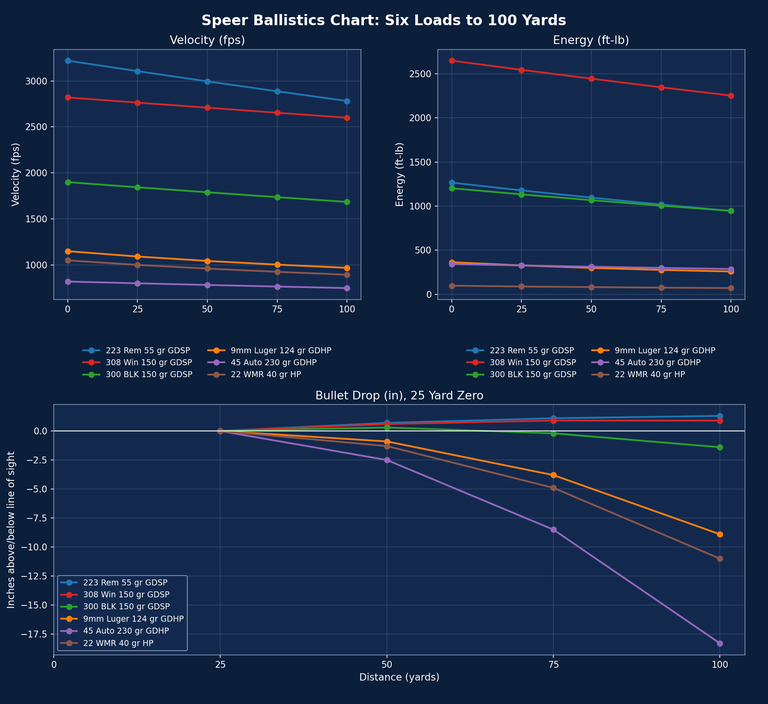
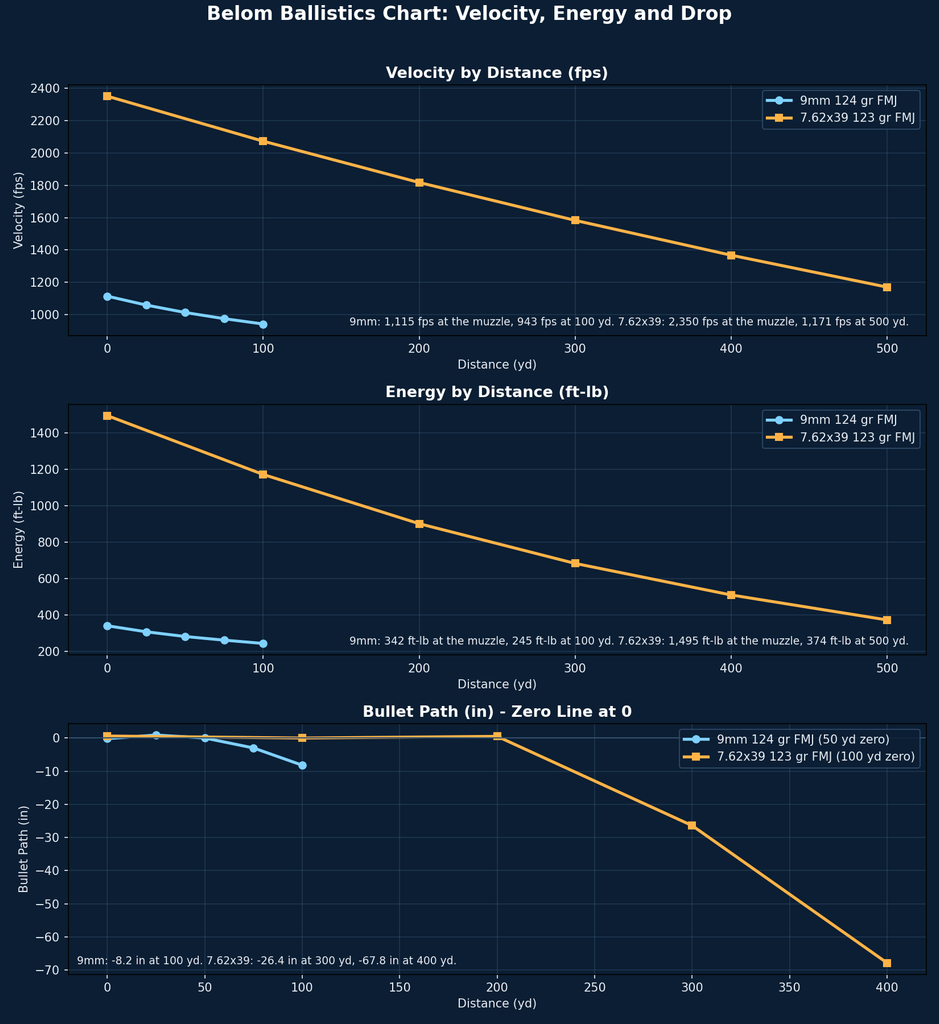
No Belom sheet prints a downrange table. Each specification sheet gives a velocity taken at 16 or 24 metres, a pressure limit and a bullet weight, and nothing past that. The chart below therefore shows the two loads sold commercially, the 9mm 124 grain FMJ out to 100 yards and the 7.62×39 123 grain FMJ out to 500 yards, with the factory specification table after it.
Table of Contents [Click to minimize]
Belom Ballistics: Velocity and Energy Chart: The Full 9mm and 7.62×39 Grid
A 50 yard zero and a 4 inch barrel sit behind the 9mm numbers. The 124 grain FMJ starts at 1,115 fps and 342 ft-lb, and it drops 8.2 inches by 100 yards.
| Load | BC (G1) | Barrel | Velocity Muzzle (fps) | Velocity 25 yd (fps) | Velocity 50 yd (fps) | Velocity 75 yd (fps) | Velocity 100 yd (fps) | Energy Muzzle (ft-lb) | Energy 25 yd (ft-lb) | Energy 50 yd (ft-lb) | Energy 75 yd (ft-lb) | Energy 100 yd (ft-lb) | Bullet Path Muzzle (in) | Bullet Path 25 yd (in) | Bullet Path 50 yd (in) | Bullet Path 75 yd (in) | Bullet Path 100 yd (in) |
|---|---|---|---|---|---|---|---|---|---|---|---|---|---|---|---|---|---|
| 9 x 19 mm 124 gr FMJ | 0.134 | 4 in | 1115 | 1060 | 1014 | 976 | 943 | 342 | 309 | 283 | 263 | 245 | -0.2 | 0.9 | 0 | -3 | -8.2 |
7.62×39 123 Grain FMJ to 500 Yards
A 100 yard zero and a 20 inch barrel sit behind the 7.62×39 numbers. The 123 grain FMJ starts at 2,350 fps and 1,495 ft-lb, holds 1,583 fps at 300 yards, and drops 67.8 inches by 400 yards. For this load the published table shows +0.5 inches at 200 yards, and it gives no drop figure at 500 yards.
| Load | BC (G1) | Barrel | Velocity Muzzle (fps) | Velocity 100 yd (fps) | Velocity 200 yd (fps) | Velocity 300 yd (fps) | Velocity 400 yd (fps) | Velocity 500 yd (fps) | Energy Muzzle (ft-lb) | Energy 100 yd (ft-lb) | Energy 200 yd (ft-lb) | Energy 300 yd (ft-lb) | Energy 400 yd (ft-lb) | Energy 500 yd (ft-lb) | Bullet Path Muzzle (in) | Bullet Path 100 yd (in) | Bullet Path 200 yd (in) | Bullet Path 300 yd (in) | Bullet Path 400 yd (in) | Bullet Path 500 yd (in) |
|---|---|---|---|---|---|---|---|---|---|---|---|---|---|---|---|---|---|---|---|---|
| 7.62 x 39 mm 123 gr FMJ | 0.282 | 20 in | 2350 | 2072 | 1817 | 1583 | 1368 | 1171 | 1495 | 1172 | 902 | 684 | 511 | 374 | 0.6 | 0 | 0.5 | -26.4 | -67.8 | – |
The Full Belom Factory Specification Table
All seven Belom loads appear below, in the metric units printed on the specification sheets. The velocities are taken at 16 metres for the 9mm rounds and at 24 metres for the 7.62 and 12.7 rounds, so they are not muzzle velocities. No ballistic coefficient and no trajectory table is published for any of them.
| Load | Cartridge | Bullet Type | Bullet Weight | Velocity (m/s) | Velocity Measured At | Test Barrel | Max Pressure |
|---|---|---|---|---|---|---|---|
| 9 x 19 mm Luger 124gr FMJ | 9 x 19 mm Luger | FMJ | 8.00±0.10 g | 340±10 | at 16 m | 200 mm EPVAT proof barrel | ≤2400 bar |
| 9 x 19 mm BALL 124gr MIL | 9 x 19 mm | FMJ (BALL) | 8.00±0.10 g | 375±15 | at 16 m | 200 mm proof barrel | ≤2850 bar |
| 7.62 x 39 mm BALL M43 | 7.62 x 39 mm | FMJ (BALL M43) | 7.97±0.10 g | 715±10 | at 24 m | 600 mm EPVAT proof barrel | ≤3300 bar |
| 7.62 x 39 mm BALL M16 (TACTICAL) | 7.62 x 39 mm | FMJ (BALL M16) | 7.97±0.10 g | 700±10 | at 24 m | 600 mm EPVAT proof barrel | ≤3100 bar |
| 12.7 x 108 mm BALL | 12.7 x 108 mm | FMJ BALL | 48.2±0.8 g | 810-825 | at 24 m | 1008 mm proof barrel | ≤3400 bar |
| 12.7 x 108 mm API | 12.7 x 108 mm | API | 48.2±0.8 g | 810-825 | at 24 m | 1008 mm proof barrel | ≤3400 bar |
| 12.7 x 108 mm APIT | 12.7 x 108 mm | APIT | 44.0±0.8 g | 810-825 | at 24 m | 1008 mm proof barrel | ≤3400 bar |
How to Read the Belom Chart
The Two 9mm Rounds
Two 9mm loads share a 124 grain FMJ bullet and a 200 mm proof barrel, but they run at different speeds. The Luger load is aimed at police training and competition and prints 340 metres per second at 16 metres. The MIL BALL load prints 375 metres per second, meets MIL-C-70508 and STANAG 4090, and carries the only energy figure Belom publishes anywhere.
Steel Core Against Lead Core
Belom’s two 7.62×39 rounds are twins with different cores. The M43 BALL has a steel core, prints 715 metres per second at 24 metres and is rated to 3,300 bar. The M16 TACTICAL has a lead core, prints 700 metres per second and is rated to 3,100 bar. Both use the same case, the same 7.97 gram bullet weight and the same powder charge range.
The 12.7×10⁸ Trio
Three 12.7 x 108 mm rounds close out the catalog. The BALL and API rounds both fire a 48.2 gram bullet at 810 to 825 metres per second, while the APIT tracer fires a 44.0 gram bullet at the same speed. The API round defeats 15 mm of armour plate at 100 metres, and the APIT tracer remains visible for at least 1,000 metres.
Why the Velocity Is Not a Muzzle Velocity
Every Belom velocity is an average taken downrange, at 16 metres for 9mm and 24 metres for the rifle and heavy machine gun rounds, from a standard proof barrel at 21 degrees Celsius. Because the bullet loses speed over that distance, the muzzle velocity is a little higher than the printed number, and the printed number should never be quoted as a muzzle figure.
Energy Is Published for One Load Only
Six of the seven Belom loads print no energy figure at all. The single exception is the 9mm MIL BALL, rated at at least 480 and under 620 joules. Energy numbers in the chart above come from the 9mm and 7.62×39 tables, while the factory table sticks to what Belom itself prints: velocity, weight and pressure.
No Coefficient and No Drop Table
Belom prints no ballistic coefficient, no sight-in distance and no drop table for any load. The G1 values shown in the chart, 0.134 for the 9mm and 0.282 for the 7.62×39, belong to the published tables behind those charts. No Belom load is carried past the distances its table covers.
Belom Ballistics FAQs
Which cartridges does Belom load?
Belom loads three cartridges across seven products: 9 x 19 mm, 7.62 x 39 mm and 12.7 x 108 mm. The 9mm and 7.62×39 loads are 124 and 123 grain FMJ, and the 12.7 loads use 44.0 and 48.2 gram bullets.
Which Belom load is the fastest?
The 12.7 x 108 mm BALL, API and APIT loads are the fastest, printing 810 to 825 metres per second at 24 metres from a 1008 mm proof barrel. The steel core 7.62 x 39 mm BALL M43 is the fastest of the commercial loads at 715 metres per second, listed at 2,350 fps muzzle velocity in retail listings.
Which Belom load hits hardest?
The 12.7 x 108 mm BALL and API loads fire the heaviest bullets in the range at 48.2 grams and 810 to 825 metres per second. Belom prints no energy figure for them, so no foot-pound value is stated here.
Why does Belom measure velocity at 16 and 24 metres?
Belom follows military proof practice, measuring average velocity downrange from the muzzle. The distance is 16 metres for 9mm and 24 metres for the 7.62 and 12.7 rounds, so the printed figure is not a muzzle velocity.
How much does the 9mm 124 grain FMJ drop at 100 yards?
With a 50 yard zero it drops 8.2 inches at 100 yards. Muzzle velocity is 1,115 fps with 342 ft-lb of energy, falling to 943 fps and 245 ft-lb at 100 yards.
How much does the 7.62×39 123 grain FMJ drop at 300 yards?
With a 100 yard zero it drops 26.4 inches at 300 yards. Muzzle velocity is 2,350 fps with 1,495 ft-lb of energy, falling to 1,583 fps and 684 ft-lb at 300 yards.
How do the M43 and M16 7.62×39 loads differ?
The M43 BALL has a steel core and the M16 TACTICAL has a lead core. The M43 is 15 metres per second faster at 24 metres and is rated to 3,300 bar, against 3,100 bar for the M16.
Does Belom publish ballistic coefficients?
No, Belom publishes no ballistic coefficient, no drop table and no sight-in distance for any load. The G1 figures in the chart above come from the published tables behind those two loads.
What is the 12.7×10⁸ APIT round?
It is an armour piercing incendiary tracer with a 44.0 gram bullet, fired at 810 to 825 metres per second. Its tracer is visible by 200 metres and remains visible for at least 1,000 metres.
Who makes Belom ammunition?
Belom d.o.o. makes it in Serbia, at Uzici near Pozega, as part of the Yugoimport SDPR group. The firm supplies military and law enforcement customers, and its 9mm and 7.62×39 loads are also sold commercially.