IGMAN Ballistics: Velocity and Energy Chart
Igman d.d. of Konjic, Bosnia and Herzegovina, builds military ammunition, and the ballistics it publishes cover 58 loads across five calibre groups, running from 5.56×45 mm up to 12.7×108 mm. Its quickest load is the 5.56×45 mm M193 Ball at 964,7 m/s, while its heaviest bullet, the 12.7×108 mm Ball, weighs 48,00 g. All figures in this article are metric and taken straight from IGMAN’s own spec sheets.
One warning before the tables. IGMAN never prints a muzzle velocity, so the velocity figures here are the values measured at the distance each sheet states, and the article shows that distance for every load. Energy appears for just 11 of the 58 loads, and the sheets carry no ballistic coefficient, no test barrel length and no trajectory at all.
Table of Contents [Click to minimize]
IGMAN Ballistics: Velocity and Energy Chart: The Full Military Velocity Table
Read the Measured At column as the subscript printed on the sheet itself. V23,77 stands for 23,77 metres from the muzzle, V16 for 16 metres, V4,5 for 4,5 metres and V6 for 6 metres. Where a sheet prints only a minimum, the table shows it as min. and nothing more.
| Cartridge | Load | Bullet Weight | Velocity (m/s) | Measured At | Pressure (bar) |
|---|---|---|---|---|---|
| 5.56×45 mm | M193 Ball | 3,56 (55 gr) | 964,7 ± 12 | V23,77 | max. 3792 |
| 5.56×45 mm | M196 Tracer | 3,50 (54 gr) | 949,5 ± 12 | V23,77 | max. 3792 |
| 5.56×45 mm | M856 Tracer | 3,92 (61 gr) | 917,4 ± 12 | V23,77 | max. 4450 |
| 5.56×45 mm | M855/SS109 | 4,00 (62 gr) | 920,5 ± 12 | V23,77 | max. 4450 |
| 7.62×39 mm | M67 Ball | 8,00 (123 gr) | 737 ± 15 | V23,77 | max. 3600 |
| 7.62×39 mm | M78 Tracer | 7,70 (119 gr) | 706 ± 15 | V23,77 | max. 3600 |
| 7.62×39 mm | AP | 8,00 (123 gr) | 737 ± 15 | V23,77 | max. 3600 |
| 7.62 mm | IGNITION CHARGE FOR RIFLE GRENADE (no bullet) | – | 59,5 ± 0,5 | V6 | max. 1570 |
| 7.62×51 mm | M80 Ball | 9,67 (149 gr) | 833,6 ± 9,1 | V23,77 | max. 4450 |
| 7.62×51 mm | M62 Tracer | 9,46 (146 gr) | 812,3 ± 9,1 | V23,77 | max. 4450 |
| 7.62×51 mm | M61 AP | 9,55 (147 gr) | 833,6 ± 9,1 | V23,77 | max. 4450 |
| 7.62×51 mm | API | 8,75 (135 gr) | 833,6 ± 9,14 | V23,77 | max. 4450 |
| 7.62×51 mm | APT | 8,70 (134 gr) | 812,3 ± 9,14 | V23,77 | max. 4450 |
| 7.62×51 mm | SNIPER BULLET FMJBT (10,9 g) | 10,9 (g only | 777 ± 9,1 | V23,77 | max. 4450 |
| 7.62×51 mm | SNIPER BULLET FMJBT (11,7 g) | 11,7 (g only | 777 ± 9,1 | V23,77 | max. 4450 |
| 7.62×51 mm | SNIPER BULLET HPBT (10,9 g) | 10,9 (g only | 777 ± 9,1 | V23,77 | max. 4450 |
| 7.62×51 mm | SNIPER BULLET HPBT (11,3 g) | 11,3 (g only | 777 ± 9,1 | V23,77 | max. 4450 |
| 7.62×54 mm R | M30 Ball | 11,00 (170 gr) | min. 780 | V23,77 | max. 3898 |
| 7.62×54 mm R | M87 Tracer | 9,40 (149 gr) | min. 780 | V23,77 | max. 3898 |
| 7.62×54 mm R | M90 API | 10,30 (159 gr) | min. 780 | V23,77 | max. 3898 |
| 7.62×54 mm R | AP | 10,30 (159 gr) | min. 780 | V23,77 | max. 3898 |
| 7.62×54 mm R | SNIPER | 11,80 (182 gr) | min. 780 | V23,77 | max. 3898 |
| 7.62×63 mm | M25 Tracer | 9,35 (144 gr) | 812 ± 9,1 | V23,77 | max. 3447 |
| 7.62×63 mm | M2 Ball | 9,85 (152 gr) | 835 ± 9,1 | V23,77 | max. 3447 |
| 7.9×57 mm | M49 Ball | 12,85 (198 gr) | 720 ± 10 | V23,77 | max. 2940 |
| 7.9×57 mm | M70 Tracer | 12,55 (194 gr) | 705 ± 10 | V23,77 | max. 2940 |
| 9×19 mm | FMJ 115 gr (7,45 g) | 7,45 g (115 gr) | 380 ± 10 | V16 | max. 2850 |
| 9×19 mm | FMJ 124 gr (8 g) | 8,00 g (124 gr) | 370 ± 10 | V16 | max. 2850 |
| 9×19 mm | FMJ 115 gr (7,45 g) CIP | 7,45 g (115 gr) | 360 ± 15 | V4,5 | max. 2350 |
| 9×19 mm | FMJ 124 gr (8 g) CIP | 8,00 g (124 gr) | 350 ± 15 | V4,5 | max. 2350 |
| 12.7×99 mm | M33 Ball | 42,31 (653 gr) | 885,4 ± 9,1 | V23,77 | max. 4500 |
| 12.7×99 mm | M17 Tracer | 40,05 (618 gr) | 885,4 ± 9,1 | V23,77 | max. 4500 |
| 12.7×99 mm | M8 API | 42,65 (661 gr) | 885,4 ± 9,1 | V23,77 | max. 4500 |
| 12.7×99 mm | M20 APIT | 40,12 (620 gr) | 885,4 ± 9,1 | V23,77 | max. 4500 |
| 12.7×99 mm | M2 AP | 42,56 (656 gr) | 885,4 ± 9,1 | V23,77 | max. 4500 |
| 12.7×99 mm | M02 APEI | 42,65 (661 gr) | 885,4 ± 9,1 | V23,77 | max. 4500 |
| 12.7×99 mm | APT | 40,05 (618 gr) | 885,4 ± 9,1 | V23,77 | max. 4500 |
| 12.7×99 mm | M33 SNIPER | – | 885,4± 9,1 | V23,77 | max. 4500 |
| 12.7×99 mm | M2 AP SNIPER | ~42,56 (~656 gr) | 885,4 ± 9,1 | V23,77 | max. 4500 |
| 12.7×108 mm | Ball | 48,00 (740 gr) | min. 810 | V23,77 | max. 3114 |
| 12.7×108 mm | AP | 48,00 (740 gr) | min. 810 | V23,77 | max. 3114 |
| 12.7×108 mm | Tracer | 44,00 (679 gr) | min. 810 | V23,77 | max. 3114 |
| 12.7×108 mm | APT | 44,00 (679 gr) | min. 810 | V23,77 | max. 3114 |
| 12.7×108 mm | B32 API | 48,00 (740 gr) | min. 810 | V23,77 | max. 3114 |
| 12.7×108 mm | BZT44 APIT | 44,00 (679 gr) | min. 810 | V23,77 | max. 3114 |
| 12.7×108 mm | SNIPER | 48 00 (755 gr) | min. 810 | V23,77 | max. 3114 |
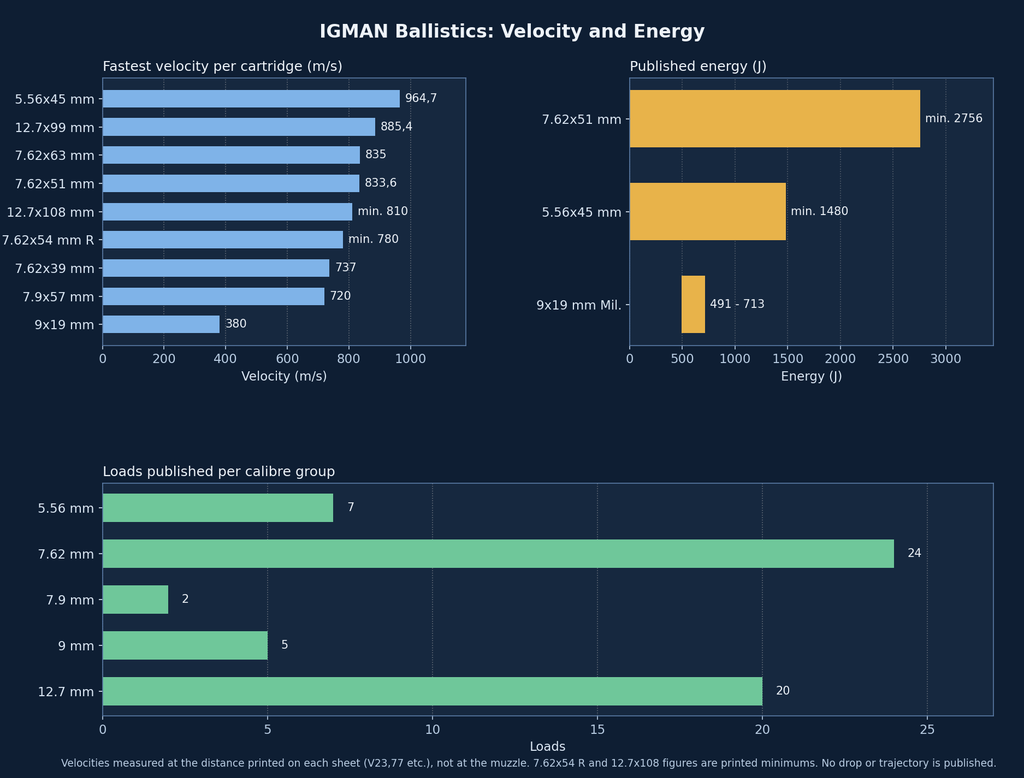
The catalogue leans heavily on two groups: 24 loads are 7.62 mm and 20 are 12.7 mm, leaving just 14 across 5.56 mm, 7.9 mm and 9 mm. Twelve loads carry no velocity figure, seven of them blanks, one a proof cartridge, one a competition load and three solid special bullets. The slowest figure in the chart is the rifle-grenade ignition charge at 59,5 m/s, measured 6 metres from the muzzle.
IGMAN Ballistics: The Eleven Loads With Published Energy
| Cartridge | Load | Bullet Weight | Energy (J) | Energy Measured At |
|---|---|---|---|---|
| 5.56×45 mm | M856 Tracer | 3,92 (61 gr) | min. 1480 | 24 m |
| 5.56×45 mm | M855/SS109 | 4,00 (62 gr) | min. 1480 | 24 m |
| 7.62×51 mm | M80 Ball | 9,67 (149 gr) | min. 2756 | 24 m |
| 7.62×51 mm | M62 Tracer | 9,46 (146 gr) | min. 2756 | 24 m |
| 7.62×51 mm | M61 AP | 9,55 (147 gr) | min. 2756 | 24 m |
| 7.62×51 mm | API | 8,75 (135 gr) | min. 2756 | 24 m |
| 7.62×51 mm | APT | 8,70 (134 gr) | min. 2756 | 24 m |
| 9×19 mm | FMJ 115 gr (7,45 g) | 7,45 g (115 gr) | 491 – 713 | 16 m |
| 9×19 mm | FMJ 124 gr (8 g) | 8,00 g (124 gr) | 491 – 713 | 16 m |
| 9×19 mm | FMJ 115 gr (7,45 g) CIP | 7,45 g (115 gr) | – | – |
| 9×19 mm | FMJ 124 gr (8 g) CIP | 8,00 g (124 gr) | – | – |
Energy is the thinnest part of the IGMAN data. Five 7.62×51 mm live loads and two 5.56×45 mm loads print a minimum energy at 24 metres, the two 9 mm military loads share one range of 491 to 713 joules at 16 metres, and the two 9 mm CIP sheets leave the energy column blank with a dash. The sheets also carry a few print errors, left untouched: the M87 Tracer weight reads 9,40 g beside 149 gr, the 12.7×108 mm Sniper weight reads 48 00 beside 755 gr, and the 7.62×51 mm API and APT sheets give a tolerance of plus or minus 9,14 where the rest give 9,1.
IGMAN Ballistics: Blanks, Proof Loads and Special Bullets
| Cartridge | Load | Pressure (bar) | Published Instead |
|---|---|---|---|
| 5.56×45 mm | HP (High Pressure) | 4836 ± 207 | Pressure only (proof load) |
| 5.56 mm | M200 BLANK (no bullet – blank) | – | Cyclic rate only: rifles 550-920, M249 650-950 per minute |
| 5.56 mm | M200A1 BLANK (no bullet – blank) | – | Cyclic rate only: rifles 550-920, M249 650-950 per minute |
| 7.62 mm | M68 BLANK (no bullet – blank) | – | Cyclic rate only: min. 475 per minute (AK 47) |
| 7.62 mm (for 7.62×51 mm weapon caliber) | M82 BLANK (no bullet – blank) | – | Cyclic rate only: M60 min. 450, M240 min. 650 per minute |
| 7.62 mm R | BLANK (no bullet – blank) | – | Cyclic rate only: min. 600 per minute (M84) |
| 7.62 mm | M1909 BLANK (no bullet – blank) | – | No ballistic data printed in this sheet |
| 9×19 mm | FMJ 147 gr (9,5 g) IPSC | max. 2350 | Pressure and power factor coefficient |
| 12.7×99 mm | Solid API (SPECIAL BULLETS) | max. 4500 | Pressure and accuracy only |
| 12.7×99 mm | Solid Ball (SPECIAL BULLETS) | max. 4500 | Pressure and accuracy only |
| 12.7×99 mm | Solid AP (SPECIAL BULLETS) | max. 4500 | Pressure and accuracy only |
| 12.7×99 mm | M1A1 BLANK (no bullet – blank) | – | Cyclic rate only: 450-600 per minute (M2 HB) |
These twelve loads publish other figures in place of velocity. The seven blanks give a cyclic rate for the weapon they are made for, the proof cartridge gives only pressure, the IPSC load gives pressure and a power factor coefficient, and the three solid special bullets give pressure and accuracy.
IGMAN Ballistics Explained
Where the Speed Is: 5.56 mm Leads the Chart
Speed in the IGMAN catalogue belongs to the smallest calibre. The 5.56×45 mm M193 Ball prints 964,7 m/s and the M196 Tracer 949,5 m/s, both measured 23,77 metres from the muzzle. Behind them come the 12.7×99 mm loads at 885,4 m/s, the 7.62×63 mm M2 Ball at 835 m/s and the 7.62×51 mm M80 Ball at 833,6 m/s. The slowest bullet is the 9 mm CIP 124 grain FMJ at 350 m/s.
Heavy Metal: the 12.7 mm Sheets
A third of the IGMAN catalogue is 12.7 mm, thirteen loads in 12.7×99 mm and seven in 12.7×108 mm. The 12.7×99 mm loads with a velocity all print the same 885,4 m/s, while the 12.7×108 mm loads print a minimum of 810 m/s. The catalogue’s heaviest bullet is the 12.7×108 mm Ball at 48,00 g, and four of the twenty 12.7 mm loads, the three solid special bullets and the M1A1 blank, print no velocity.
Why the 7.62 mm Group Dominates the Catalogue
Almost half the IGMAN catalogue is 7.62 mm, with 24 loads in four cartridges. The 7.62×51 mm M80 Ball, M61 AP and API share 833,6 m/s, and the 7.62×63 mm M2 Ball edges them at 835 m/s. All five 7.62×54 mm R loads give only a minimum of 780 m/s, the 7.62×39 mm M67 Ball and AP print 737 m/s, and the four 7.62 mm blanks carry no velocity figure.
The 9 mm Sheets and Their Three Standards
Five 9 mm loads cover three standards. The military sheets print 380 and 370 m/s at 16 metres, the civilian CIP sheets print 360 and 350 m/s at 4,5 metres, and the IPSC sheet prints no velocity at all. Both military sheets give the same energy range, 491 to 713 joules, while the CIP sheets mark energy with a dash. The IPSC load instead gives pressure and a power factor coefficient of at least 125.
Loads With No Velocity Figure
Twelve loads have no velocity on their sheets. Seven are blanks, and they give a cyclic rate instead: M200 blanks run rifles at 550 to 920 cartridges per minute and the M249 at 650 to 950. The high-pressure proof cartridge gives only pressure, 4836 plus or minus 207 bar. The IPSC load gives pressure and a power factor coefficient, and the three solid special bullets give pressure and accuracy figures.
Gaps in the Published Data
Three things are missing from every IGMAN sheet: a ballistic coefficient, a test barrel length, and any trajectory or bullet drop figure. The nearest thing to downrange data is accuracy: the 7.62×51 mm sniper bullets claim 0,6 MOA, and the 12.7×99 mm solid bullets give accuracy out to 1100 metres. Energy reaches only eleven loads, and three sheets print a cartridge length shorter than the case length.
Frequently Asked Questions About IGMAN Ballistics
1. Who makes IGMAN ammunition?
Igman d.d. of Konjic, Bosnia and Herzegovina, a military ammunition maker whose published ballistics cover 58 loads in five calibre groups.
2. Why does the chart not list muzzle velocity?
IGMAN never prints muzzle velocity. Each sheet gives velocity at a stated distance from the muzzle, and the chart shows that distance in the Measured At column.
3. How do I read a V23,77 figure?
V23,77 means the velocity was measured 23,77 metres from the muzzle. The 9 mm military sheets use V16, the 9 mm CIP sheets use V4,5, and the ignition charge uses V6.
4. What is the fastest IGMAN cartridge?
The 5.56×45 mm M193 Ball leads the chart at 964,7 m/s, measured 23,77 metres from the muzzle.
5. How much energy do IGMAN loads publish?
Only eleven loads print energy: the 7.62×51 mm live loads give a minimum of 2756 joules, the 5.56×45 mm loads a minimum of 1480 joules, and the 9 mm military loads 491 to 713 joules.
6. Is there a BC for any IGMAN bullet?
No. IGMAN prints no ballistic coefficient for any of its bullets.
7. Can I find drop data for IGMAN loads anywhere in the chart?
No. IGMAN publishes no trajectory or bullet drop figures, so there is no drop table in either version of this article.
8. Which calibre group has the most IGMAN loads?
The 7.62 mm group, with 24 loads, followed by the 12.7 mm group with 20.
9. What do the blank cartridges publish instead of velocity?
A cyclic rate for the weapon they feed. The M200 blanks, for example, cycle rifles at 550 to 920 cartridges per minute and the M249 at 650 to 950.
10. Do the IGMAN sheets use metric or imperial units?
Metric only. Weights are in grams, velocities in metres per second, energy in joules and pressure in bar.