257 Roberts Ballistics – Trajectory and Bullet Drop Chart
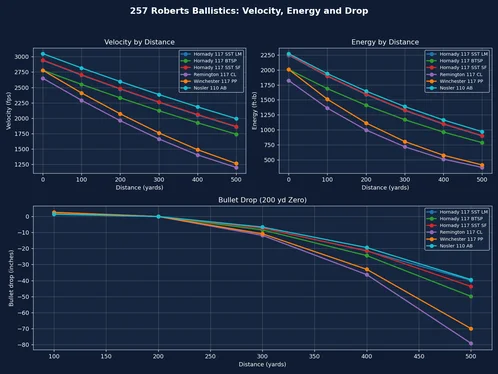
The 257 Roberts has been putting deer on the ground since 1934, and it still does the job with mild recoil and a flat arc. Remington brought it out as a commercial cartridge based on the 7×57 Mauser case necked down for a .257 inch bullet. Six factory loads in this chart publish complete tables to 500 yards, and three more publish muzzle figures.
Modern +P ammunition gives the old cartridge new life, driving a 117 grain bullet near 3,000 feet per second. Below are the velocity, energy and drop figures for each load that publishes a full table, followed by the muzzle figures for the rest.
Table of Contents [Click to minimize]
257 Roberts Ballistics: The Full Factory Grid to 500 Yards
| Brand | Load | Product Line | SKU | Traj. Zero (yd) | Vel. Muzzle (fps) | Vel. 100 yd (fps) | Vel. 200 yd (fps) | Vel. 300 yd (fps) | Vel. 400 yd (fps) | Vel. 500 yd (fps) | Energy Muzzle (ft-lb) | Energy 100 yd (ft-lb) | Energy 200 yd (ft-lb) | Energy 300 yd (ft-lb) | Energy 400 yd (ft-lb) | Energy 500 yd (ft-lb) | Traj. 100 yd (in) | Traj. 200 yd (in) | Traj. 300 yd (in) | Traj. 400 yd (in) | Traj. 500 yd (in) |
|---|---|---|---|---|---|---|---|---|---|---|---|---|---|---|---|---|---|---|---|---|---|
| Hornady | 117 gr SST InterLock | Light Magnum | 85354 | 200 | 2,940 | 2,701 | 2,474 | 2,258 | 2,053 | 1,859 | 2,245 | 1,895 | 1,589 | 1,324 | 1,095 | 898 | 1.6 | 0 | -7.3 | -21.5 | -39.9 |
| Hornady | 117 gr BTSP InterLock | Custom | 8135 | 200 | 2,780 | 2,550 | 2,331 | 2,122 | 1,925 | 1,740 | 2,007 | 1,688 | 1,411 | 1,170 | 963 | 787 | 1.9 | 0 | -8.4 | -24.4 | -49.9 |
These two loads are taken from Hornady’s older printed chart. The Light Magnum SST InterLock runs at 2,940 feet per second, and the standard BTSP InterLock at 2,780. Both are shown on a 200 yard zero with a full path to 500 yards. Hornady prints no ballistic coefficient for either load.
257 Roberts Ballistics: Federal 120 Grain Nosler Partition
| Brand | Load | Product Line | SKU | Vel. Muzzle (fps) | Vel. 100 yd (fps) | Vel. 200 yd (fps) | Vel. 300 yd (fps) | Vel. 400 yd (fps) | Vel. 500 yd (fps) | Energy Muzzle (ft-lb) | Energy 100 yd (ft-lb) | Energy 200 yd (ft-lb) | Energy 300 yd (ft-lb) | Energy 400 yd (ft-lb) | Energy 500 yd (ft-lb) |
|---|---|---|---|---|---|---|---|---|---|---|---|---|---|---|---|
| Federal | 120 gr Nosler Partition | Vital-Shok | P257B | 2,780 | 2,560 | 2,360 | 2,160 | 1,970 | 1,790 | 2,060 | 1,750 | 1,480 | 1,240 | 1,030 | 855 |
This Federal load uses the 120 grain Nosler Partition, the heaviest bullet in the Roberts lineup. It leaves at 2,780 feet per second with 2,060 foot-pounds, and it still holds 855 foot-pounds at 500 yards. Only velocity and energy are published for it, so it has no path column. The published ballistic coefficient for the 120 grain Partition is 0.391.
257 Roberts Manufacturer Ballistics: The Four Complete Factory Tables
| Brand | Load | Product Line | SKU | BC (G1) | Traj. Zero (yd) | Vel. Muzzle (fps) | Vel. 100 yd (fps) | Vel. 200 yd (fps) | Vel. 300 yd (fps) | Vel. 400 yd (fps) | Vel. 500 yd (fps) | Energy Muzzle (ft-lb) | Energy 100 yd (ft-lb) | Energy 200 yd (ft-lb) | Energy 300 yd (ft-lb) | Energy 400 yd (ft-lb) | Energy 500 yd (ft-lb) | Traj. 100 yd (in) | Traj. 200 yd (in) | Traj. 300 yd (in) | Traj. 400 yd (in) | Traj. 500 yd (in) |
|---|---|---|---|---|---|---|---|---|---|---|---|---|---|---|---|---|---|---|---|---|---|---|
| Hornady | 117 gr SST | Superformance | 81353 | – | 200 | 2,946 | 2,707 | 2,480 | 2,265 | 2,060 | 1,866 | 2,255 | 1,903 | 1,598 | 1,332 | 1,102 | 905 | 1.6 | 0 | -7.3 | -21.4 | -43.7 |
| Remington | 117 gr Core-Lokt Soft Point | Core-Lokt | 28335 | .240 | 200 | 2,650 | 2,291 | 1,960 | 1,663 | 1,403 | 1,199 | 1,824 | 1,363 | 998 | 718 | 512 | 373 | 2.6 | 0 | -11.8 | -36.3 | -79.2 |
| Winchester | 117 gr Power-Point | Power-Point | X257P3 | 0.240 | 200 | 2,780 | 2,411 | 2,071 | 1,761 | 1,488 | 1,263 | 2,009 | 1,511 | 1,115 | 806 | 576 | 415 | 2.6 | 0 | -10.8 | -33 | -70 |
| Nosler | 110 gr AccuBond | Trophy Grade | 60010 | – | 200 | 3,050 | 2,817 | 2,596 | 2,385 | 2,184 | 1,993 | 2,272 | 1,938 | 1,646 | 1,389 | 1,165 | 970 | 1.4 | 0 | -6.6 | -19.4 | -39.4 |
These four loads are the current factory tables. The Nosler 110 grain AccuBond tops the chart at 3,050 feet per second and 2,272 foot-pounds. Hornady’s current 117 grain SST, item 81353, prints almost the same velocity as the older Light Magnum SST above, but it drops 43.7 inches at 500 yards against 39.9, so both stay in the chart. Nosler’s table runs to 800 yards, and the figures past 500 yards appear in the drop section. Hornady and Nosler print no ballistic coefficient for these loads. Nosler is the only maker to print a test barrel length, 24 inches.
257 Roberts Drop Chart: The 100 Yard Zero Paths
| Brand | Load | Product Line | SKU | Path 50 yd (in) | Path 100 yd (in) | Path 200 yd (in) | Path 300 yd (in) |
|---|---|---|---|---|---|---|---|
| Remington | 117 gr Core-Lokt Soft Point | Core-Lokt | 28335 | 0 | 0 | -5.2 | -19.6 |
| Winchester | 117 gr Power-Point | Power-Point | X257P3 | -0.1 | 0 | -4.5 | -17.2 |
| Nosler | 110 gr AccuBond | Trophy Grade | 60010 | – | 0 | -2.9 | -11 |
Three makers print a 100 yard zero path for the Roberts. The Nosler AccuBond drops least at every distance, 11 inches low at 300 yards. Winchester prints a 400 yard figure of 41.3 inches low, and the Nosler table runs to 800 yards, where the AccuBond is 171.6 inches low. Hornady prints no 100 yard zero path for its Roberts loads.
257 Roberts Wind Drift: The 10 mph Crosswind Table
| Brand | Load | Product Line | SKU | Drift 100 yd (in) | Drift 200 yd (in) | Drift 300 yd (in) | Drift 400 yd (in) | Drift 500 yd (in) |
|---|---|---|---|---|---|---|---|---|
| Remington | 117 gr Core-Lokt Soft Point | Core-Lokt | 28335 | 1.5 | 6.5 | 15.9 | 30.5 | 51.4 |
Remington is the only maker to print wind drift for the Roberts. In a 10 mph crosswind, the 117 grain Core-Lokt moves 1.5 inches at 100 yards, 6.5 at 200, 15.9 at 300, 30.5 at 400, and 51.4 at 500. Drift is small inside 200 yards and grows fast after that.
257 Roberts Muzzle Figures: Loads Without a Downrange Table
| Brand | Load | Product Line | SKU | Muzzle Velocity (fps) | Muzzle Energy (ft-lb) |
|---|---|---|---|---|---|
| HSM | 117 gr Spitzer Boat Tail GameKing | Game King | HSM-257Rbts-7-N | 2,675 | 1,859 |
| HSM | 115 gr Match Hunting Very Low Drag | Trophy Gold | BER-257R115VLD | 2,955 | 2,230 |
| HSM | 75 gr V-Max | Varmint | HSM-257Rbts-6-N | 3,338 | 1,856 |
These three loads publish muzzle velocity and energy only, with no downrange table. HSM’s 75 grain V-Max is the quickest Roberts load in this article at 3,338 feet per second, and its 115 grain Trophy Gold Berger VLD is the second hardest hitting at 2,230 foot-pounds. The 115 grain load also carries the highest ballistic coefficient of the three, 0.483.
How Fast Is the 257 Roberts?
The quickest 257 Roberts loads
The Nosler 110 grain AccuBond is the quickest fully charted load at 3,050 feet per second. HSM’s 75 grain V-Max lists a quicker muzzle velocity of 3,338 feet per second, but it has no downrange table. At 500 yards the Nosler load is still fastest at 1,993 feet per second, ahead of the Hornady Light Magnum SST at 1,859.
Speed loss downrange
Each Roberts load loses around a third of its muzzle velocity by 500 yards. The Remington 117 grain load slows the most, from 2,650 to 1,199 feet per second. The Nosler 110 grain load keeps its speed best, holding 1,993 feet per second at 500 yards. That is why it stays ahead at long range, even though the Hornady SST loads start close behind.
How Much Energy Does the 257 Roberts Carry?
Muzzle energy by load
Nosler’s 110 grain AccuBond makes the most muzzle energy at 2,272 foot-pounds. The two Hornady 117 grain SST loads follow at 2,255 and 2,245 foot-pounds. HSM’s 75 grain V-Max, the lightest load here, makes 1,856 foot-pounds at the muzzle despite its speed, since energy depends on bullet weight as well as velocity.
Energy at 500 yards
At 500 yards the Nosler 110 grain AccuBond still holds 970 foot-pounds, the most of any charted load. The Hornady SST loads keep 905 and 898. The Remington 117 grain load drops to 373 foot-pounds at 500 yards, the lowest in the chart. Fast, heavy bullets keep more energy downrange, which is why the Nosler load leads at distance.
What Is the Bullet Drop of the 257 Roberts?
Drop on a 200 yard zero
Sighted at 200 yards, the Roberts falls 6.6 to 11.8 inches by 300 yards, with the load deciding where it lands in that range. The Nosler 110 grain AccuBond stays flattest all the way out, dropping 39.4 inches at 500 yards. The Remington 117 grain load falls the most, 79.2 inches at 500. At 100 yards every charted load is within about two and a half inches of the line of sight.
Reading the path numbers
Path figures show where the bullet strikes compared with the line of sight. Positive figures mean the bullet is above the line of sight, and negative figures mean it is below. Sighted at 200 yards, the bullet crosses the line of sight at 200 yards, rides about one and a half to two and a half inches high at 100, and falls steadily after 200. The Hornady loads begin 1.5 inches low at the muzzle.
What Is the Effective Range of the 257 Roberts?
Deer hunting range
The Roberts shines as a deer cartridge inside 300 yards. Every charted load still carries more than 700 foot-pounds at 300 yards, with drop inside 11.8 inches on a 200 yard zero. Beyond 400 yards the drop climbs fast, passing 39 inches at 500, and wind drift climbs with it. Most deer hunters call 300 yards the practical limit.
What +P means for your rifle
Most Roberts loads today are +P, loaded to higher pressure than the 1934 original. A +P load drives a 117 grain bullet at 2,780 to 2,946 feet per second, while the standard pressure Remington load runs 2,650. Rifles made before the +P standard should stick to standard pressure loads, so check the rifle before picking a +P round.
What 257 Roberts Ammo Can You Buy?
Factory loads on the shelf
Six makers load the Roberts today. Hornady leads the choice with 117 grain SST and InterLock rounds. Remington and Winchester each offer a 117 grain soft point. Nosler’s catalog has a 110 grain AccuBond Trophy Grade load plus three NoslerCustom rounds. Federal’s Roberts load is a 120 grain Nosler Partition, and HSM covers 75 to 117 grains with three loads.
Handloading the Roberts
Handloaders can pick bullets from 75 to 120 grains for the Roberts. Nosler prints handload data in weights from 85 to 120 grains and sells Roberts brass, but its NoslerCustom factory loads carry no ballistics table. Doubletap lists three Roberts loads with no published velocity or energy. Factory Roberts ammo costs about 2 dollars per round.
How Does the 257 Roberts Compare to the 25-06?
The same bullet in both cartridges
With a 117 grain bullet, the 25-06 Remington runs about 210 feet per second faster than the Roberts. A 117 grain 25-06 load leaves the muzzle at 2,990 feet per second, while the standard Roberts +P load leaves at 2,780. The 25-06 also carries more energy at every distance, holding 1,465 foot-pounds at 300 yards, ahead of the best Roberts figure of 1,389.
Picking between the two
The 25-06 is the faster cartridge, winning on flat trajectory and energy at long range. The Roberts is the milder cartridge, kicking less and fitting a shorter action, and it does its best work inside 300 yards. Most deer hunters will find the Roberts is enough gun. Shooters who want more reach should pick the 25-06.
Frequently Asked Questions
Which 257 Roberts load is fastest?
The Nosler 110 grain AccuBond is the fastest fully charted load at 3,050 feet per second. HSM’s 75 grain V-Max lists 3,338 feet per second at the muzzle, but it has no downrange table.
How much muzzle energy does the 257 Roberts have?
Muzzle energy runs from 1,824 to 2,272 foot-pounds across the charted loads. The Nosler 110 grain AccuBond leads at 2,272.
How far does a 257 Roberts drop at 500 yards?
Sighted at 200 yards, the Roberts drops 39.4 to 79.2 inches at 500 yards, from the Nosler 110 grain AccuBond to the Remington 117 grain Core-Lokt.
Which 257 Roberts load is best for deer?
The Nosler 110 grain AccuBond is the flattest and hardest hitting load here, while the Hornady 117 grain SST is the classic deer choice. Both work well inside 300 yards.
Can you hunt varmints with a 257 Roberts?
Yes, with light bullets. HSM’s 75 grain V-Max leaves the muzzle at 3,338 feet per second. Most factory loads are 110 to 120 grain deer bullets, though.
How far will a 257 Roberts shoot?
Most shooters treat 300 yards as the practical deer limit. Drop stays inside 11.8 inches at 300 yards, then passes 39 inches at 500, while wind drift grows fast past 400.
What does +P mean on a 257 Roberts box?
+P marks a load built to higher pressure than the 1934 original. Most Roberts loads today are +P, and older rifles should stick to standard pressure loads.
Is the 257 Roberts or the 25-06 faster?
The 25-06 runs about 210 feet per second faster with a 117 grain bullet and carries more energy at every distance. The Roberts kicks less and fits a shorter action.
What bullet weights come in 257 Roberts?
Weights in this chart run from 75 to 120 grains. The 117 grain bullet is the most common weight, with 110 and 120 grain loads alongside it.
What zero is the 257 Roberts chart based on?
The main tables use a 200 yard zero. Remington, Winchester and Nosler also print 100 yard zero sets, shown in the drop table.