Hornady 300 Blackout Ballistics Chart
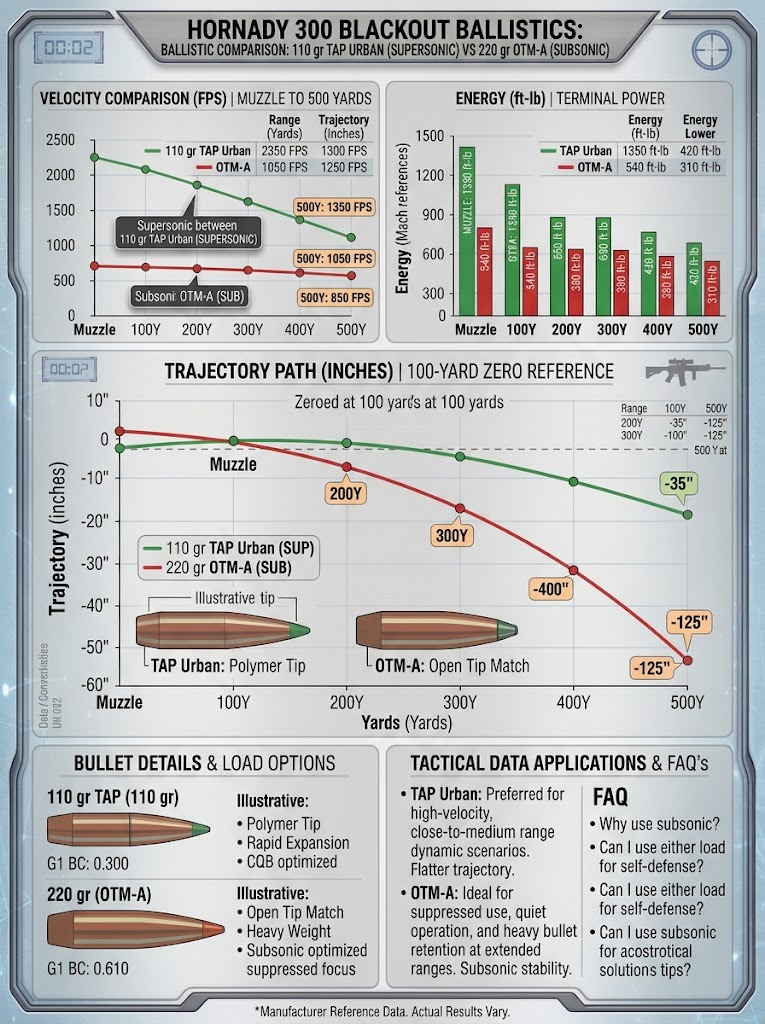
The Hornady 300 Blackout ballistics chart provides information about bullet velocity, energy, and trajectory at different distances. Hornady offers both supersonic and subsonic 300 Blackout ammunition, with different bullet weights and ballistic characteristics.
This guide covers two Hornady loads: the 110-grain TAP Urban and the 220-grain OTM-A. Their manufacturer-published figures show how bullet weight and velocity affect the cartridge’s ballistic performance.
Table of Contents [Click to minimize]
Hornady 300 Blackout 110 Grain Ballistics Chart
The 110-grain TAP Urban is a supersonic 300 Blackout load. Hornady lists a muzzle velocity of 2,370 feet per second and muzzle energy of 1,372 foot-pounds using a 16-inch SAAMI test barrel.
| Distance | Velocity (FPS) | Energy (ft-lbs) | Trajectory (inches) |
|---|---|---|---|
| Muzzle | 2,370 | 1,372 | -1.5 |
| 100 yards | 2,089 | 1,066 | 0 |
| 200 yards | 1,830 | 818 | -6.5 |
| 300 yards | 1,594 | 620 | -23.5 |
| 400 yards | 1,386 | 469 | -54.2 |
| 500 yards | 1,215 | 361 | -103.2 |
Hornady 300 Blackout 220 Grain Ballistics Chart
The 220-grain OTM-A is a subsonic 300 Blackout load. Its heavier bullet has a lower muzzle velocity than the 110-grain option. Hornady lists a muzzle velocity of 1,050 FPS and muzzle energy of 539 foot-pounds.
| Distance | Velocity (FPS) | Energy (ft-lbs) | Trajectory (inches) |
|---|---|---|---|
| Muzzle | 1,050 | 539 | -1.5 |
| 100 yards | 1,009 | 498 | 0 |
| 200 yards | 975 | 464 | -32.6 |
| 300 yards | 945 | 436 | -101.8 |
| 400 yards | 918 | 411 | -209.9 |
| 500 yards | 893 | 390 | -359.5 |
Hornady 300 Blackout Ammunition Specifications
The following table compares the published specifications of the two Hornady loads.
| Specification | 110 Grain TAP Urban | 220 Grain OTM-A |
|---|---|---|
| Item Number | 80885 | 80859 |
| Bullet Weight | 110 grains | 220 grains |
| Bullet Type | TAP Urban | Open Tip Match |
| Ballistic Coefficient | 0.290 | 0.625 |
| Sectional Density | 0.166 | 0.331 |
| Test Barrel | 16 inches | 16 inches |
| Muzzle Velocity | 2,370 FPS | 1,050 FPS |
| Muzzle Energy | 1,372 ft-lbs | 539 ft-lbs |
Supersonic vs. Subsonic 300 Blackout Ballistics
The main difference between these two Hornady loads is their velocity. The 110-grain TAP Urban travels at a much higher initial velocity, while the 220-grain OTM-A is designed as a subsonic load.
The lighter bullet has higher muzzle velocity and muzzle energy in these manufacturer figures. The heavier bullet has a higher listed ballistic coefficient and sectional density.
These differences explain why the two loads have different trajectory profiles. The 220-grain load shows considerably more bullet drop at longer distances in the published chart.
What Affects Hornady 300 Blackout Ballistics?
Bullet Weight
Bullet weight affects velocity, energy, and trajectory. Hornady’s 110-grain and 220-grain loads demonstrate the differences between lighter supersonic and heavier subsonic ammunition.
Barrel Length
Barrel length can influence the velocity achieved by a cartridge. Hornady identifies the test barrel used for its published figures, so results from firearms with different barrel lengths may vary.
Ballistic Coefficient
The ballistic coefficient describes how a bullet performs against air resistance. Hornady lists a coefficient of 0.290 for the 110-grain TAP Urban and 0.625 for the 220-grain OTM-A.
Atmospheric Conditions
Temperature, air pressure, altitude, and air density can influence actual ballistic performance. Manufacturer figures are based on specified test conditions and may differ from results in other environments.
Frequently Asked Questions
What Is the Muzzle Velocity of Hornady 300 Blackout?
It depends on the ammunition. Hornady lists 2,370 FPS for its 110-grain TAP Urban and 1,050 FPS for its 220-grain OTM-A, using a 16-inch test barrel.
What Is the Difference Between 110-Grain and 220-Grain 300 Blackout?
The 110-grain TAP Urban is a supersonic load with higher muzzle velocity. The 220-grain OTM-A is a subsonic load with a heavier bullet and lower muzzle velocity.
What Is the Ballistic Coefficient of Hornady 220-Grain OTM-A?
Hornady lists a ballistic coefficient of 0.625 and sectional density of 0.331 for its 220-grain OTM-A bullet.
Does Barrel Length Affect 300 Blackout Ballistics?
Yes. Barrel length can affect the velocity produced by a cartridge. Actual results may differ from Hornady’s published figures when using a different firearm or barrel.
Why Does the 220-Grain 300 Blackout Chart Show More Bullet Drop?
The 220-grain OTM-A starts at a much lower velocity than the 110-grain TAP Urban. Its published trajectory figures therefore show substantially more drop at the listed distances.
Are Hornady 300 Blackout Ballistics Charts the Same for Every Load?
No. Hornady publishes different ballistic figures for different bullet weights and ammunition types. Supersonic and subsonic loads should be compared separately.
What Test Barrel Did Hornady Use for These Ballistic Figures?
The cited 110-grain TAP Urban and 220-grain OTM-A charts specify a 16-inch test barrel.
What Is the Muzzle Energy of Hornady 110-Grain 300 Blackout?
Hornady lists 1,372 foot-pounds of muzzle energy for its 110-grain TAP Urban ammunition.
What Is the Muzzle Energy of Hornady 220-Grain 300 Blackout?
Hornady lists 539 foot-pounds of muzzle energy for its 220-grain OTM-A ammunition.
Where Can I Find Official Hornady 300 Blackout Data?
Hornady’s official ammunition guides and Law Enforcement and Military catalog provide manufacturer specifications and ballistic tables for selected 300 Blackout loads.
Hornady 300 Blackout Ballistics Data
Review Hornady’s published ammunition specifications, bullet information, and ballistic resources for 300 Blackout.
View Official Hornady Ballistic Data ↗