6.5 Creedmoor Ballistics: Chart, Trajectory and Bullet Drop
The 6.5 Creedmoor is a popular rifle cartridge for hunting, precision shooting, and long-range target applications. It is known for its relatively high ballistic efficiency, manageable recoil, and ability to retain velocity over extended distances. Its performance depends on bullet weight, bullet design, muzzle velocity, barrel length, and environmental conditions.
This 6.5 Creedmoor ballistics guide covers common ammunition weights, 140-grain bullet performance, 200-yard zero trajectory, 1,000-yard ballistics, and barrel-length velocity differences.
Table of Contents [Click to minimize]
6.5 Creedmoor Ballistics
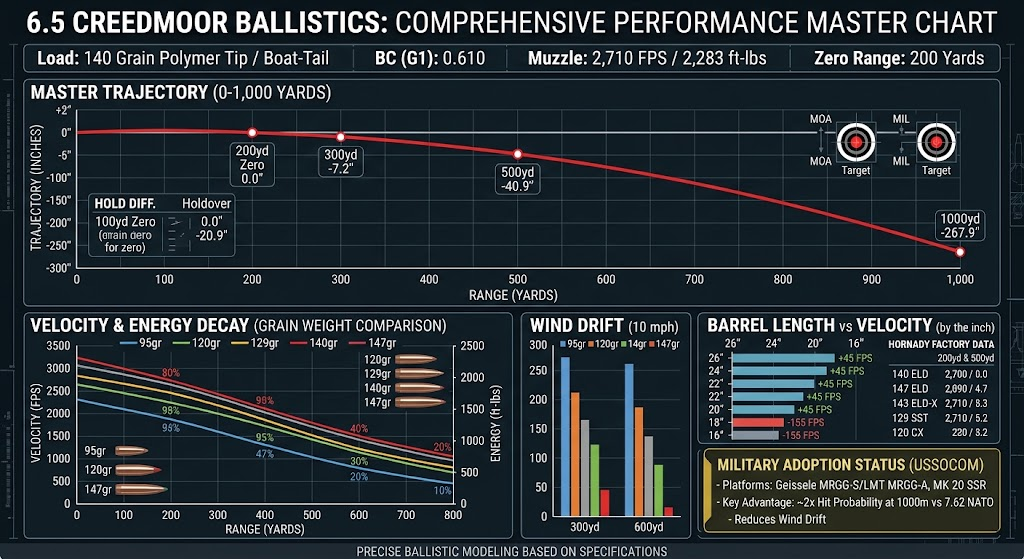
The 6.5 Creedmoor offers a range of factory ammunition options, including 120-, 129-, 140-, 143-, and 147-grain bullets. The 140-grain load is a useful reference for understanding the cartridge’s performance at different distances.
The following master reference table uses the supplied 140-grain polymer-tip boat-tail profile. Its listed ballistic coefficient is G1 0.610, with a reference muzzle velocity of 2,710 feet per second and a 200-yard zero.
6.5 Creedmoor Ballistics Chart
| Range (yards) | Velocity (fps) | Energy (ft-lb) | Trajectory (inches) | Wind Drift (10 mph) | Time of Flight (s) | Velocity (Mach) |
|---|---|---|---|---|---|---|
| Muzzle (0) | 2,710 | 2,283 | -1.50 | 0.00 | 0.000 | 2.43 |
| 100 | 2,548 | 2,017 | +1.70 | 0.65 | 0.114 | 2.28 |
| 200 | 2,392 | 1,778 | 0.00 | 2.65 | 0.235 | 2.14 |
| 300 | 2,241 | 1,560 | -7.22 | 6.10 | 0.364 | 2.01 |
| 400 | 2,096 | 1,364 | -20.61 | 11.12 | 0.502 | 1.88 |
| 500 | 1,956 | 1,187 | -40.85 | 17.85 | 0.650 | 1.75 |
| 600 | 1,822 | 1,030 | -68.80 | 26.43 | 0.808 | 1.63 |
| 800 | 1,572 | 768 | -148.22 | 49.20 | 1.162 | 1.41 |
| 1,000 | 1,351 | 567 | -267.85 | 81.65 | 1.578 | 1.21 |
The table illustrates how velocity and energy decrease as the bullet travels farther. The trajectory also changes with distance, while wind drift becomes more significant as flight time increases.
These figures are a supplied reference profile, not a universal specification for every 6.5 Creedmoor rifle or ammunition brand. Actual performance depends on the specific load and shooting conditions.
Ballistics for 6.5 Creedmoor
Different 6.5 Creedmoor loads can produce noticeably different ballistic results. Bullet weight, construction, ballistic coefficient, and muzzle velocity all influence how a cartridge performs downrange.
The following comparison includes several popular hunting and target ammunition types. The figures are supplied reference values and should not be interpreted as current verified manufacturer specifications.
| Load Description | Bullet Weight and Type | Muzzle Velocity (fps) | Muzzle Energy (ft-lb) | 200-Yard Velocity (fps) | 200-Yard Energy (ft-lb) | 500-Yard Drop (200-Yard Zero) |
|---|---|---|---|---|---|---|
| Hornady ELD Match | 140 gr ELD-M | 2,710 | 2,283 | 2,423 | 1,824 | -39.6 in |
| Hornady Precision Hunter | 143 gr ELD-X | 2,700 | 2,315 | 2,422 | 1,861 | -39.8 in |
| Federal Gold Medal | 140 gr Sierra MatchKing | 2,675 | 2,224 | 2,371 | 1,747 | -41.9 in |
| Nosler Trophy Grade | 129 gr AccuBond Long Range | 2,850 | 2,326 | 2,514 | 1,812 | -36.5 in |
| Winchester Expedition | 142 gr AccuBond LR | 2,700 | 2,300 | 2,428 | 1,858 | -39.5 in |
The 129-grain reference load has the highest listed muzzle velocity in this comparison. The 140- and 143-grain options offer different combinations of velocity, energy, and bullet design.
Ammunition selection should be based on the manufacturer’s specifications and the intended application. Match ammunition, hunting ammunition, and lead-free ammunition are designed with different priorities, so their ballistic figures are not directly interchangeable.
6.5 Creedmoor Ammo Ballistics
Bullet weight is an important factor when comparing 6.5 Creedmoor ammunition. Lighter bullets can have higher muzzle velocities, while heavier bullets may offer different ballistic coefficients and retained-energy characteristics.
The table below compares five bullet-weight categories using the supplied reference data and a 200-yard zero.
| Bullet Weight | Typical Muzzle Velocity (fps) | Typical Muzzle Energy (ft-lb) | 300-Yard Energy (ft-lb) | 500-Yard Drop | 500-Yard Wind Drift (10 mph) |
|---|---|---|---|---|---|
| 95 gr | 3,300 | 2,297 | 1,180 | -37.2 in | 22.8 in |
| 120 gr | 2,910 | 2,256 | 1,412 | -37.8 in | 19.2 in |
| 129 gr | 2,820 | 2,278 | 1,485 | -38.2 in | 18.5 in |
| 140 gr | 2,710 | 2,283 | 1,560 | -40.8 in | 17.8 in |
| 147 gr | 2,690 | 2,359 | 1,648 | -40.2 in | 16.2 in |
The comparison shows that bullet weight alone does not determine downrange performance. Bullet shape and ballistic coefficient also influence how well a projectile retains velocity and resists wind drift.
The figures represent different example loads rather than a controlled test in which only bullet weight changes. Always check the exact ammunition manufacturer’s published data when comparing products.
6.5 Creedmoor Ballistics 1000 Yards
The 6.5 Creedmoor is well known for its use in long-range target shooting. Its relatively high ballistic efficiency allows suitable bullets to retain velocity over extended distances, although actual results depend on the bullet design, muzzle velocity, and atmospheric conditions.
The following table uses the supplied 147-grain Hornady ELD Match reference profile. The stated G1 ballistic coefficient is 0.697 and the G7 coefficient is 0.351. The reference muzzle velocity is 2,690 fps, with a 1.5-inch sight height and a 200-yard zero.
| Distance (yards) | Velocity (fps) | Energy (ft-lb) | Trajectory (inches) | Elevation Correction | Wind Drift (10 mph) | Time of Flight (s) |
|---|---|---|---|---|---|---|
| 0 (Muzzle) | 2,690 | 2,359 | -1.50 | — | 0.00 | 0.000 |
| 200 (Zero) | 2,398 | 1,872 | 0.00 | 0.0 MOA / 0.0 MIL | 2.52 | 0.235 |
| 400 | 2,125 | 1,472 | -19.98 | -4.8 MOA / -1.4 MIL | 10.38 | 0.501 |
| 600 | 1,869 | 1,139 | -66.30 | -10.5 MOA / -3.1 MIL | 24.36 | 0.803 |
| 800 | 1,631 | 868 | -142.15 | -17.0 MOA / -4.9 MIL | 45.12 | 1.147 |
| 1,000 | 1,416 | 654 | -255.30 | -24.4 MOA / -7.1 MIL | 74.02 | 1.545 |
At 1,000 yards, the supplied reference profile lists a remaining velocity of 1,416 fps and energy of 654 ft-lb. The trajectory and wind figures demonstrate why long-range performance depends on more than muzzle velocity.
The 1,000-yard values are estimates from the supplied profile, not a guarantee for every 147-grain ELD Match load. Actual ballistic calculations require the exact bullet data, measured muzzle velocity, atmospheric conditions, and a verified zero.
6.5 Creedmoor Ballistics by the Inch
Barrel length can influence the muzzle velocity of a 6.5 Creedmoor rifle. A longer barrel generally gives expanding propellant gases more time to accelerate the bullet, while a shorter barrel can produce a lower muzzle velocity.
The following comparison uses the supplied Hornady 140-grain ELD Match reference figures. It uses a 24-inch barrel as the baseline.
| Barrel Length | Muzzle Velocity (fps) | Difference vs. 24-Inch Barrel | Muzzle Energy (ft-lb) | Listed Transonic Range Threshold |
|---|---|---|---|---|
| 26 inches | 2,755 | +45 fps | 2,359 | ~1,350 yards |
| 24 inches | 2,710 | Baseline | 2,283 | ~1,300 yards |
| 22 inches | 2,662 | -48 fps | 2,202 | ~1,250 yards |
| 20 inches | 2,610 | -100 fps | 2,117 | ~1,200 yards |
| 18 inches | 2,555 | -155 fps | 2,029 | ~1,140 yards |
| 16 inches | 2,495 | -215 fps | 1,935 | ~1,070 yards |
The supplied comparison shows a reduction in muzzle velocity as barrel length decreases. However, the amount of velocity change is not fixed for every rifle or ammunition load.
The often-quoted estimate of 20 to 25 fps per inch should not be treated as a universal rule. Actual changes depend on the ammunition, barrel, chamber, and test conditions. The transonic thresholds in this table are also estimates, not fixed distances.
6.5 Creedmoor 140 Grain Ballistics
The 140-grain bullet is one of the most recognised 6.5 Creedmoor bullet weights. It is available in match and hunting-oriented designs, including polymer-tipped and boat-tail options.
The supplied reference profile uses a 140-grain bullet with a listed G1 ballistic coefficient of 0.610, a muzzle velocity of 2,710 fps, and a 200-yard zero.
| Range (yards) | Velocity (fps) | Energy (ft-lb) | Trajectory (inches) | Wind Drift (10 mph) | Time of Flight (s) |
|---|---|---|---|---|---|
| Muzzle (0) | 2,710 | 2,283 | -1.50 | 0.00 | 0.000 |
| 100 | 2,548 | 2,017 | +1.70 | 0.65 | 0.114 |
| 200 | 2,392 | 1,778 | 0.00 | 2.65 | 0.235 |
| 300 | 2,241 | 1,560 | -7.22 | 6.10 | 0.364 |
| 400 | 2,096 | 1,364 | -20.61 | 11.12 | 0.502 |
| 500 | 1,956 | 1,187 | -40.85 | 17.85 | 0.650 |
| 600 | 1,822 | 1,030 | -68.80 | 26.43 | 0.808 |
| 700 | 1,693 | 890 | -105.32 | 36.88 | 0.978 |
| 800 | 1,572 | 768 | -151.35 | 49.38 | 1.162 |
A 140-grain bullet provides a useful example of the cartridge’s balance between velocity, bullet weight, and ballistic efficiency. However, different 140-grain bullets can have different shapes and ballistic coefficients, so their performance should not be assumed to be identical.
6.5 Creedmoor Ballistics Chart 200 Yard Zero
A 200-yard zero means the rifle’s sighting system is adjusted so the bullet’s path intersects the point of aim at 200 yards under the specified conditions. The bullet can be above or below the line of sight at other distances.
The following table compares the supplied 200-yard-zero profile with a 100-yard-zero profile for the same 140-grain reference load.
| Range (yards) | Velocity (fps) | Energy (ft-lb) | Trajectory (200-Yard Zero) | Trajectory (100-Yard Zero) | Holdover Difference |
|---|---|---|---|---|---|
| Muzzle (0) | 2,710 | 2,283 | -1.50 in | -1.50 in | 0.00 in |
| 50 | 2,628 | 2,146 | +0.62 in | -0.23 in | +0.85 in |
| 100 | 2,548 | 2,017 | +1.70 in | 0.00 in | +1.70 in |
| 150 | 2,469 | 1,894 | +1.48 in | -1.07 in | +2.55 in |
| 200 | 2,392 | 1,778 | 0.00 in | -3.40 in | +3.40 in |
| 250 | 2,315 | 1,666 | -2.85 in | -7.10 in | +4.25 in |
| 300 | 2,241 | 1,560 | -7.22 in | -12.32 in | +5.10 in |
| 400 | 2,096 | 1,364 | -20.61 in | -27.41 in | +6.80 in |
| 500 | 1,956 | 1,187 | -40.85 in | -49.35 in | +8.50 in |
The two zeroing profiles produce different listed trajectory values beyond the muzzle. A 200-yard zero places the reference trajectory at zero at 200 yards, while the 100-yard profile places it at zero at 100 yards.
These figures are reference estimates. Confirm the actual point of impact with the specific rifle and ammunition rather than assuming that a generic chart represents every setup.
6.5 Creedmoor Trajectory Chart
A trajectory chart shows the bullet’s position relative to the line of sight at different distances. With a 200-yard zero, the supplied 140-grain reference load starts below the line of sight at the muzzle, rises above it at shorter distances, and returns to zero at 200 yards. Beyond that distance, the listed trajectory becomes increasingly negative.
| Distance (yards) | Trajectory (inches) |
|---|---|
| 0 | -1.50 |
| 100 | +1.70 |
| 200 | 0.00 |
| 300 | -7.22 |
| 400 | -20.61 |
| 500 | -40.85 |
| 600 | -68.80 |
| 700 | -105.32 |
| 800 | -151.35 |
| 1,000 | -267.85 |
Reference load: 140-grain bullet, G1 BC 0.610, listed muzzle velocity 2,710 fps, 1.5-inch sight height, and 200-yard zero. Figures are supplied estimates and should be verified against the exact ammunition and rifle.
6.5 Creedmoor Bullet Drop Chart
The bullet drop chart below presents the same reference load at distances from 100 to 1,000 yards. Negative values indicate the listed distance below the line of sight. Drop increases with distance as the bullet loses velocity and gravity continues to affect its flight.
| Distance (yards) | Bullet Drop (inches) |
|---|---|
| 100 | +1.70 |
| 200 | 0.00 |
| 300 | -7.22 |
| 400 | -20.61 |
| 500 | -40.85 |
| 600 | -68.80 |
| 700 | -105.32 |
| 800 | -151.35 |
| 1,000 | -267.85 |
These are trajectory values relative to the line of sight, not independent measurements of gravitational drop. The chart uses a 200-yard zero and the supplied 140-grain reference profile. Actual results vary with ammunition, barrel, sight height, and environmental conditions.
Does the Military Use 6.5 Creedmoor?
Yes. The U.S. military has adopted and developed 6.5 Creedmoor systems for certain special operations applications, particularly sniper-support and precision-rifle roles. However, this does not mean that the cartridge is the standard ammunition used by every branch or every military rifle.
U.S. Special Operations Command (USSOCOM) selected 6.5 Creedmoor as an intermediate precision cartridge in 2018 after evaluating it against alternatives, including .260 Remington and 7.62 NATO. The decision was influenced by its long-range performance, wind resistance, and potential to improve effective engagement distance.
The cartridge has also been associated with the Mid-Range Gas Gun program, which includes sniper-support and assault configurations. The MRGG-S program is intended for a sniper-support and designated-marksman role. Public reporting identifies the Geissele MRGG-S as a 6.5 Creedmoor platform selected for USSOCOM’s program.
| Category | Details |
|---|---|
| Military organization | U.S. Special Operations Command (USSOCOM) |
| Adoption milestone | 2018 selection of 6.5 Creedmoor for an intermediate precision role |
| Main application | Sniper-support and precision-rifle roles |
| Earlier platform work | Conversion and evaluation of existing 7.62 mm sniper systems |
| Later program | Mid-Range Gas Gun, including the MRGG-S |
| MRGG-S manufacturer selection | Geissele Automatics |
| Main reasons for interest | Long-range performance, reduced wind drift, and improved effective range compared with 7.62 NATO in the evaluated role |
The military’s interest in 6.5 Creedmoor is based on its performance in a specialised role. It should not be confused with the U.S. Army’s broader standard-issue rifle and ammunition programs, which have followed separate development paths.
Frequently Asked Questions
What is the effective range of a 6.5 Creedmoor?
The practical range depends on the rifle, ammunition, bullet design, environmental conditions, and intended application. The cartridge is commonly used for long-range target shooting, and suitable loads can retain useful velocity at extended distances. There is no single effective-range figure that applies to every load or purpose.
How far can a 6.5 Creedmoor shoot accurately?
Accuracy depends on the rifle, ammunition consistency, optics, environmental conditions, and shooter’s ability. The cartridge is widely used in long-range target shooting, including at distances approaching and exceeding 1,000 yards, but results vary by setup.
What is the best grain weight for 6.5 Creedmoor?
There is no single best bullet weight for every application. Common factory options include 120, 129, 140, 143, and 147 grains. The right choice depends on bullet construction, intended use, and the ammunition manufacturer’s specifications.
How much does a 6.5 Creedmoor drop at 500 yards?
In the supplied 140-grain reference profile with a 200-yard zero, the listed trajectory at 500 yards is approximately 40.85 inches below the line of sight. Other bullet weights and ammunition loads can produce different results.
What is the muzzle velocity of a 140-grain 6.5 Creedmoor?
The supplied reference profile lists a muzzle velocity of 2,710 fps for its 140-grain load. Actual factory ammunition can vary by manufacturer, bullet design, and test-barrel conditions.
Is 6.5 Creedmoor good for 1,000-yard shooting?
The cartridge is popular for long-range target shooting because suitable bullets can retain velocity and resist wind drift relatively well. Actual performance at 1,000 yards depends on the specific load, rifle, atmospheric conditions, and shooter’s skill.
Does barrel length affect 6.5 Creedmoor velocity?
Yes. Barrel length can affect muzzle velocity. A shorter barrel commonly produces lower velocity than a longer barrel with the same ammunition, although the amount of change varies by rifle and load.
What is the difference between a 100-yard and 200-yard zero?
A 100-yard zero places the bullet’s path at the point of aim at 100 yards. A 200-yard zero places it at the point of aim at 200 yards. The trajectory at other distances differs between the two setups.
Is 6.5 Creedmoor better than .308 Winchester?
Neither cartridge is automatically better for every purpose. The 6.5 Creedmoor is known for its efficient bullet designs and long-range performance, while .308 Winchester has broad ammunition availability and an established range of applications. The better choice depends on the rifle, ammunition, and intended use.
Does the military use 6.5 Creedmoor instead of 7.62 NATO?
USSOCOM has adopted and developed 6.5 Creedmoor for certain sniper-support and precision applications that previously used 7.62 NATO systems. It has not replaced 7.62 NATO across the entire U.S. military.