5.7×28 Ammo Ballistics: Bullet Drop and Trajectory Chart
The 5.7x28mm is a small-caliber, high-velocity cartridge developed by FN Herstal. Its ballistics depend on bullet weight, ammunition design, barrel length and the firearm used. Compared with many traditional handgun cartridges, the 5.7x28mm can produce relatively high muzzle velocities, although its lightweight bullets lose velocity as they travel downrange.
This 5.7×28 ammo ballistics guide includes velocity, energy, wind drift, bullet drop and trajectory charts for a reference 40-grain load. The figures provided here are estimates for comparison and should not be treated as verified specifications for every commercial load or firearm.
Table of Contents [Click to minimize]
5.7×28 Ballistics Chart
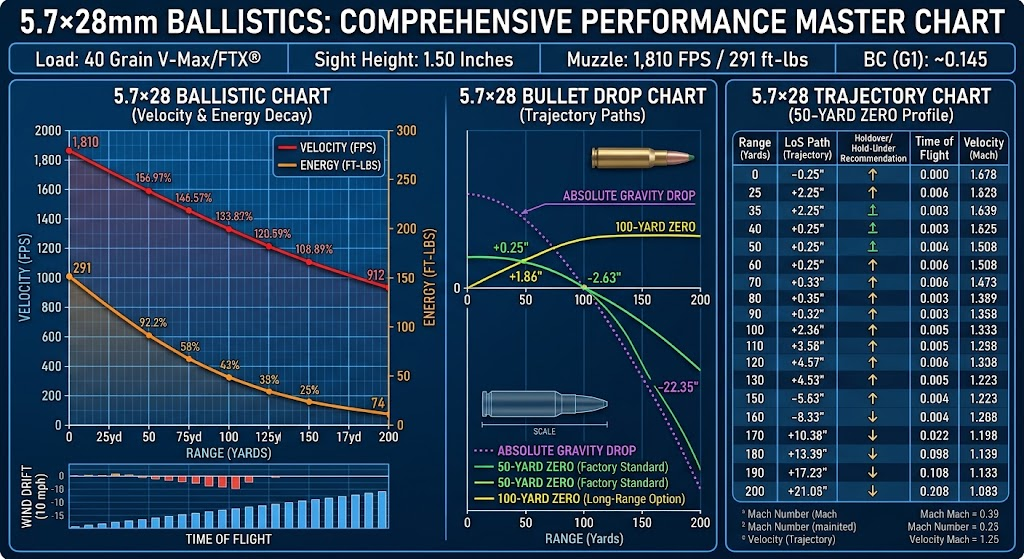
The following 5.7×28 ballistics chart uses the supplied reference figures for a 40-grain V-Max or FTX-style bullet. The reference muzzle velocity is 1,810 FPS, muzzle energy is 291 ft-lbs, and the estimated G1 ballistic coefficient is approximately 0.140 to 0.150.
| Range (Yards) | Velocity (FPS) | Energy (ft-lbs) | Time of Flight (Seconds) | Wind Drift at 10 MPH | Velocity (Mach) |
|---|---|---|---|---|---|
| 0 | 1,810 | 291 | 0.000 | 0.00 in | 1.62 |
| 25 | 1,695 | 255 | 0.042 | 0.35 in | 1.52 |
| 50 | 1,586 | 223 | 0.088 | 1.38 in | 1.42 |
| 75 | 1,484 | 195 | 0.137 | 3.10 in | 1.33 |
| 100 | 1,343 | 160 | 0.190 | 5.62 in | 1.20 |
| 125 | 1,195 | 127 | 0.249 | 8.95 in | 1.07 |
| 150 | 1,053 | 99 | 0.315 | 13.15 in | 0.94 |
| 175 | 978 | 85 | 0.392 | 18.25 in | 0.88 |
| 200 | 912 | 74 | 0.473 | 24.30 in | 0.82 |
The supplied data show velocity decreasing from 1,810 FPS at the muzzle to 912 FPS at 200 yards. The listed energy also declines from 291 ft-lbs to 74 ft-lbs over the same distance.
Wind drift increases with distance because the bullet is exposed to crosswind for longer. The exact amount of drift depends on the bullet’s aerodynamic characteristics, wind direction and speed, and atmospheric conditions.
These values are a reference dataset, not a confirmed trajectory for every 5.7x28mm cartridge. Manufacturer specifications and actual chronograph results may differ.
5.7×28 Bullet Drop Chart
The 5.7×28 bullet drop chart shows the supplied reference bullet’s vertical position at different distances. The provided figures use a sight height of 1.50 inches above the bore and include separate columns for 50-yard and 100-yard zeros.
| Range (Yards) | Supplied Drop Reference (Inches) | Relative to 50-Yard Zero (Inches) | Relative to 100-Yard Zero (Inches) |
|---|---|---|---|
| 0 | -1.50 | -1.50 | -1.50 |
| 25 | +0.25 | +0.25 | +1.34 |
| 50 | 0.00 | 0.00 | +1.86 |
| 75 | -0.92 | -0.92 | +1.71 |
| 100 | -2.63 | -2.63 | 0.00 |
| 125 | -5.48 | -5.48 | -2.08 |
| 150 | -9.60 | -9.60 | -5.42 |
| 175 | -15.15 | -15.15 | -10.19 |
| 200 | -22.35 | -22.35 | -16.61 |
The table reproduces the supplied trajectory figures. However, the columns should be checked against a consistent ballistic calculation before being used as a verified drop chart. The supplied values do not clearly reconcile across all zero-distance references, and a true drop chart must specify the same ammunition, sight height and trajectory model throughout.
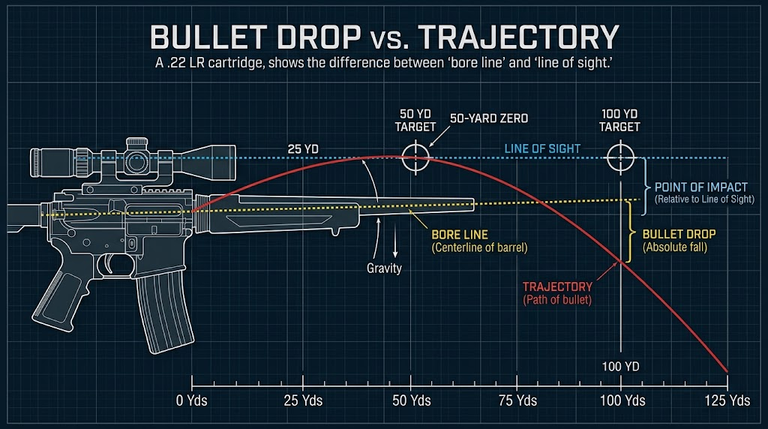
A bullet’s position relative to the line of sight is different from its gravitational drop relative to the bore or its initial direction of travel. These measurements should not be treated as interchangeable.
5.7×28 Trajectory Chart
A trajectory chart describes the bullet’s position relative to the line of sight at different distances. The supplied reference profile uses a 50-yard zero and lists the trajectory and corresponding hold information at ranges from the muzzle to 200 yards.
| Range (Yards) | Supplied Trajectory (Inches) | Listed Hold Reference | Trajectory Description |
|---|---|---|---|
| 0 | -1.50 | +1.50 inches | Below line of sight at muzzle |
| 25 | +0.25 | -0.25 inches | Above line of sight |
| 50 | 0.00 | Zero point | Reference zero |
| 75 | -0.92 | +0.92 inches | Below line of sight |
| 100 | -2.63 | +2.63 inches | Increasing drop |
| 125 | -5.48 | +5.48 inches | Greater vertical separation |
| 150 | -9.60 | +9.60 inches | Further below line of sight |
| 175 | -15.15 | +15.15 inches | Increasing trajectory drop |
| 200 | -22.35 | +22.35 inches | Largest listed drop |
The trajectory values above reproduce the supplied reference profile. The hold column is also reproduced as provided, but it should not be interpreted as a verified aiming recommendation without confirming the trajectory data for the exact firearm and ammunition.
Trajectory depends on muzzle velocity, bullet shape, sight height, zero distance and atmospheric conditions. A different firearm or load can produce a different curve, so a chart should be treated as a general reference rather than a universal prediction.
5.7×28 Muzzle Velocity and Energy
Muzzle velocity measures how fast the bullet travels as it leaves the barrel. Muzzle energy describes its kinetic energy at that point. Both values are affected by the ammunition load and the firearm’s barrel length.
The supplied reference load has a muzzle velocity of 1,810 FPS and muzzle energy of 291 ft-lbs. Its listed velocity and energy decline as the distance increases.
| Measurement | Supplied Reference Value |
|---|---|
| Bullet weight | 40 grains |
| Muzzle velocity | 1,810 FPS |
| Muzzle energy | 291 ft-lbs |
| Approximate G1 ballistic coefficient | 0.140 to 0.150 |
| Velocity at 100 yards | 1,343 FPS |
| Energy at 100 yards | 160 ft-lbs |
| Velocity at 200 yards | 912 FPS |
| Energy at 200 yards | 74 ft-lbs |
These figures illustrate the supplied load’s estimated downrange performance. Exact velocity and energy values should be confirmed against the manufacturer’s data for the specific ammunition product.
What Affects 5.7×28 Ammo Ballistics?
Several factors influence the ballistic performance of 5.7x28mm ammunition.
Bullet Weight and Design
Bullet weight and shape influence muzzle velocity, aerodynamic drag and retained energy. Different bullet designs can perform differently even when they have the same nominal weight. The bullet’s construction also affects its intended application and terminal behavior.
Barrel Length
Barrel length can affect muzzle velocity because the expanding propellant gases accelerate the bullet while it travels through the barrel. Results vary with the ammunition, firearm design and individual barrel. A velocity figure measured in one firearm should not automatically be applied to another.
Ballistic Coefficient
Ballistic coefficient is a measure of a bullet’s aerodynamic performance under a specified model. A bullet with a higher coefficient generally retains velocity more efficiently when other relevant factors are comparable. The coefficient alone does not establish a bullet’s complete trajectory.
Zero Distance
A 50-yard zero and a 100-yard zero produce different bullet positions relative to the line of sight. The zero distance changes the trajectory reference, while the underlying muzzle velocity and energy remain the same for the same shot conditions.
Wind and Atmospheric Conditions
Wind can move a bullet away from its original path. Temperature, air density, elevation and other atmospheric factors can also affect trajectory. Wind drift values therefore depend on the conditions assumed by the ballistic model.
Frequently Asked Questions
What is the muzzle velocity of 5.7×28 ammunition?
Muzzle velocity depends on the specific load and firearm. The supplied reference chart lists 1,810 FPS for a 40-grain bullet. Commercial ammunition can produce different velocities depending on bullet design, loading specifications and barrel length.
How much muzzle energy does 5.7×28 have?
The supplied reference load has a muzzle energy of 291 ft-lbs. This figure is specific to the stated bullet and velocity and should not be assumed to represent every 5.7x28mm load.
How fast does a 5.7×28 bullet travel at 100 yards?
The supplied reference table lists a velocity of 1,343 FPS at 100 yards. Actual velocity depends on the ammunition, firearm and conditions, so manufacturer data for the exact load should be consulted.
How much energy does 5.7×28 retain at 200 yards?
The supplied reference chart lists 74 ft-lbs at 200 yards. This is an estimate from the provided dataset rather than a verified figure for all 5.7x28mm ammunition.
What is the difference between a 50-yard and 100-yard zero?
A zero is the distance at which the bullet’s path intersects the rifle’s line of sight. Changing the zero distance changes the trajectory values relative to that line. It does not change the bullet’s muzzle velocity or kinetic energy.
Does barrel length affect 5.7×28 velocity?
Yes. Barrel length can affect muzzle velocity, but the size of the difference depends on the firearm and ammunition. Use manufacturer specifications or chronograph measurements for the specific combination rather than assuming one velocity applies to every barrel.
Does 5.7×28 lose velocity over distance?
Yes. A bullet loses velocity as it travels through the air because of aerodynamic drag. The amount of velocity loss depends on the bullet’s initial speed, shape, ballistic coefficient and atmospheric conditions.
Are 5.7×28 ballistics charts exact?
No. Ballistics charts are estimates based on assumptions about the ammunition, firearm, sight height, zero distance and environment. Values should be checked against reliable manufacturer data and, where precision matters, verified with measurements from the specific firearm and load.