Ballistic Coefficient Chart By Caliber
A ballistic coefficient (BC) indicates a projectile’s ability to overcome atmospheric drag and retain its forward momentum during flight. By consulting a ballistic coefficient chart, shooters can effectively evaluate different ammunition options to determine which projectiles will minimize wind deflection and reduce bullet drop at extended ranges.
Table of Contents [Click to minimize]
Ballistic Coefficient Chart
| Caliber | Bullet Weight | Bullet Type | Manufacturer and Bullet Model | G1 Ballistic Coefficient | G7 Ballistic Coefficient | Drag Model or Source Notes |
| .22 LR | 40 gr | Solid Lead Round Nose | CCI Standard Velocity | .120 | Not verified | G1 published by manufacturer |
| .223 Remington | 55 gr | Full Metal Jacket Boat Tail | Hornady FMJ-BT | .243 | Not verified | G1 published by manufacturer |
| 6.5 Creedmoor | 143 gr | Polymer Tip Boat Tail | Hornady ELD-X | .625 | .315 | G1 and G7 published by manufacturer |
| 7mm Rem Mag | 180 gr | Very Low Drag Boat Tail | Berger VLD Hunting | .673 | .344 | G1 and G7 published by manufacturer |
| .308 Winchester | 175 gr | Hollow Point Boat Tail | Sierra MatchKing | .505 | .243 | G1 velocity dependent, G7 published |
| 9mm Luger | 115 gr | Jacketed Hollow Point | Hornady XTP | .129 | Not verified | G1 published by manufacturer |
| .45 ACP | 230 gr | Full Metal Jacket | Winchester White Box | .194 | Not verified | G1 published by manufacturer |
Overview of Chart Data
- Verified G1 BC figures within this dataset span from a low of .120 for the .22 LR up to .673 for the 180-grain 7mm Berger projectile.
- Variations between bullets of identical calibers are significant, especially when contrasting short pistol rounds with elongated, streamlined rifle bullets.
- Heavier and longer profiles, such as the 180-grain 7mm VLD, yield substantially higher aerodynamic efficiencies compared to lighter, shorter projectiles like the 55-grain .223 option.
- For modern boat-tail rifle bullets, the published G1 figures are generally twice as high as their G7 counterparts.
- This chart highlights the necessity of evaluating individual bullets rather than grouping them by caliber, as the physical profile and mass determine the coefficient, not the barrel diameter.
Ballistic Coefficient Chart by Caliber
| Caliber | Bullet Weight | Bullet Design | Manufacturer and Model | G1 BC | G7 BC |
| .22 LR | 40 gr | Lead Round Nose | CCI Mini-Mag | .125 | Not verified |
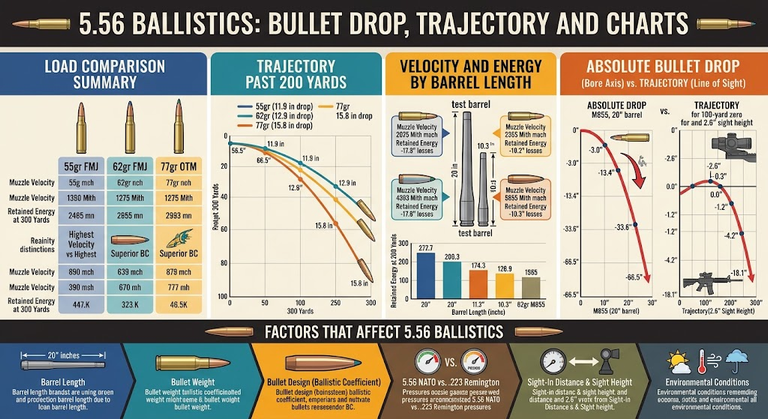
| .223 Rem / 5.56 NATO | 77 gr | Hollow Point Boat Tail | Sierra MatchKing | .372 | .190 |
| .243 Winchester | 95 gr | Polymer Tip Boat Tail | Hornady V-MAX | .365 | Not verified |
| 6.5 Creedmoor | 140 gr | Polymer Tip Boat Tail | Hornady ELD Match | .646 | .326 |
| .270 Winchester | 130 gr | Spire Point Flat Base | Nosler Partition | .416 | Not verified |
| 7mm Rem Mag | 162 gr | Polymer Tip Boat Tail | Hornady ELD-X | .631 | .318 |
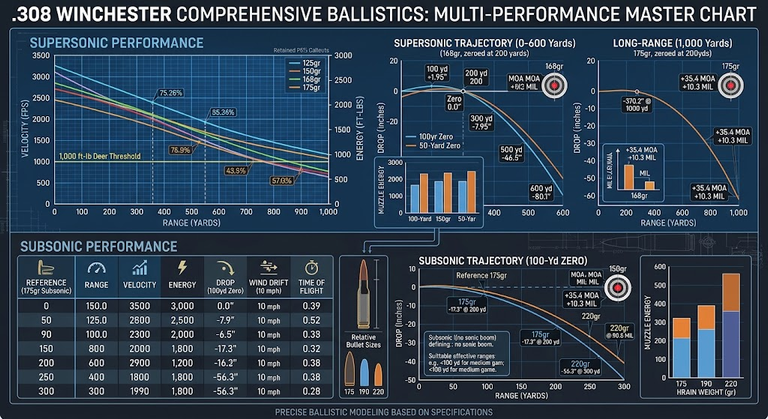
| .308 Winchester | 168 gr | Hollow Point Boat Tail | Sierra MatchKing | .462 | .218 |
| .30-06 Springfield | 180 gr | Soft Point Flat Base | Remington Core-Lokt | .383 | Not verified |
| .300 Win Mag | 210 gr | Very Low Drag Boat Tail | Berger VLD Target | .720 | .369 |
| 9mm Luger | 147 gr | Jacketed Hollow Point | Federal HST | .205 | Not verified |
| .45 ACP | 230 gr | Jacketed Hollow Point | Speer Gold Dot | .143 | Not verified |
Caliber and Projectile Trends
- Cartridges designed for long-range precision, such as the 6.5 Creedmoor and .300 Winchester Magnum, deliver the highest aerodynamic efficiency when loaded with heavy, sleek match projectiles.
- Handgun rounds uniformly exhibit G1 BC metrics well below .250, a direct result of their short and blunt geometry.
- In the .30 caliber category, a 168-grain boat-tail projectile boasts a higher BC than a heavier 180-grain flat-base bullet, demonstrating that aerodynamic geometry often outweighs raw mass.
- While elevated BC metrics translate to reduced wind drift downrange, they do not guarantee superior accuracy or greater kinetic energy transfer at close distances.
Bullet Ballistic Coefficient Chart by Bullet Type
| Bullet Type | Caliber | Bullet Weight | Manufacturer and Model | G1 BC | G7 BC | Notes |
| Round Nose | .30-30 Win | 170 gr | Hornady InterLock RN | .189 | Not verified | Blunt profile generates substantial drag |
| Flat Base | .270 Win | 130 gr | Sierra Pro-Hunter | .370 | Not verified | Reliable hunting profile with moderate resistance |
| Boat Tail | .308 Win | 165 gr | Nosler Ballistic Tip | .475 | Not verified | Tapered rear section minimizes base drag |
| Hollow Point | 9mm Luger | 124 gr | Speer Gold Dot | .135 | Not verified | Open nose cavity diminishes aerodynamics |
| Polymer Tip | 6.5 CM | 143 gr | Hornady ELD-X | .625 | .315 | Synthetic tip prevents in-flight deformation |
| Match | .300 Win Mag | 230 gr | Berger Hybrid Target | .718 | .368 | Engineered specifically for maximum flight efficiency |
Performance by Bullet Geometry
- Traditional round-nose shapes and expansive hollow points yield the lowest ballistic coefficients across all surveyed categories.
- Polymer-tipped variants and specialized match projectiles consistently register the highest aerodynamic efficiency.
- Upgrading from a standard flat base to a tapered boat-tail configuration dramatically boosts a rifle bullet’s BC by smoothing the turbulent airflow at the rear of the projectile.
- Because physical geometry dictates published BC figures, projectiles within the same broad design category can still exhibit widely varying flight characteristics.
What Is the Ballistic Coefficient?
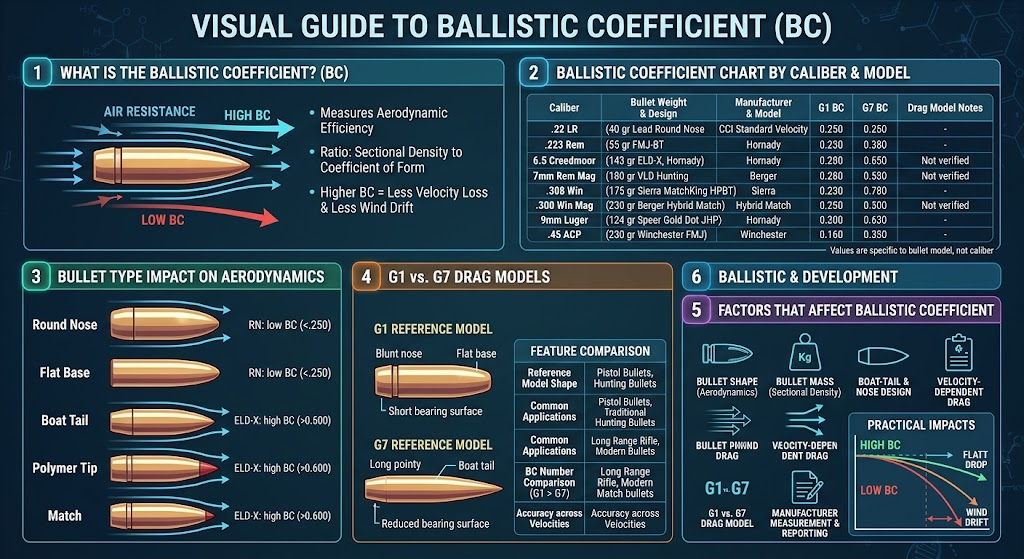
A ballistic coefficient serves as a mathematical representation of how effortlessly a bullet navigates through the atmosphere relative to a standard drag model. An elevated number signifies that the projectile sheds velocity at a slower rate and resists environmental factors like crosswinds more efficiently.
- This metric assesses the relationship between a projectile’s sectional density and its aerodynamic form factor.
- Elongated, streamlined bullets carrying more weight relative to their diameter generally produce superior BC figures.
- Coefficients fluctuate wildly among bullets of identical calibers because a flat-nosed projectile encounters far more atmospheric resistance than a sharply pointed one of the exact same weight.
- The G1 standard represents a flat-based projectile featuring a moderately curved nose, whereas the G7 standard mirrors a modern boat-tail bullet with an elongated, pointed tip.
- Certain projectiles list varying BC metrics across different speed brackets because atmospheric drag characteristics shift significantly as the bullet drops from supersonic to subsonic velocities.
- A high BC cannot map out a complete flight path on its own, as starting velocity, ambient temperature, and barometric pressure are equally vital in calculating the exact point of impact.
How to Calculate Ballistic Coefficient
Determining a reliable ballistic coefficient goes beyond simply knowing the bullet’s diameter and weight. It demands precise data regarding the projectile’s behavior and velocity decay over a measured distance.
- Factory-Provided Data: The most dependable approach involves referencing the specific coefficient supplied by the ammunition or bullet manufacturer, ensuring you identify whether the figure uses the G1 or G7 standard.
- Live-Fire Measurement: You can calculate an estimated BC by recording the bullet’s exact speed at the muzzle and then capturing its speed again at a specific downrange interval, such as 100 yards. By comparing this measured velocity loss against the expected velocity loss of a standard reference projectile, you determine the bullet’s aerodynamic efficiency.
Capturing only the muzzle velocity provides no insight into drag. Producing a trustworthy BC demands multiple downrange data points aligned with a recognized mathematical standard.
To successfully estimate a ballistic coefficient, you must gather:
- Precise velocity at the muzzle.
- Precise remaining velocity at a known downrange distance.
- The exact distance separating the two chronographs.
- Environmental variables including ambient temperature, barometric pressure, and altitude.
- The specific reference drag profile utilized for the comparison.
G1 vs. G7 Ballistic Coefficient
| Feature | G1 Ballistic Coefficient | G7 Ballistic Coefficient |
| Reference model | Modeled after a flat-based projectile with a blunt, curved nose | Modeled after a boat-tail projectile with an elongated, sharp tip |
| Common applications | Handgun ammunition, classic hunting rounds, shotgun slugs | Long-distance rifle ammunition, advanced precision projectiles |
| Bullet designs | Ideal for round-nose and flat-base geometries | Ideal for low-drag, tapered boat-tail geometries |
| Comparing published values | Metrics appear numerically higher and shift based on flight speed | Metrics appear numerically lower and remain consistent across speed ranges |
Understanding the Drag Models
- G1 metrics will consistently present as a larger number than G7 metrics for the identical projectile.
- Relying on a G1 standard for an advanced boat-tail bullet usually requires calculating multiple BC values for different velocity bands to maintain precision.
- The G7 standard delivers a more uniform, single-number flight prediction for sleek rifle bullets across their entire trajectory.
- Shooters cannot directly swap or convert G1 numbers into G7 numbers without utilizing specialized ballistic calculators.
Factors That Affect Ballistic Coefficient
Bullet shape and aerodynamic design control how seamlessly the atmosphere flows over the metal. A pointed, streamlined tip generates a minimal shockwave compared to a blunt tip, drastically lowering frontal air resistance.
Bullet mass and diameter combine to establish sectional density. A heavier projectile of a given caliber possesses greater momentum to punch through the atmosphere, yielding a superior ballistic coefficient compared to a lighter projectile sharing the exact same exterior shape.
Boat-tail and nose design dictate the rearward aerodynamic profile. A tapered rear section shrinks the low-pressure pocket that trails the bullet during flight, which sharply minimizes total drag and elevates the overall efficiency rating.
Velocity-dependent changes in drag take place because the atmosphere interacts differently with objects moving faster than the speed of sound versus those moving slower. As a projectile decelerates, its drag curve shifts, meaning the functional ballistic coefficient alters mid-flight.
The selected G1 or G7 model directly dictates the final published metric. The BC is not a fixed physical dimension of the bullet; rather, it is a relative performance score measured against a theoretical standard.
Manufacturer measurement and reporting methods also introduce variables. Competing brands evaluate their projectiles under differing atmospheric standards, using various barrel twist rates and speed ranges, which results in minor discrepancies in published metrics for nearly identical bullet designs.
Frequently Asked Questions
What is the ballistic coefficient?
The ballistic coefficient is a standardized numerical rating that evaluates how well a projectile cuts through the atmosphere and maintains its speed compared to a theoretical reference bullet.
What is a ballistic coefficient chart?
A ballistic coefficient chart is an organized reference tool that displays the aerodynamic efficiency ratings of various projectiles, allowing shooters to easily contrast their downrange performance.
How do you read a ballistic coefficient chart by caliber?
You navigate the chart by finding your specific caliber, identifying the exact bullet weight and brand you plan to shoot, and examining the listed G1 or G7 metric to gauge its aerodynamic capability.
How do you calculate ballistic coefficient?
You derive it by tracking the projectile’s exact speed at the muzzle and again at a known distance downrange, then comparing that measured rate of deceleration against a standard mathematical drag model.
What is the difference between G1 and G7 ballistic coefficient?
The G1 rating relies on a flat-based reference projectile with a relatively blunt tip, whereas the G7 rating utilizes a highly aerodynamic boat-tail reference projectile with a sharp, elongated tip.
Does a higher ballistic coefficient mean better accuracy?
No, a higher metric simply indicates the projectile is superior at retaining velocity and bucking the wind; actual precision relies heavily on the shooter’s skill, barrel quality, and ammunition consistency.
Do heavier bullets always have a higher ballistic coefficient?
Not necessarily. While mass contributes to momentum, a lighter bullet engineered with an aggressive boat-tail and streamlined polymer tip will often outpace a heavier bullet with a blunt, flat-nosed profile.
Why do bullets of the same caliber have different BC values?
Variations occur because a bullet’s overall length, nose sharpness, and base taper influence atmospheric resistance just as heavily as the physical diameter of the round.
Where can you find a bullet’s ballistic coefficient?
Shooters can typically locate this data printed directly on factory ammunition boxes, published in the manufacturer’s technical specifications online, or detailed in comprehensive reloading manuals.
How does ballistic coefficient affect bullet trajectory?
A projectile boasting a high coefficient sheds its speed much slower, which translates to a flatter vertical trajectory and significantly less horizontal drift caused by crosswinds over long distances.