AAC Ballistics: Muzzle Velocity and Ballistic Coefficient Chart
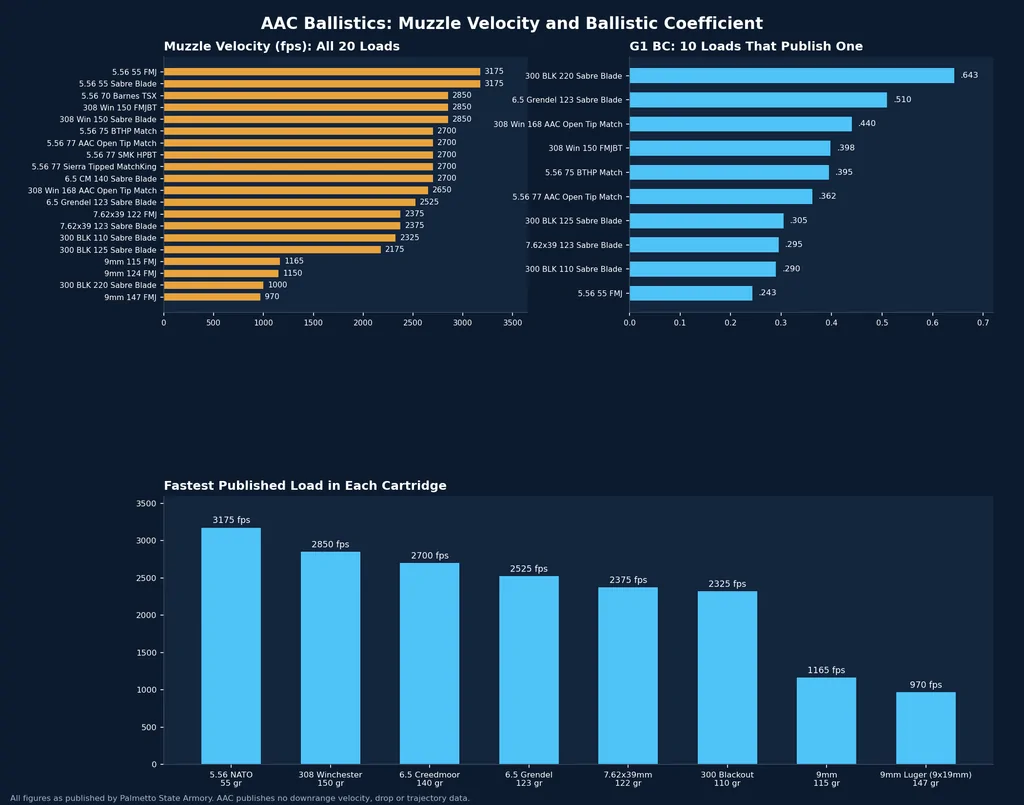
This page lists the muzzle velocity and G1 ballistic coefficient published for AAC ammunition, the house brand of Palmetto State Armory. The stored library holds 20 AAC loads in 8 cartridges, and each one carries a published muzzle velocity. The quickest loads reach 3,175 fps, the slowest runs 970 fps, and half the lineup prints a ballistic coefficient, from .243 up to .643.
Each Palmetto State Armory listing gives one velocity figure at the muzzle. There are no downrange tables, no drop figures and no test barrel lengths, and only one load prints a muzzle energy. The numbers below come straight from those listings, with gaps shown as gaps rather than filled in.
Table of Contents [Click to minimize]
AAC Ballistics: Muzzle Velocity and Ballistic Coefficient Chart: The Full Published BC Table
Below are the 10 AAC loads with a published G1 ballistic coefficient, arranged by cartridge and then by bullet weight. Every row in this table is complete, with a velocity and a BC for each load.
| Cartridge | Bullet Weight | Bullet Type | G1 BC | Muzzle Velocity (fps) | SKU |
|---|---|---|---|---|---|
| 300 Blackout | 110 gr | Sabre Blade Black Tip | .290 | 2325 | AAC300SAB1-20 |
| 300 Blackout | 125 gr | Sabre Blade Black Tip | .305 | 2175 | AAC300SAB2-20 |
| 300 Blackout | 220 gr | Sabre Blade Black Tip | .643 | 1000 | AAC300SAB4-20 |
| 308 Winchester | 150 gr | Full Metal Jacket Boat Tail | .398 | 2850 | AAC308FMJ1-20 |
| 308 Winchester | 168 gr | AAC Open Tip Match (OTM) | .440 | 2650 | AAC308OTM1-20 |
| 5.56 NATO | 55 gr | Full Metal Jacket | .243 | 3175 | AAC556FMJ1-20 |
| 5.56 NATO | 75 gr | Hornady BTHP Match w/ Cannelure | .395 | 2700 | AAC556BTHP1-20 |
| 5.56 NATO | 77 gr | AAC Open Tip Match (OTM) | .362 | 2700 | AAC556OTM1-20 |
| 6.5 Grendel | 123 gr | Sabre Blade Black Tip | .510 | 2525 | AAC65GSAB1-20 |
| 7.62x39mm | 123 gr | Sabre Blade Black Tip (SSSC) | .295 | 2375 | AAC762X39ZSAB1-20 |
Velocity Only: 10 Loads Without a Published BC
Ten more AAC loads print a muzzle velocity and no ballistic coefficient. They appear in this second table, which drops the BC column entirely so the table stays full.
| Cartridge | Bullet Weight | Bullet Type | Muzzle Velocity (fps) | SKU |
|---|---|---|---|---|
| 308 Winchester | 150 gr | Sabre Blade Black Tip | 2850 | AAC308SAB1-20 |
| 5.56 NATO | 55 gr | Sabre Blade Black Tip | 3175 | AAC556SAB1-20 |
| 5.56 NATO | 70 gr | Barnes TSX | 2850 | – |
| 5.56 NATO | 77 gr | Sierra MatchKing HPBT w/ Cannelure | 2700 | AAC556SMK1-20 |
| 5.56 NATO | 77 gr | Sierra Tipped MatchKing (TMK) | 2700 | AAC556TMK1-20 |
| 6.5 Creedmoor | 140 gr | Sabre Blade Black Tip | 2700 | AAC65CMSAB1-20 |
| 7.62x39mm | 122 gr | Full Metal Jacket (SSSC – Sabre Slick Silver Casing) | 2375 | AAC762X39ZFMJ1-20 |
| 9mm | 115 gr | Full Metal Jacket | 1165 | AAC9FMJ1-100 |
| 9mm | 124 gr | Full Metal Jacket | 1150 | – |
| 9mm Luger (9x19mm) | 147 gr | FMJ (Full Metal Jacket) | 970 | AAC9FMJ3SD-500BP |
The One Published Muzzle Energy Figure
Only one of the 20 loads prints a muzzle energy. The 9mm Luger 147 grain FMJ subsonic lists about 307 ft-lb next to its 970 fps velocity, and the tilde is kept exactly as the listing prints it.
| Load | Muzzle Velocity (fps) | Muzzle Energy (ft-lb) |
|---|---|---|
| 9mm Luger 147 gr FMJ Subsonic | 970 | ~307 |
Understanding the AAC Ballistics Chart
Quickest Loads in the Lineup
The top velocity in the chart is 3,175 fps, shared by the 5.56 NATO 55 grain FMJ and the 5.56 NATO 55 grain Sabre Blade Black Tip. The 308 Winchester 150 grain loads and the 5.56 NATO 70 grain Barnes TSX follow at 2,850 fps. The slowest figures belong to the subsonic pair: the 300 Blackout 220 grain Sabre Blade at 1,000 fps and the 9mm 147 grain at 970 fps.
5.56 NATO: The Biggest AAC Group
Seven of the twenty AAC loads are 5.56 NATO, more than any other cartridge. Bullet weights run from 55 to 77 grains, and velocities from 2,700 to 3,175 fps. The 55 grain FMJ, the 75 grain Hornady BTHP Match and the 77 grain OTM print a BC, at .243, .395 and .362. The other four 5.56 loads, including all three 77 grain match variants except the OTM, print velocity only.
300 Blackout: Three Sabre Blade Loads
The 300 Blackout group holds three loads, and every one is a Sabre Blade Black Tip with a published BC. The 110 grain load runs 2,325 fps with a .290 BC, the 125 grain runs 2,175 fps with a .305 BC, and the 220 grain subsonic runs 1,000 fps with a .643 BC, the highest in the chart. No other AAC cartridge spans as wide a velocity range as these three.
The Sabre Blade Black Tip Line
Eight of the twenty loads carry the Sabre Blade Black Tip name, making it the biggest AAC line. It appears in 5.56 NATO, 308 Winchester, 7.62x39mm, 6.5 Grendel, 6.5 Creedmoor and 300 Blackout, and five of the eight print a BC. The line includes the fastest load in the chart and the load with the highest BC, the 300 Blackout 220 grain.
How the BC Values Compare
Published G1 values in the AAC lineup run from .243 to .643. The lowest is the 5.56 NATO 55 grain FMJ, and the highest is the 300 Blackout 220 grain Sabre Blade. Between them sit the 6.5 Grendel 123 grain Sabre Blade at .510 and the 308 Winchester 168 grain OTM at .440. Ten loads print no BC, and this page does not borrow a BC for them from any bullet maker or sibling load.
Figures AAC Leaves Out
No AAC load in the stored library prints downrange velocity, a trajectory table or a test barrel length, and only the 9mm 147 grain subsonic prints muzzle energy. The chart therefore ends at the muzzle. The single energy figure is about 307 ft-lb, and it is shown with its tilde because that is how the listing prints it.
Loads This Chart Does Not Include
Eleven AAC loads are known to be sold by Palmetto State Armory but are not in the tables, because no published velocity was retrieved for them. Six are 300 Blackout, two are 5.56 NATO 69 grain, two are 308 Winchester and one is a .380 ACP 95 grain FMJ. They are listed here by name so readers can see what is missing, and none of their figures has been guessed.
AAC Ballistics FAQs
1. How many AAC loads are in this chart?
Twenty loads, across 8 cartridges. All twenty publish a muzzle velocity, and ten of them also publish a G1 ballistic coefficient. The figures are taken exactly as published, with nothing calculated or filled in.
2. Which AAC load leaves the muzzle fastest?
Two loads tie at 3,175 fps: the 5.56 NATO 55 grain FMJ and the 5.56 NATO 55 grain Sabre Blade Black Tip. The FMJ is sold in a 20 round box and a 250 round ammo can, both with the same published velocity.
3. Which AAC load is slowest at the muzzle?
The 9mm Luger 147 grain FMJ subsonic, at 970 fps. It is also the only load in the chart with a published muzzle energy, about 307 ft-lb.
4. What is the best G1 BC in the AAC lineup?
The 300 Blackout 220 grain Sabre Blade Black Tip, at .643. The next highest is the 6.5 Grendel 123 grain Sabre Blade at .510, followed by the 308 Winchester 168 grain OTM at .440.
5. Is muzzle energy printed for AAC loads?
For one load only. The 9mm Luger 147 grain FMJ subsonic prints about 307 ft-lb of muzzle energy. The other nineteen loads in the stored library print no energy figure at all.
6. Can I find downrange velocity or drop for AAC ammo here?
No. Palmetto State Armory prints no downrange figures, no drop table and no test barrel length for any AAC load, so this page lists muzzle velocity and ballistic coefficient only. No trajectory has been worked out from the published numbers.
7. What does the Sabre Blade Black Tip line offer?
Eight loads in six cartridges, from 5.56 NATO to 6.5 Creedmoor. Five of the eight print a G1 ballistic coefficient, and the line holds both the fastest load in the chart and the highest BC.
8. Why is the BC column blank on half the rows?
Because those ten loads print no BC in the published details. The 5.56 NATO 55 grain Sabre Blade is the exception: two listings show .230 and .255, so its BC stays blank instead of picking one. The rest simply have no BC published.
9. What does a blank SKU mean?
It means no SKU appeared in the source excerpts for that load. The two loads affected are the 5.56 NATO 70 grain Barnes TSX and the 9mm 124 grain FMJ. Their cartridge, weight, bullet type and velocity are published, so they are listed with a hyphen where the SKU would go.
10. Does AAC sell loads this chart leaves out?
Yes, eleven of them. They include six more 300 Blackout loads, two 5.56 NATO 69 grain loads, two 308 Winchester loads and a .380 ACP 95 grain FMJ. No published velocity was retrieved for them, so they are named in the detail section and kept out of the tables.