Nammo Ballistics: Velocity and Energy Chart
Nammo is a Norwegian-Finnish defence company, and its ammunition handbook is the source for every figure in this chart. The handbook lists 125 products across 22 cartridges, from 4.6 mm training rounds to 155 mm artillery shells. For each load Nammo prints a projectile weight and a muzzle velocity, and 101 of the 125 loads carry both figures.
There is one thing readers should know up front. Nammo publishes no muzzle energy, no ballistic coefficient, no trajectory table and no test barrel length for any of these loads. This chart therefore shows exactly what Nammo prints: projectile weight and velocity, in the metric units the handbook uses. The fastest figure in the book is the 120 mm KE-TP tank round at 1,770 m/s from the longer L55 gun.
Table of Contents [Click to minimize]
Nammo Ballistics: Velocity and Energy Chart: Small Caliber Ammunition
| Cartridge | Load | Projectile Weight | Velocity |
|---|---|---|---|
| 5.56 mm x 45 | 5.56 mm x 45 AP 3 M995 | 3.4 g (52 grain) | 1 030 m/s |
| 5.56 mm x 45 | 5.56 mm x 45 AP 45 | 4.5 g (69 grain) | 900 m/s |
| 5.56 mm x 45 | 5.56 mm x 45 NATO BALL M855 | 4 g (62 grain) | 930 m/s |
| 5.56 mm x 45 | 5.56 mm x 45 BALL NON TOXIC 4 HP Mk2 | 4 g (62 grain) | 930 m/s |
| 5.56 mm x 45 | 5.56 mm x 45 DIM TRACER (IR) 4 Mk301 Mod 0 | 3.9 g (60 grain) | 930 m/s |
| 5.56 mm x 45 | 5.56 mm x 45 NATO TRACER | 4 g (62 grain) | 920 m/s |
| 5.56 mm x 45 | 5.56 mm x 45 TRACER NON TOXIC 4 | 3.9 g (60 grain) | 920 m/s |
| 5.56 mm x 45 | 5.56 mm x 45 FRANGIBLE NON TOXIC 4 SEMI-JACKETED | 4.0 g (62 grain) | 900 m/s |
| 7.62 mm x 51 | 7.62 mm x 51 NATO BALL | 9.45 g (146 grain) | 810 m/s |
| 7.62 mm x 51 | 7.62 mm x 51 BALL 11 LONG RANGE | 10.9 g (168 grain) | 780 m/s |
| 7.62 mm x 51 | 7.62 mm x 51 AP 10 | 9.85 g (152 grain) | 845 m/s |
| 7.62 mm x 51 | 7.62 mm x 51 AP 8 M993 | 8.3 g (128 grain) | 930 m/s |
| 7.62 mm x 51 | 7.62 mm x 51 BALL NON TOXIC 9 HP | 9 g (139 grain) | 860 m/s |
| 7.62 mm x 51 | 7.62 mm x 51 NATO TRACER | 9 g (139 grain) | 820 m/s |
| 7.62 mm x 51 | 7.62 mm x 51 TRACER NON TOXIC 9 | 8.7 g (134 grain) | 850 m/s |
| 7.62 mm x 51 | 7.62 mm x 51 DIM TRACER (IR) 9 | 9 g (139 grain) | 840 m/s |
| 7.62 mm x 51 | 7.62 mm x 51 BALL NON TOXIC 6 RR | 6.2 g (96 grain) | 880 m/s |
| 7.62 mm x 51 | 7.62 mm x 51 FRANGIBLE NON TOXIC 9 OPEN TIP | 9.1 g (140 grain) | 815 m/s |
| 7.62 mm x 51 | 7.62 mm x 51 TRACER NON TOXIC 6 RR | 5.9 g (91 grain) | 880 m/s |
| 7.62 mm x 35 (300 BLK) | 7.62 mm x 35 (300 BLK) FRANGIBLE 7 OPEN TIP | 7.1 g (110 gr) | 690 m/s |
| 7.62 mm x 35 (300 BLK) | 7.62 mm x 35 (300 BLK) BALL 13 SUBSONIC SPECIAL PURPOSE | 12.6 g (194 gr) | 290 m/s |
| 7.62 mm x 51 | 7.62 mm x 51 .308 WINCHESTER D46 | 12.0 g (185 grain) | 760 m/s (2 490 fps) |
| 7.62 mm x 51 | 7.62 mm x 51 .308 WINCHESTER LOCK BASE | 11.0 g (170 grain) | 840 m/s (2 756 fps) |
| 7.62 mm x 51 | 7.62 mm x 51 .308 WINCHESTER SEMI-AUTO | 11.0 g (170 grain) | 744 m/s (2 440 fps) |
| 7.62 mm x 51 | 7.62 mm x 51 .308 WINCHESTER SCENAR | 10.0 g (155 grain) | 860 m/s (2 820 fps) |
| 7.62 mm x 51 | 7.62 mm x 51 .308 WINCHESTER SCENAR | 11.3 g (175 grain) | 793 m/s (2 602 fps) |
| 7.62 mm x 51 | 7.62 mm x 51 .308 WINCHESTER SCENAR | 10.85 g (167 grain) | 820 m/s (2 690 fps) |
| 7.62 mm x 51 | 7.62 mm x 51 .308 WINCHESTER SCENAR | 12.0 g (185 grain) | 755 m/s (2 475 fps) |
| 7.62 mm x 51 | 7.62 mm x 51 .308 WINCHESTER AP | 10.8 g (167 grain) | 855 m/s (2 805 fps) |
| 7.62 mm x 51 | 7.62 mm x 51 .308 WINCHESTER SUBSONIC | 13.0 g (200 grain) | 325 m/s (1 066 fps) |
| 8.6 mm x 70 | 8.6 mm x 70 .338 LAPUA® MAGNUM LOCK BASE | 16.2 g (250 grain) | 900 m/s (2 953 fps) |
| 8.6 mm x 70 | 8.6 mm x 70 .338 LAPUA® MAGNUM SCENAR | 16.2 g (250 grain) | 905 m/s (2 970 fps) |
| 8.6 mm x 70 | 8.6 mm x 70 .338 LAPUA® MAGNUM SCENAR | 19.4 g (300 grain) | 820 m/s (2 690 fps) |
| 8.6 mm x 70 | 8.6 mm x 70 .338 LAPUA® MAGNUM SOLID | 15.0 g (231 grain) | 920 m/s (3 018 fps) |
| 8.6 mm x 70 | 8.6 mm x 70 .338 LAPUA® MAGNUM AP | 16.1 g (248 grain) | 905 m/s (2 970 fps) |
| 8.6 mm x 70 | 8.6 mm x 70 .338 LAPUA® MAGNUM AP | 19.4 g (300 grain) | 830 m/s (2 723 fps) |
| 8.6 mm x 70 | 8.6 mm x 70 .338 LAPUA® API | 16.4 g (253 grain) | 895 m/s (2 935 fps) |
| 8.6 mm x 70 | 8.6 mm x 70 .338 LAPUA® API | 19.4 g (300 grain) | 830 m/s (2 723 fps) |
| 12.7 mm x 99 | 12.7 mm x 99 BALL (.50 CAL) | 42 g | 903 m/s |
| 12.7 mm x 99 | 12.7 mm x 99 TRACER (.50 CAL) | 40 g | 903 m/s |
| 12.7 mm x 99 | 12.7 mm x 99 SG BALL (.50 CAL) NM241 Grade A (Match Grade) and Grade B (Linked) | 43 g | 903 m/s |
| 12.7 mm x 99 | 12.7 mm x 99 SG-T BALL TRACER (.50 CAL) NM242 Grade A (Match Grade) and Grade B (Linked) | 43 g | 903 m/s |
| 12.7 mm x 99 | 12.7 mm x 99 SG-M (.50 CAL) Grade A (Match Grade) and Grade B (Linked) | 43 g | 903 m/s |
| 12.7 mm x 99 | 12.7 mm x 99 API (.50 CAL) | 42 g | 903 m/s |
| 12.7 mm x 99 | 12.7 mm x 99 API-T (.50 CAL) | 40 g | 903 m/s |
| 12.7 mm x 99 | 12.7 mm x 99 AP-S (.50 CAL) NM185 Grade A (Match Grade) and Grade B (Linked) | 47 g | 893 m/s |
| 12.7 mm x 99 | 12.7 mm x 99 API-S (.50 CAL) NM173 Grade A (Match Grade) and Grade B (Linked) | 47 g | 893 m/s |
| 12.7 mm x 99 | 12.7 mm x 99 MP (.50 CAL) NM140F3 Grade A (Match Grade) and Grade B (Linked) | 43 g | 903 m/s |
| 12.7 mm x 99 | 12.7 mm x 99 MP-T (.50 CAL) NM160F3 Grade A (Match Grade) and Grade B (Linked) | 44 g | 903 m/s |
| 12.7 mm x 99 | 12.7 mm x 99 RR (.50 CAL) NM243 Grade A (Match Grade) and Grade B (Linked) | 38 g | 940 m/s |
| 12.7 mm x 99 | 12.7 mm x 99 RR-T (.50 CAL) NM244 Grade A (Match Grade) and Grade B (Linked) | 36 g | 940 m/s |
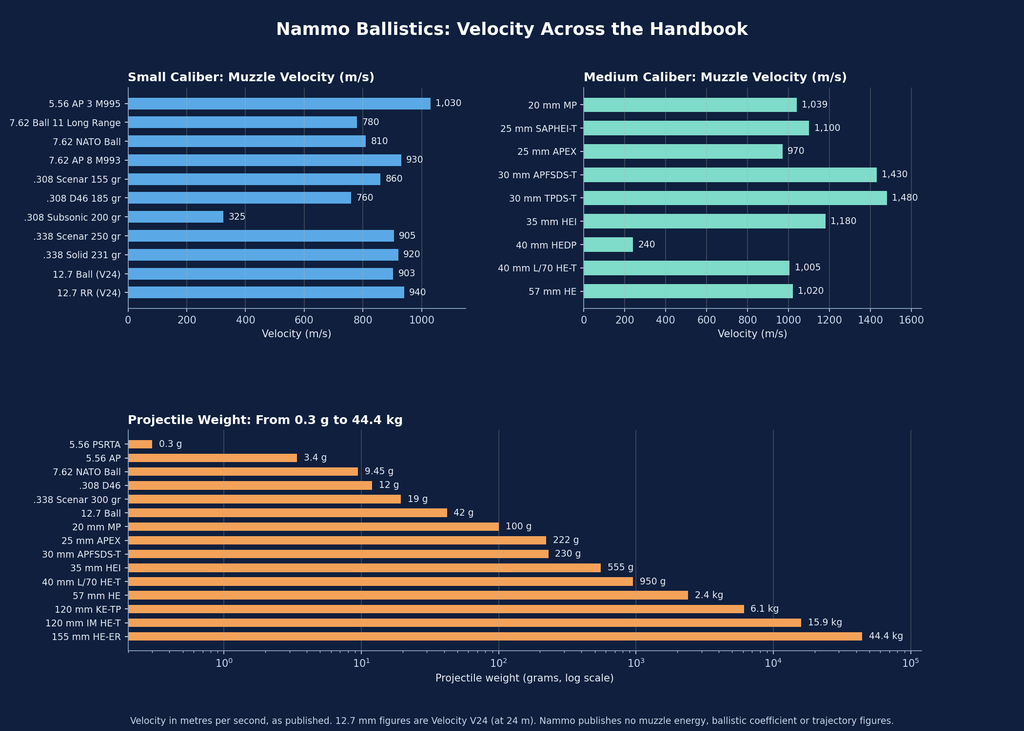
The 12.7 mm x 99 rows need a note. Nammo labels those velocities “Velocity V24”, which means velocity at 24 m from the muzzle, not muzzle velocity. The 20 mm x 102 TP and TP-T row is labelled the same way, as muzzle velocity at 24 m. The .308 Winchester and .338 Lapua Magnum rows print feet per second in parentheses next to the metres per second figure, exactly as the handbook prints them.
Medium Caliber Ammunition: Velocity and Weight
| Cartridge | Load | Projectile Weight | Velocity |
|---|---|---|---|
| 20 mm x 102 | 20 mm x 102 MP LD M70 AND MP LD M70 A1 | 100 g | 1 039 m/s |
| 20 mm x 102 | 20 mm x 102 TP-RRR LD AND TP-RRR LD M2 | 100 g | 1 039 m/s |
| 20 mm x 102 | 20 mm x 102 TP LD M12 AND TP-T LD M13 | 101 g | 1 039 m/s |
| 20 mm x 102 | 20 mm x 102 MP M70 A2 | 102 g | 1 030 m/s |
| 20 mm x 102 | 20 mm x 102 TP-M | 102 g | 1 030 m/s |
| 20 mm x 102 | 20 mm x 102 TP AND TP-T | 100 g/94.6 g | 1 030 m/s |
| 20 mm x 128 | 20 mm x 128 HEI/SD AND HEI-T/SD | 102 g/112 g | 1 050 or 1 100 m/s |
| 20 mm x 128 | 20 mm x 128 API-T | 112.5 g | 1 050 or 1 100 m/s |
| 20 mm x 128 | 20 mm x 128 TP AND TP-T | 125 g | 1 050 or 1 100 m/s |
| 20 mm x 139 | 20 mm x 139 MP-T SD NM75 F2/DM91 | 122 g | 1 045 m/s |
| 25 mm x 137 | 25 mm x 137 SAPHEI-T PGU-32/U | 185 g | 1 100 m/s |
| 25 mm x 137 | 25 mm x 137 APEX PGU-47/U | 222 g | 970 m/s |
| 25 mm x 137 | 25 mm x 137 TP-RRR AND TP-T RRR PGU-51/B and PGU-52/B | 223 g | 970 m/s |
| 25 mm x 137 | 25 mm x 137 MP-T SD Mk2 | 183 g | 1 100 m/s |
| 25 mm x 137 | 25 mm x 137 HEI AND HEI-T | 198 g | 1 100 m/s |
| 25 mm x 137 | 25 mm x 137 HEI/SD AND HEI-T/SD | 180 g | 1 100 m/s |
| 25 mm x 137 | 25 mm x 137 SAPHEI/SD AND SAPHEI-T/SD | 170 g/180 g | 1 100 m/s |
| 25 mm x 137 | 25 mm x 137 TP AND TP-T | 190 g/180 g | 1 100 m/s |
| 27 mm x 145 | 27 mm x 145 MP DM73 | 260 g | 1 025 m/s |
| 27 mm x 145 | 27 mm x 145 TP-RRR DM68 | 260 g | 1 025 m/s |
| 30 mm x 113 | 30 mm x 113 TP AND TP-T | 236 g/245 g | 800 m/s |
| 30 mm x 173 | 30 mm x 173 HEI AND HEI-T | 378 g | 1 100 m/s |
| 30 mm x 173 | 30 mm x 173 HEI/SD AND HEI-T/SD | 363 g | 1 100 m/s |
| 30 mm x 173 | 30 mm x 173 SAPHEI/SD AND SAPHEI-T/SD | 363 g/365 g | 1 100 m/s |
| 30 mm x 173 | 30 mm x 173 MP-T/SD NM 222/Mk 264 | 363 g | 1 070 m/s |
| 30 mm x 173 | 30 mm x 173 APFSDS-T NM225/Mk258 Mod 0 | 230 g | 1 430 m/s |
| 30 mm x 173 | 30 mm x 173 APFSDS-T Mk258 Mod 1 Swimmer | 230 g | 1 430 m/s |
| 30 mm x 173 | 30 mm x 173 TP-T NM219/Mk270 | 363 g | 1 070 m/s |
| 30 mm x 173 | 30 mm x 173 TPDS-T AND APDS-T NM245/Mk320 | 190 g | 1 480 m/s |
| 35 mm x 228 | 35 mm x 228 HEI/SD AND HEI-T/SD | 555 g/565 g | 1 180 m/s |
| 35 mm x 228 | 35 mm x 228 SAPHEI/SD | 550 g | 1 180 m/s |
| 35 mm x 228 | 35 mm x 228 TP AND TP-T | 550 g | 1 180 m/s |
| 40 mm x 53 | 40 mm x 53 HEDP-AB Mk314 | 247 g | 240 m/s |
| 40 mm x 53 | 40 mm x 53 HEDP-RF NM 264 | 247 g | 240 m/s |
| 40 mm x 53 | 40 mm x 53 HEDP AND HEDP-SD | 245 g | 240 m/s |
| 40 mm x 53 | 40 mm x 53 HE AND HE/SD | 240 g | 240 m/s |
| 40 mm x 53 | 40 mm x 53 TP AND TP-T | 245 g/249 g | 240 m/s |
| 40 mm x 53 | 40 mm x 53 TPM-T NM 265 | 247 g | 240 m/s |
| 40 mm L/70 | 40 mm L/70 HE-T | 0.95 kg | 1 005 m/s |
| 40 mm L/70 | 40 mm L/70 TP-T | 0.96 kg | 1 005 m/s |
| 57 mm L/70 | 57 mm L/70 HE | 2.4 kg | 1 020 m/s |
| 57 mm L/70 | 57 mm L/70 TP | 2.4 kg | 1 020 m/s |
| 20 mm x 128 | 20 mm x 128 SAPHEI/SD | 128 g | 1 050 or 1 100 m/s |
Large Caliber Ammunition: Velocity and Weight
| Cartridge | Load | Projectile Weight | Velocity |
|---|---|---|---|
| 120 mm | 120 mm IM HE-T | 15.9 kg | L44: 1 030 m/s; L55: 1 070 m/s |
| 120 mm | 120 mm IM TP-T | 15.9 kg | L44: 1 030 m/s; L55: 1 070 m/s |
| 120 mm | 120 mm KE-TP | 6.1 kg | L44: 1 700 m/s; L55: 1 770 m/s |
| 155 mm | 155 mm IM HE-ER NM269 | 44.4 kg [with fuze] | 935 m/s (6 DM72/& in L/52) |
| 155 mm | 155 mm HE-ER | 44.2 kg [with fuze] | 935 m/s (6 DM72/& in L/52) |
| 155 mm | 155 mm TP-ER | 44.4 kg [with fuze] | 935 m/s (6 DM72/& in L/52) |
| 155 mm | 155 mm HE | 42.5 kg [without fuze] | 380 m/s to 800 m/s |
The large caliber table is short because most of its rows are mortar rounds, and mortar rounds print a velocity range across charge increments instead of a single figure. The 120 mm Mortar HE, for example, prints 103-455 m/s. Those range figures sit in the velocity-only listing below, since the mortar pages print no projectile weight.
Loads With Only a Velocity, or Only a Weight
Eight loads print a velocity but no projectile weight. Seven of them are mortar rounds, and the eighth is the 120 mm IM Canister.
| Cartridge | Load | Velocity |
|---|---|---|
| 120 mm | 120 mm IM CANISTER | 1 410 m/s |
| 81 mm Mortar | 81 mm MORTAR HE | 76-310 m/s |
| 81 mm Mortar | 81 mm MORTAR IR-SMK | 75-316 m/s |
| 81 mm Mortar | 81 mm MORTAR ILLUMINATING ROUND | 75-316 m/s |
| 120 mm Mortar | 120 mm MORTAR HE | 103-455 m/s |
| 120 mm Mortar | 120 mm MORTAR IR-SMK | 100-391 m/s |
| 120 mm Mortar | 120 mm MORTAR ILLUMINATING ROUND | 100-391 m/s |
| 120 mm Mortar | 120 mm Mortar High Explosive Extended Range | 128-500 m/s depending on weapon system |
Four loads print a projectile weight but no velocity. All four are short-range training rounds.
| Cartridge | Load | Projectile Weight |
|---|---|---|
| 5.56 mm x 45 | 5.56 mm x 45 PSRTA M862 A1 | 0.3 g (5 grain) |
| 7.62 mm x 51 | 7.62 mm x 51 PSRTA | 0.7 g (11 grain) |
| 12.7 mm x 99 | 12.7 mm x 99 PSRTA-T (.50 CAL) | 3.4 g ball, 4.3 g tracer |
| 30 mm x 173 | 30 mm x 173 PSRTA-T | 45 g |
Loads With No Published Weight or Velocity
Twelve handbook products print neither a projectile weight nor a velocity. Seven are plastic blank rounds, one is a proof, drill and blank set, one is a polymer-cased .50 caliber round, and three are mortar practice rounds that print a range table only.
| Cartridge | Load |
|---|---|
| 4.6 mm x 30 | 4.6 mm x 30 PLASTIC BLANK AMMUNITION |
| 4.6 mm x 30 | 4.6 mm x 30 PSRTA |
| 5.56 mm x 45 | 5.56 mm x 45 PLASTIC BLANK AMMUNITION |
| 7.62 mm x 51 | 7.62 mm x 51 PLASTIC BLANK AMMUNITION |
| 8.6 mm x 70 | 8.6 mm x 70 .338 LAPUA® MAGNUM PROOF, DRILL AND BLANK |
| 12.7 mm x 99 | 12.7 mm x 99 POLYMER CASED AMMUNITION (.50 CAL) (MAC) |
| 12.7 mm x 99 | 12.7 mm x 99 PLASTIC BLANK AMMUNITION (.50 CAL) |
| 25 mm x 137 | 25 mm x 137 PLASTIC BLANK AMMUNITION |
| 30 mm x 173 | 30 mm x 173 PLASTIC BLANK AMMUNITION |
| 120 mm Mortar | 120 mm Mortar Practice Ammunition |
| 81 mm Mortar | 81 mm Mortar Practice Ammunition |
| 60 mm Mortar | 60 mm Mortar Practice Ammunition |
Reading the Chart: Notes on the Figures
Four handbook figures disagree with the same product’s page on the official Nammo website, and the handbook figure is used in the tables above. The 7.62 mm x 51 Ball 11 Long Range prints 780 m/s in the handbook and 805 m/s on the website. The 12.7 mm x 99 SG Ball prints 43 g in the handbook and 46 g on the website, the RR prints 38 g against 43 g, and the RR-T prints 36 g against 38 g. Two products appear only on the website and not in the handbook: the 20 mm x 128 SAPHEI/SD and the 120 mm Mortar High Explosive Extended Range. The 120 mm tank rounds print two velocities each, one for the L44 gun and one for the L55 gun. The only barrel length anywhere in the handbook is on the .308 Winchester Subsonic page, which gives 300-450 mm, or 12-17 inches.
Nammo Ballistics in Detail
Fastest Nammo Loads
The fastest figure in the handbook belongs to the 120 mm KE-TP tank round, at 1,700 m/s from the L44 gun and 1,770 m/s from the L55 gun. The next fastest are the 30 mm x 173 discarding sabot rounds, the TPDS-T and APDS-T at 1,480 m/s and the APFSDS-T at 1,430 m/s, followed by the 120 mm IM Canister at 1,410 m/s.
Slowest Nammo Loads
The slowest published velocities are the 40 mm x 53 grenade rounds, all six of them at 240 m/s. Among rifle rounds the slowest is the .308 Winchester Subsonic at 325 m/s, or 1,066 fps as the handbook prints it. The 155 mm HE prints the widest range of all, 380 m/s to 800 m/s depending on charge.
Small Caliber Ammunition
Small caliber covers 61 of the 125 products, and 51 of them carry both a weight and a velocity. The fastest small caliber load is the 5.56 mm x 45 AP 3 M995 at 1,030 m/s. The 7.62 mm x 51 NATO Ball prints 810 m/s, while the long range Ball 11 prints 780 m/s in the handbook. The .338 Lapua Magnum Solid is the quickest of the .338 rows at 920 m/s.
Medium Caliber Ammunition
Medium caliber covers 46 products, and 43 of them carry both figures. Most 20 mm and 25 mm rounds cluster near 1,000 to 1,100 m/s, with the 25 mm APEX and TP-RRR rounds the slowest of that group at 970 m/s. The 30 mm x 173 sabot rounds stand apart at 1,430 and 1,480 m/s. At the other end, every 40 mm x 53 grenade round prints the same 240 m/s.
Large Caliber Ammunition and Mortars
Large caliber covers 18 products, but only 7 of them carry both a weight and a velocity, because the mortar pages print velocity ranges and no weights. The 120 mm tank rounds dominate the table, with the KE-TP reaching 1,770 m/s. The 155 mm shells are the heaviest projectiles in the book at up to 44.4 kg with fuze.
What Nammo Does Not Publish
Nammo publishes no muzzle energy, no ballistic coefficient, no trajectory table and no test barrel length for any load in this chart. That is the handbook’s own scope, not a gap in this article. Readers looking for energy or drop figures will not find them in the official Nammo data, and none have been added here from other makers or from calculation.
Handbook and Website: Four Conflicts
Four products carry different figures in the handbook and on the official website. The 7.62 mm x 51 Ball 11 Long Range differs by 25 m/s, and the three 12.7 mm x 99 reduced range and match ball weights differ by 2 to 5 g. The handbook figure is used in every case, and the website figure is recorded in the notes for that row.
Metric Units and the V24 Label
All figures are in the metric units the handbook prints: projectile weight in grams or kilograms, velocity in metres per second. The .308 Winchester and .338 Lapua Magnum pages also print feet per second in parentheses, and those figures are kept. The 12.7 mm velocities are labelled V24, velocity at 24 m, and are not muzzle velocities.
Nammo Ballistics FAQs
1. What does the Nammo Ballistics chart cover?
It covers all 125 ammunition products in the official Nammo Ammunition Handbook, Edition 7, from 4.6 mm small caliber rounds to 155 mm artillery shells, with the projectile weight and velocity the handbook prints for each one.
2. What is the fastest Nammo load?
The 120 mm KE-TP tank round, at 1,770 m/s from the L55 gun and 1,700 m/s from the L44 gun.
3. What is the slowest Nammo load?
The 40 mm x 53 grenade rounds, all six of which print 240 m/s. The slowest rifle round is the .308 Winchester Subsonic at 325 m/s.
4. Does Nammo publish muzzle energy?
No. Nammo prints no muzzle energy figure for any load in the handbook, so this chart carries no energy column.
5. Does Nammo publish bullet drop or trajectory?
No. The handbook prints no trajectory table and no bullet drop figures, so no drop table or drop curve appears in this article.
6. Why are the 12.7 mm velocities labelled V24?
Nammo labels them Velocity V24, meaning the velocity measured 24 m from the muzzle, rather than muzzle velocity. The figure is shown exactly as the handbook labels it.
7. Which small caliber Nammo load is fastest?
The 5.56 mm x 45 AP 3 M995, at 1,030 m/s with a 3.4 g projectile.
8. What is the heaviest Nammo projectile?
The 155 mm HE-ER and TP-ER shells, at 44.4 kg with fuze. The lightest is the 5.56 mm x 45 PSRTA training round at 0.3 g.
9. Why do some loads show two velocities, L44 and L55?
The 120 mm tank rounds are fired from two different guns, the L44 and the L55, and Nammo prints a separate muzzle velocity for each. The L55 figure is always the higher one.
10. How many Nammo loads publish no weight or velocity?
Twelve of the 125 products print neither figure. Most are plastic blank rounds, plus a proof, drill and blank set, a polymer-cased .50 caliber round and three mortar practice rounds.