The 10-yard zero is an extreme close-range calibration technique primarily used to get a new optic on paper or establish a simulated 50-yard trajectory indoors. Because the target is so close to the muzzle, compensating for the rifle’s height over bore is absolutely essential. This comprehensive guide covers short-range offsets, target printables, and common trigger control mistakes.
Table of Contents
[Click to minimize]
10 Yard Zero
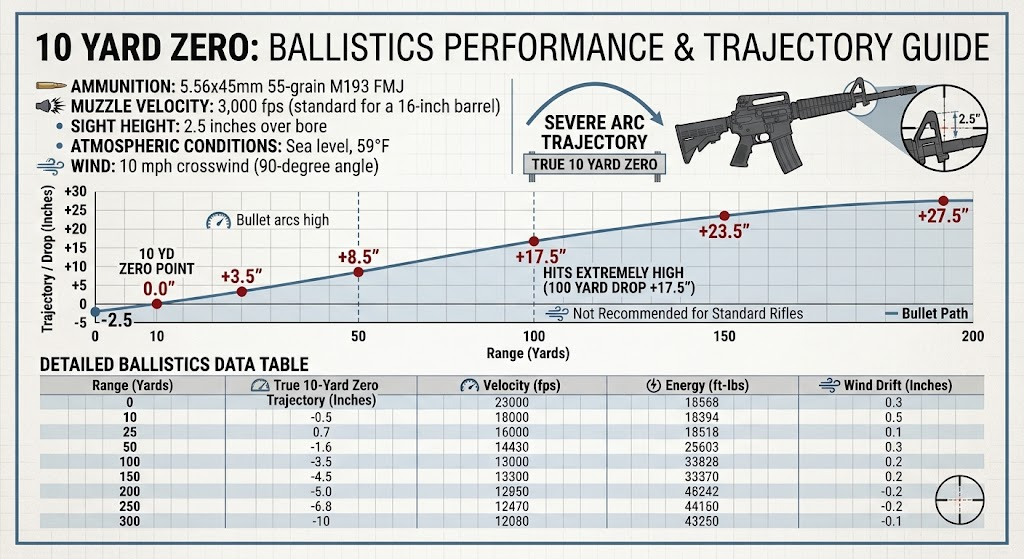
Setting a true 10-yard zero indicates that the bullet’s flight path intersects your optic’s aiming point at exactly 10 yards.
To achieve this true zero, the rifle barrel must be angled sharply upward to compensate for the 2.5-inch gap between the bore and the optic.
If you zero directly on the bullseye at this distance, your projectile will arc aggressively high as it travels downrange.
Firing a standard 5.56mm AR-15 with a true 10-yard zero results in impacts that are 17 to 20 inches above the target at the 100-yard mark.
For this reason, a true zero at this range is almost exclusively reserved for 9mm Pistol Caliber Carbines (PCCs) used in close-quarters competition.
Rifle shooters utilizing the 10-yard line are almost always doing so to calculate an offset zero for longer distances.
Ammunition: 5.56x45mm 55-grain M193 FMJ
Muzzle Velocity: 3,000 fps (standard for a 16-inch barrel)
The primary purpose of shooting at 10 yards is to artificially mimic a 50/200 yard zero when confined to an indoor shooting bay.
Establishing a 50-yard flight path at a 10-yard distance requires you to utilize a specific hold-under method.
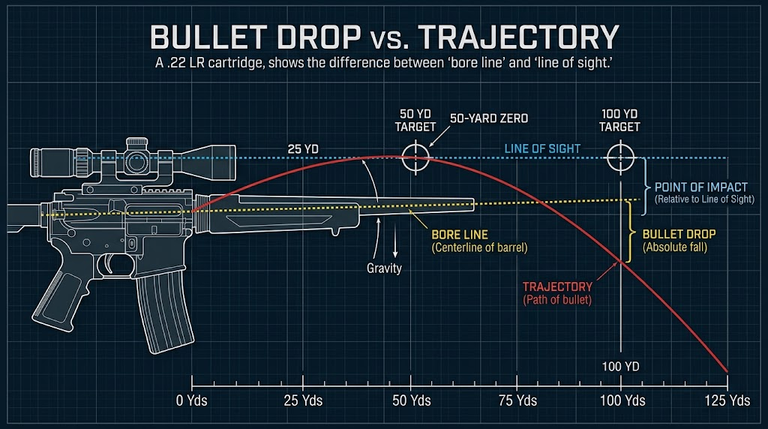
Because the projectile has barely exited the barrel at 10 yards, it is physically still located about 2.0 inches below your line of sight.
To lock in a 50-yard trajectory on a standard AR-15, your shot group must land precisely 2.0 inches directly below your crosshairs.
This calculated offset guarantees that the bullet has the correct upward trajectory to meet the crosshairs accurately at 50 yards.
Any minor deviation at 10 yards is severely magnified over distance; being off by just half an inch will result in a total miss at 200 yards.
Shooters must always treat a 10-yard offset as a temporary measure and verify their impacts at a true 50-yard outdoor range.
Target Distance: 10 Yards
Zero Distance Goal: 50/200 Yards
Ammunition / Load
Sight Height (Over Bore)
Muzzle Velocity (fps)
Required Point of Impact (POI) Offset at 10 Yards
5.56x45mm 55-grain M193
1.5 inches (Standard Iron Sights)
3,000
-1.2 inches (Low)
5.56x45mm 55-grain M193
2.5 inches (Standard AR-15 Optic)
3,000
-2.0 inches (Low)
5.56x45mm 55-grain M193
3.5 inches (Tall / NVG Mount)
3,000
-2.8 inches (Low)
.300 Blackout 110-grain
2.5 inches (Standard AR-15 Optic)
2,350
-2.0 inches (Low)
10 Yard Zero Target
A specialized 10-yard zero target is drawn with specific proportions to handle the extreme close-range offset.
These paper targets generally include a distinct primary aiming point at the top and a designated impact zone located a few inches below.
Relying on a properly formatted target eliminates the hassle of holding a tape measure up to your shot groups.
The grid squares on these targets are highly specialized, as standard 1-inch MOA math does not function normally at a 10-yard distance.
Adjusting a standard 1/4 MOA scope at 10 yards requires a massive number of clicks (roughly 10 clicks just to move the bullet 1/4 of an inch).
You will need to spin your turrets much further than you would at 100 yards to see the group shift on the paper.
10 Yard Zero Target Printable
Utilizing a 10-yard zero target printable is a highly effective way to calibrate a new rifle build from the comfort of an indoor range.
These downloadable PDFs are meticulously designed with exact hold-under measurements for popular AR-15 mounting heights.
When sending the file to your printer, it is mandatory to ensure the scale is locked to “100%” or “Actual Size.”
If your printer defaults to “Fit to Printable Area,” the grid will compress, completely ruining the required 2.0-inch offset geometry.
Reliable printables will feature a 1-inch square block in the margin, allowing you to measure it with a physical ruler to verify scaling.
Jerking the Trigger 10 Yard Zero
“Jerking the trigger” is a widespread shooting flaw that becomes painfully obvious when trying to cluster shots at 10 yards.
This error happens when a shooter slaps or yanks the trigger abruptly, failing to use a steady, rolling press.
For standard right-handed shooters, a trigger jerk consistently throws the muzzle slightly down and to the left.
Because a proper 10-yard zero already requires a low impact, shooters frequently mistake their low-left trigger jerk for a zeroing issue.
If your bullets are grouping consistently low and to the left side of the impact zone, do not touch your optic adjustments.
Trying to “fix” a trigger jerk by turning your turrets will completely ruin your zero, causing you to shoot far to the right at longer distances.
The best remedy is to conduct dry-fire practice, observing the reticle to ensure it remains perfectly still when the sear breaks.
Frequently Asked Questions
1. What does it mean to zero at 10 yards?
A true 10-yard zero forces the bullet to hit the exact point of aim at 10 yards, however, most shooters use this distance strictly to create a 50-yard offset zero.
2. What happens if I aim and hit dead center at 10 yards?
Because your sight sits above the barrel, forcing the bullet to the center at 10 yards creates a steep upward trajectory, resulting in impacts nearly 18 inches high at 100 yards.
3. How do I simulate a 50-yard zero on a 10-yard target?
You must hold your crosshairs on the center bullseye and dial your optic until the bullets group approximately 2.0 inches directly below your aiming point.
4. Does the height of my scope matter at this distance?
Yes, it is the most important variable. Standard optics require a 2.0-inch drop, whereas lower iron sights only need a 1.2-inch drop to achieve the same 50-yard trajectory.
5. Why is my scope barely moving the bullet at 10 yards?
Scopes are designed for 100-yard adjustments. At 10 yards, a single click moves the impact a tiny fraction of an inch, so you must turn the dial significantly more.
6. Why are my shots grouping low and to the left?
For right-handed shooters, shooting low and left is the universal sign of jerking or slapping the trigger rather than applying a smooth, steady squeeze.
7. Should I adjust my sights if I am shooting low and left?
Absolutely not. Adjusting your sights to mask a trigger control issue will cause your rifle to be completely misaligned when shooting at true distances.
8. Is a 10-yard zero reliable for long-range shooting?
No. A 10-yard offset is only useful to get your initial shots on paper. Tiny errors at this short distance will cause you to miss targets completely at 100 or 200 yards.
9. Can I use a 10-yard zero for a home defense 9mm carbine?
Yes, a true 10-yard or 15-yard zero is very popular for 9mm PCCs because it provides a reliable point of impact for extreme close-quarters distances.
10. How do I make sure my printable target is accurate?
You must verify that your printer dialogue box is set to print at “100% scale” or “Actual Size,” otherwise the offset measurements will shrink and ruin your zero.