30-06 Ballistics Chart: Bullet Drop And Trajectory
The .30-06 Springfield is a rifle cartridge known for its combination of muzzle velocity, energy retention and versatility across different bullet weights. These .30-06 ballistics charts cover 150-grain, 165-grain and 180-grain ammunition, along with 125-grain loads, barrel-length comparisons and trajectory data for a 100-yard zero. The tables provide estimated velocity, muzzle energy, bullet drop, wind drift and time of flight at multiple distances.
Table of Contents [Click to minimize]
30-06 Ballistics Chart
The following .30-06 ballistics chart uses a representative 165-grain bullet with an estimated muzzle velocity of 2,800 feet per second (FPS). The trajectory data assumes a 200-yard zero and a sight height of 1.5 inches. Wind drift estimates use a 10 mph crosswind.
| Range (Yards) | Velocity (FPS) | Energy (ft-lbs) | Trajectory (Inches) | Wind Drift (10 mph) | Time of Flight (Sec) |
|---|---|---|---|---|---|
| Muzzle (0) | 2,800 | 2,872 | -1.50 | 0.00 | 0.000 |
| 50 | 2,693 | 2,657 | +0.76 | 0.22 | 0.055 |
| 100 | 2,590 | 2,458 | +1.78 | 0.88 | 0.112 |
| 150 | 2,489 | 2,270 | +1.56 | 2.01 | 0.171 |
| 200 | 2,391 | 2,094 | 0.00 | 3.64 | 0.233 |
| 250 | 2,295 | 1,930 | -2.92 | 5.79 | 0.297 |
| 300 | 2,201 | 1,775 | -7.34 | 8.50 | 0.364 |
| 400 | 2,020 | 1,495 | -21.41 | 15.68 | 0.506 |
| 500 | 1,848 | 1,251 | -43.20 | 25.46 | 0.662 |
Note: These figures are estimates based on the supplied reference data. Actual ballistic performance varies by ammunition, barrel length, bullet design and atmospheric conditions. Confirm trajectory and wind-drift figures using validated data for the specific load.
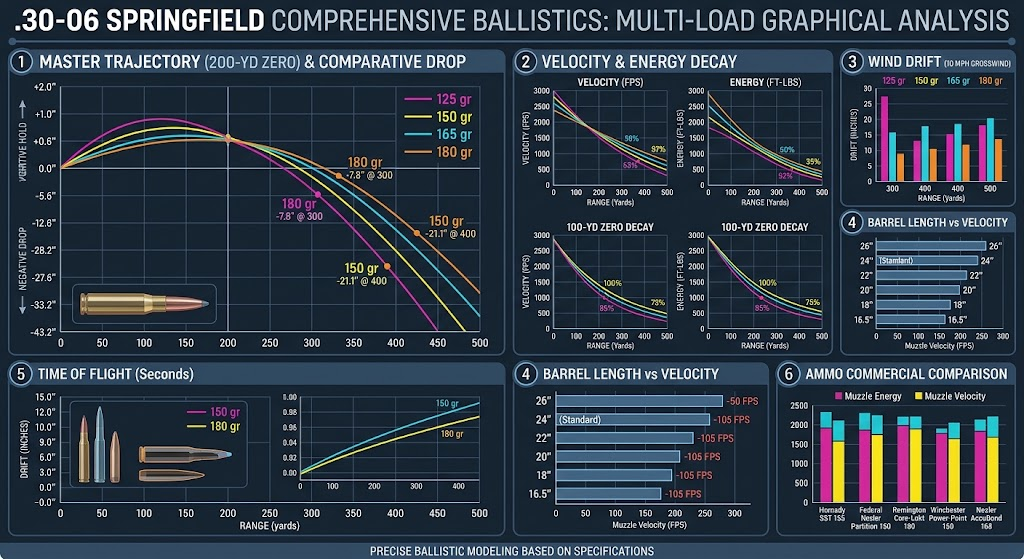
30-06 Springfield Trajectory and Bullet Drop Chart
The following separate .30-06 trajectory and bullet drop tables use the supplied 165-grain reference load with a muzzle velocity of 2,800 FPS and a G1 ballistic coefficient of 0.447. The first table uses a 200-yard zero, while the second uses a 100-yard zero.
30-06 Trajectory Chart (200-Yard Zero)
| Range (Yards) | Trajectory (Inches) | Bullet Position |
|---|---|---|
| 0 | -1.50 | Below line of sight |
| 50 | +0.76 | Above line of sight |
| 100 | +1.78 | Above line of sight |
| 150 | +1.56 | Above line of sight |
| 200 | 0.00 | Zero |
| 250 | -2.92 | Below line of sight |
| 300 | -7.34 | Below line of sight |
| 400 | -21.41 | Below line of sight |
| 500 | -43.20 | Below line of sight |
30-06 Bullet Drop Chart (100-Yard Zero)
| Range (Yards) | Bullet Drop (Inches) | Bullet Position |
|---|---|---|
| 0 | -1.50 | Below line of sight |
| 50 | -0.13 | Below line of sight |
| 100 | 0.00 | Zero |
| 150 | -1.11 | Below line of sight |
| 200 | -3.56 | Below line of sight |
| 250 | -7.37 | Below line of sight |
| 300 | -12.68 | Below line of sight |
| 400 | -28.53 | Below line of sight |
| 500 | -52.10 | Below line of sight |
Note: Positive values indicate the bullet is above the line of sight; negative values indicate it is below. These are the estimates from your supplied tables, not independently verified ballistic calculations. Actual results vary with ammunition, sight height, barrel length and environmental conditions.
30-06 Springfield Ballistics Specifications
The .30-06 Springfield, also called .30-06, uses a .308-inch nominal bullet diameter. Its ballistic performance varies considerably depending on bullet weight, construction and muzzle velocity.
| Specification | Reference Value |
|---|---|
| Cartridge | .30-06 Springfield |
| Bullet Diameter | .308 inch |
| Common Bullet Weights | 125, 150, 165, 180 and 220 grains |
| Reference Bullet Weight | 165 grains |
| Reference Muzzle Velocity | 2,800 FPS |
| Reference Muzzle Energy | 2,872 ft-lbs |
| Reference Zero | 200 yards |
| Reference Sight Height | 1.5 inches |
These specifications describe the supplied reference load rather than every .30-06 factory cartridge.
30-06 Ammo Ballistics: 150 Grain vs. 180 Grain
Bullet weight influences muzzle velocity, retained energy and trajectory. Lighter bullets commonly leave the muzzle faster, while heavier bullets may retain momentum and energy differently depending on their ballistic coefficients and construction.
The following comparison uses the supplied representative factory-load figures and a 100-yard zero.
| Distance (Yards) | 150-Grain Velocity (FPS) | 150-Grain Energy (ft-lbs) | 150-Grain Drop | 180-Grain Velocity (FPS) | 180-Grain Energy (ft-lbs) | 180-Grain Drop |
|---|---|---|---|---|---|---|
| Muzzle (0) | 2,910 | 2,820 | -1.50 in | 2,700 | 2,913 | -1.50 in |
| 100 | 2,685 | 2,401 | 0.00 in | 2,504 | 2,506 | 0.00 in |
| 200 | 2,471 | 2,033 | -3.51 in | 2,316 | 2,144 | -4.80 in |
| 300 | 2,267 | 1,711 | -12.98 in | 2,136 | 1,823 | -18.30 in |
| 400 | 2,072 | 1,430 | -29.81 in | 1,963 | 1,540 | -43.40 in |
| 500 | 1,887 | 1,186 | -55.62 in | 1,798 | 1,292 | -81.20 in |
The 150-grain reference load starts faster and shows a flatter trajectory in this comparison. The 180-grain load starts with more muzzle energy in the supplied figures and retains more energy at 500 yards. Actual comparisons depend on the exact bullet design and verified ammunition specifications.
30-06 Ballistics 150 Grain
A 150-grain .30-06 load is a common option for general-purpose rifle applications. The supplied reference load uses a muzzle velocity of 2,910 FPS, muzzle energy of 2,820 ft-lbs and a 200-yard zero.
| Range (Yards) | Velocity (FPS) | Energy (ft-lbs) | Trajectory (Inches) | Wind Drift (10 mph) | Time of Flight (Sec) |
|---|---|---|---|---|---|
| Muzzle (0) | 2,910 | 2,820 | -1.50 | 0.00 | 0.000 |
| 50 | 2,793 | 2,598 | +0.65 | 0.24 | 0.053 |
| 100 | 2,680 | 2,392 | +1.61 | 0.95 | 0.108 |
| 150 | 2,570 | 2,199 | +1.44 | 2.17 | 0.165 |
| 200 | 2,463 | 2,020 | 0.00 | 3.94 | 0.224 |
| 250 | 2,359 | 1,853 | -2.78 | 6.27 | 0.286 |
| 300 | 2,258 | 1,698 | -7.11 | 9.21 | 0.351 |
| 400 | 2,063 | 1,417 | -21.14 | 16.98 | 0.490 |
The table shows a gradual decline in velocity and energy as distance increases. The listed trajectory is tied to the assumed 200-yard zero, so it should not be used as a trajectory chart for a different zero distance.
30-06 Ballistics 180 Grain
A 180-grain .30-06 load generally starts at a lower velocity than a comparable 150-grain load, although its energy and trajectory depend on bullet construction and the specific cartridge. The supplied reference load has a muzzle velocity of 2,700 FPS and muzzle energy of 2,913 ft-lbs.
| Range (Yards) | Velocity (FPS) | Energy (ft-lbs) | Trajectory (Inches) | Wind Drift (10 mph) | Time of Flight (Sec) |
|---|---|---|---|---|---|
| Muzzle (0) | 2,700 | 2,913 | -1.50 | 0.00 | 0.000 |
| 50 | 2,598 | 2,697 | +0.90 | 0.22 | 0.057 |
| 100 | 2,499 | 2,495 | +2.01 | 0.88 | 0.116 |
| 150 | 2,401 | 2,304 | +1.72 | 2.01 | 0.177 |
| 200 | 2,306 | 2,125 | 0.00 | 3.63 | 0.241 |
| 250 | 2,213 | 1,957 | -3.12 | 5.76 | 0.307 |
| 300 | 2,122 | 1,799 | -7.82 | 8.44 | 0.376 |
| 400 | 1,947 | 1,515 | -22.75 | 15.51 | 0.524 |
These estimates illustrate the relationship between distance, velocity and energy for the selected 180-grain reference load. They are not universal values for all 180-grain .30-06 ammunition.
30-06 Springfield Ballistics by Bullet Weight
Different bullet weights produce different combinations of velocity and energy. The following table summarises the reference figures supplied for common .30-06 bullet weights.
| Bullet Weight | Typical Reference Muzzle Velocity | Reference Muzzle Energy | Supplied 200-Yard Energy |
|---|---|---|---|
| 125 grains | 3,140 FPS | 2,736 ft-lbs | 1,758 ft-lbs |
| 150 grains | 2,910 FPS | 2,820 ft-lbs | 2,020 ft-lbs |
| 165 grains | 2,800 FPS | 2,872 ft-lbs | 2,094 ft-lbs |
| 180 grains | 2,700 FPS | 2,913 ft-lbs | 2,125 ft-lbs |
| 220 grains | 2,400 FPS | 2,813 ft-lbs | 1,842 ft-lbs |
The figures are representative estimates, not guaranteed performance standards. The 200-yard energy values should be verified against the specific loads before being published as manufacturer specifications.
125 Grain .30-06 Ballistics
A 125-grain bullet is lighter than the more common 150-grain and 180-grain .30-06 options. The supplied reference load lists a muzzle velocity of 3,140 FPS and muzzle energy of 2,736 ft-lbs.
| Range (Yards) | Velocity (FPS) | Energy (ft-lbs) | Trajectory (Inches) | Wind Drift (10 mph) | Time of Flight (Sec) |
|---|---|---|---|---|---|
| Muzzle (0) | 3,140 | 2,736 | -1.50 | 0.00 | 0.000 |
| 50 | 2,975 | 2,456 | +0.48 | 0.33 | 0.049 |
| 100 | 2,817 | 2,202 | +1.38 | 1.35 | 0.101 |
| 150 | 2,664 | 1,970 | +1.30 | 3.12 | 0.156 |
| 200 | 2,517 | 1,758 | 0.00 | 5.73 | 0.214 |
| 250 | 2,374 | 1,564 | -2.71 | 9.24 | 0.275 |
| 300 | 2,236 | 1,388 | -7.14 | 13.72 | 0.340 |
| 400 | 1,972 | 1,079 | -22.38 | 25.86 | 0.483 |
The supplied data shows a high initial velocity followed by a gradual reduction downrange. Because lighter bullets can have lower ballistic coefficients, their wind drift and velocity retention may differ substantially from heavier, more aerodynamic bullets.
30-06 Ballistics 165 Grain
The 165-grain bullet offers a middle-weight option between common 150-grain and 180-grain .30-06 loads. In the supplied reference data, it starts at 2,800 FPS with muzzle energy of 2,872 ft-lbs and a G1 ballistic coefficient of approximately 0.447.
| Range (Yards) | Velocity (FPS) | Energy (ft-lbs) | Trajectory (Inches) | Wind Drift (10 mph) | Time of Flight (Sec) |
|---|---|---|---|---|---|
| Muzzle (0) | 2,800 | 2,872 | -1.50 | 0.00 | 0.000 |
| 50 | 2,693 | 2,657 | +0.76 | 0.22 | 0.055 |
| 100 | 2,590 | 2,458 | +1.78 | 0.88 | 0.112 |
| 150 | 2,489 | 2,270 | +1.56 | 2.01 | 0.171 |
| 200 | 2,391 | 2,094 | 0.00 | 3.64 | 0.233 |
| 250 | 2,295 | 1,930 | -2.92 | 5.79 | 0.297 |
| 300 | 2,201 | 1,775 | -7.34 | 8.50 | 0.364 |
| 400 | 2,020 | 1,495 | -21.41 | 15.68 | 0.506 |
The 165-grain reference load provides a useful baseline for understanding .30-06 trajectory and retained energy. Actual results will vary between soft-point, polymer-tip and other bullet designs, even when their weights are identical.
30-06 Ballistics by the Inch: Barrel Length and Velocity
Barrel length can affect muzzle velocity because it changes the distance over which expanding propellant gases act on the bullet. However, velocity changes are not perfectly linear, and the results depend on the cartridge, ammunition and firearm.
The following figures are the supplied estimates for a 180-grain reference load.
| Barrel Length | Estimated Muzzle Velocity | Change vs. 24-Inch Barrel | Estimated Muzzle Energy |
|---|---|---|---|
| 26 inches | 2,750 FPS | +50 FPS | 3,022 ft-lbs |
| 24 inches | 2,700 FPS | Baseline | 2,913 ft-lbs |
| 22 inches | 2,650 FPS | -50 FPS | 2,806 ft-lbs |
| 20 inches | 2,595 FPS | -105 FPS | 2,691 ft-lbs |
| 18 inches | 2,535 FPS | -165 FPS | 2,568 ft-lbs |
| 16.5 inches | 2,480 FPS | -220 FPS | 2,458 ft-lbs |
These figures should be treated as illustrative estimates rather than a universal velocity-loss formula. The often-quoted 20 to 30 FPS change per inch is not consistent across all barrel lengths and loads. Chronograph testing is needed to establish actual performance.
30-06 Ballistics Chart: 100-Yard Zero
A 100-yard zero means the trajectory is calibrated to intersect the line of sight at 100 yards. This changes the trajectory figures compared with a 200-yard zero, even when the same ammunition and muzzle velocity are used.
The supplied chart uses a 165-grain bullet with an estimated muzzle velocity of 2,800 FPS and a G1 ballistic coefficient of 0.447.
| Range (Yards) | Velocity (FPS) | Energy (ft-lbs) | Trajectory (100-Yard Zero) | Wind Drift (10 mph) | Time of Flight (Sec) |
|---|---|---|---|---|---|
| Muzzle (0) | 2,800 | 2,872 | -1.50 in | 0.00 in | 0.000 |
| 50 | 2,693 | 2,657 | -0.13 in | 0.22 in | 0.055 |
| 100 | 2,590 | 2,458 | 0.00 in | 0.88 in | 0.112 |
| 150 | 2,489 | 2,270 | -1.11 in | 2.01 in | 0.171 |
| 200 | 2,391 | 2,094 | -3.56 in | 3.64 in | 0.233 |
| 250 | 2,295 | 1,930 | -7.37 in | 5.79 in | 0.297 |
| 300 | 2,201 | 1,775 | -12.68 in | 8.50 in | 0.364 |
| 400 | 2,020 | 1,495 | -28.53 in | 15.68 in | 0.506 |
| 500 | 1,848 | 1,251 | -52.10 in | 25.46 in | 0.662 |
A 100-yard zero produces a different point-of-impact pattern from a 200-yard zero. The table’s trajectory values are estimates, and the exact point of impact depends on sight height, ammunition performance and environmental conditions.
Frequently Asked Questions
What is the effective range of a .30-06 Springfield?
The practical range depends on the rifle, ammunition, target, environmental conditions and shooter’s proficiency. A ballistic table can show estimated velocity and trajectory at a given distance, but it cannot establish a universal effective range for every application.
What is the muzzle velocity of a .30-06?
Muzzle velocity varies by bullet weight and factory load. The supplied reference figures range from approximately 2,400 FPS for a 220-grain bullet to 3,140 FPS for a 125-grain bullet. Manufacturer specifications and actual firearm testing provide better estimates for a specific load.
How much energy does a .30-06 have at the muzzle?
The supplied examples range from approximately 2,736 ft-lbs for the 125-grain reference load to 2,913 ft-lbs for the 180-grain reference load. These values depend on the stated velocities and bullet weights.
What is the difference between 150-grain and 180-grain .30-06 ammunition?
The supplied 150-grain load starts at a higher velocity, while the 180-grain load starts with greater muzzle energy. Their trajectory and retained energy depend on the exact ballistic coefficients and velocities of the bullets being compared.
How much does a .30-06 drop at 300 yards?
In the supplied 165-grain chart with a 200-yard zero, the estimated trajectory at 300 yards is 7.34 inches below the line of sight. With the supplied 100-yard-zero chart, the estimated drop at 300 yards is 12.68 inches. These figures apply only to the respective model assumptions.
Is a 165-grain bullet a common .30-06 option?
Yes. A 165-grain bullet is a common weight for .30-06 factory ammunition. Available bullet styles include soft points and polymer-tip designs, with differences in construction and ballistic performance.
Does a shorter barrel reduce .30-06 velocity?
A shorter barrel can reduce muzzle velocity, but the size of the change varies by load and firearm. The barrel-length figures above are estimates and should not be treated as guaranteed performance for every rifle.
What is the difference between a 100-yard and 200-yard zero?
A 100-yard zero places the point of impact at the line of sight at 100 yards. A 200-yard zero places it at the line of sight at 200 yards. Consequently, the bullet’s trajectory relative to the line of sight differs at intermediate and longer distances.
What does ballistic coefficient mean?
Ballistic coefficient (BC) describes how a bullet’s shape and aerodynamic characteristics affect its ability to overcome air resistance. Comparisons require the same BC model, such as G1 or G7, and accurate values for the particular projectile.
Are these .30-06 ballistics charts exact?
No. They are estimates based on the supplied reference figures. Actual velocity, energy, trajectory and wind drift vary with ammunition, barrel length, bullet design and atmospheric conditions. Use verified manufacturer data or a validated ballistic calculator for the exact load when precision matters.